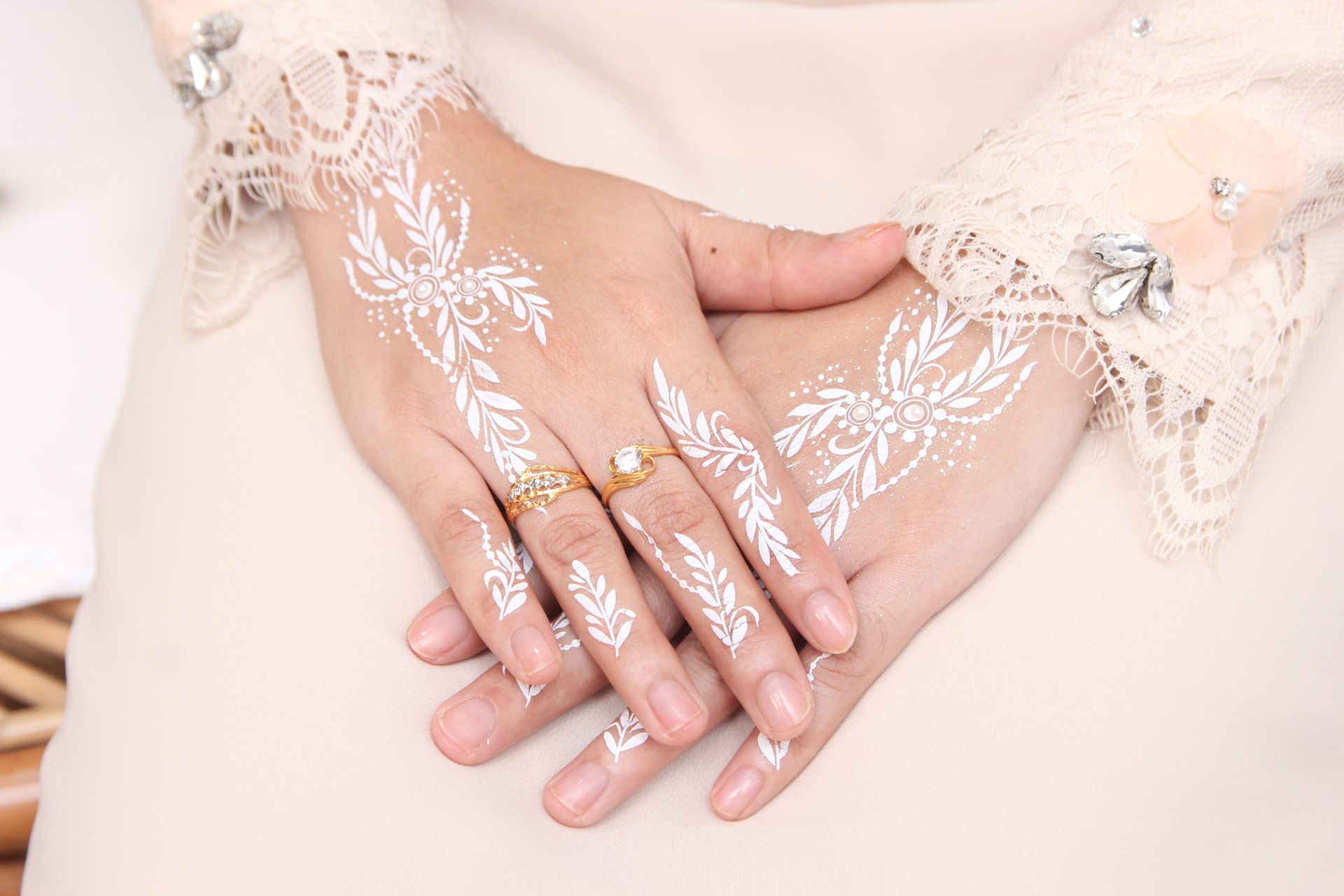
White henna looks like henna, is applied like henna, and is photographed like henna, but it is not henna at all. That single fact explains almost everything about it: why it is white instead of brown, why it lasts days instead of weeks, why it washes off instead of fading, and why the safety questions around it are completely different from the safety questions around natural henna. This guide explains what white henna actually is, how long it lasts, which designs suit it best, how it is applied and removed, how to patch test it, and how to choose between white henna and real henna for a wedding, a festival, or a weekend. If you want the look of henna without the commitment of a stain that lasts for weeks, white henna may be the right choice. If you want a traditional stain, it is not, and this guide will help you tell the difference before you book.
Key Takeaways
- White henna contains no henna. It is a cosmetic paint or adhesive worn on the surface of the skin, not a dye that stains it.
- Expect one to three days of wear, not weeks. Water, sweat, friction, and washing shorten its life fast.
- It is best for single events: weddings, parties, festivals, and photo shoots where the design only needs to last a day.
- It is applied with a cone or a brush, dries in minutes, and is removed with warm water and gentle rubbing, not scrubbing.
- Patch test every new product on a small area of skin 24 to 48 hours before the event, even if you have used natural henna safely before.
- It is not the same product as black henna, and its risks are different. Read the safety section before you buy or book.
Table of Contents
- What White Henna Actually Is
- How Long White Henna Lasts and What Makes It Fade
- The Best White Henna Designs by Occasion
- How White Henna Is Applied, Step by Step
- Removal: How to Take White Henna Off Without Damaging Skin
- Safety and Patch Testing: A Different Substance Than Natural Henna
- White Henna vs Real Henna: Which One Should You Choose
- Our View
- Frequently Asked Questions
- Sources
- Recommended
What White Henna Actually Is
The confusion starts with the name. Henna is a dye made from the leaves of the henna plant, Lawsonia inermis, and its colour comes from a molecule called lawsone, which binds to the keratin in skin and hair and leaves a stain that deepens over a day or two and lasts for one to three weeks. White henna has none of that. There is no henna plant in it, no lawsone, and no staining reaction. What is sold as white henna is usually a white body paint, a cosmetic adhesive, or a mix of the two, sometimes with glitter, shimmer powder, or tiny gems added for effect. It is painted or piped onto the skin in henna-style patterns, it dries on the surface, and it stays there until it is washed or rubbed off. The design looks like henna because the artist uses the same patterns and the same cone, but the chemistry is entirely different, and so is the result.
That difference matters because it changes what the product can and cannot do. Natural henna stains the skin, so the design sinks into the surface and survives washing, sweating, and a few days of normal life. White henna sits on top of the skin, so it is vulnerable to everything the skin touches. Water dissolves it, sweat loosens it, clothing rubs it, and handwashing wears it away from the palms and fingers first. On the other hand, white henna has advantages that natural henna cannot match. It is white, so it shows up on every skin tone, including deep skin tones where a brown henna stain can be subtle. It is visible in photographs in a way that a fresh henna stain is not, because it is bright from the moment it dries rather than deepening over two days. And it is temporary in the truest sense, which makes it a good choice for someone who wants to try a henna look for a single evening without committing to weeks of stain. Mehndi is the traditional name for henna body art in South Asia, and white henna borrows its patterns, its occasions, and its artistry, while replacing the dye itself with paint.
The table below puts the three products people confuse most often side by side. Read it before you buy anything labelled henna, because the names on the packet do not always tell you what is inside.
| Product | What it actually is | How it marks the skin | How long it lasts | Main safety point |
|---|---|---|---|---|
| White henna | White cosmetic paint or adhesive, sometimes with glitter | Sits on the surface; no stain | One to three days | Patch test the paint and adhesive; watch for adhesive or fragrance reactions |
| Natural henna | Paste from the henna plant, with lawsone as the dye | Stains the skin brown-orange, deepening over two days | One to three weeks | Patch test; use pure henna from a trusted source |
| Black henna | Henna paste mixed with a black dye, often PPD | Stains the skin black quickly | One to two weeks | Can cause severe allergic reactions; see our black henna guide before using it |
A note on the third row is essential, because the two products are often sold side by side. Black henna is a different product with a different risk, and our guide to black henna tattoo explains why it is more dangerous than it looks. White henna is not black henna, and this guide does not repeat that warning in full, but the contrast is worth holding in mind. Natural henna has been used for centuries. White henna is a modern cosmetic. Black henna is a modern product with a known danger. Knowing which one you are buying is the first safety step, and the label is not always clear, so ask the artist or the seller exactly what is in the product before it touches your skin.
White henna is also worth understanding as a form of body painting, which is the art of painting designs directly onto the skin. Body painting has been practised in many cultures, and modern cosmetic body paint is made to be safe on skin for short periods, to dry quickly, and to wash off cleanly. That is the family white henna belongs to, not the family of dyes. Once you think of it as body paint in henna patterns, the rest of this guide makes sense. The designs are chosen for how they look in a photograph, the wear time is measured in hours and days, and the removal is a matter of washing rather than waiting for a stain to fade.

How Long White Henna Lasts and What Makes It Fade
Set expectations honestly. White henna lasts one to three days, and most people get one good day out of it. The first few hours are the best, when the paint is fresh, the lines are crisp, and the glitter catches the light. By the next morning, the edges will have softened, and the parts of the design that sit on the palms and the fingers will already be wearing thin. By day three, most designs are patchy enough that they look tired rather than elegant. That is not a flaw in the product. It is what a surface paint does, and it is the trade-off for a design that washes off completely when you are done with it. If you need a design to last a whole wedding weekend, plan for the main event on the day the henna is applied, and treat the following days as a bonus.
Water is the biggest enemy. Handwashing, showering, washing dishes, and swimming all dissolve the paint, and the palms are the first place to go because they are washed most often. Sweat is the second enemy, because it loosens the adhesive from underneath and lifts the edges of the design. Friction is the third. Clothing, jewellery, bags, and even the sheets you sleep on rub the paint away, and a design on the back of the hand will last longer than the same design on the palm for that reason alone. Heat makes everything worse, because warm skin sweats more and the paint softens. A white henna design applied on a hot festival day will not last as long as the same design applied in cool weather, and a design worn to a beach day will fade faster than one worn to an indoor dinner.
You can stretch the wear time a little with care. Keep the design dry for the first few hours after it is applied, and avoid washing the area until the paint has fully set. When you do wash your hands, use lukewarm water and a gentle soap, pat the skin dry instead of rubbing it, and avoid hand sanitiser, which is harsh on most cosmetic paints. Wear loose clothing over the design where you can, and take rings and bracelets off while the paint is fresh so they do not catch the edges. A light dusting of setting powder or a cosmetic sealant spray, if the artist recommends one, can help the design survive a long evening, but do not use hairspray or household sealants on skin. They can irritate the skin and are not made for this use. The skin renews itself constantly, and a temporary tattoo or paint design can only ever last as long as the surface it sits on stays undisturbed.
Where you place the design matters as much as how you care for it. The backs of the hands, the wrists, the forearms, and the shoulders hold white henna best, because they are washed less often and rubbed less by clothing. The palms, the fingers, and the soles of the feet are the worst, because they are washed, gripped, and walked on all day. The chest and the upper back are a middle ground, protected by clothing but warmed by body heat and rubbed by fabric. If you want the design to look its best in photographs, the backs of the hands are the classic choice for a reason. They are visible in every gesture, they photograph beautifully, and they hold the paint better than the palms. For a closer look at how hand and foot placements are chosen for permanent tattoos, see our guides to best foot tattoo designs and best ankle tattoo designs, where the same logic about washing and friction applies.
The Best White Henna Designs by Occasion
Bridal white henna is the most popular use, and it is also the most demanding, because the photographs last forever even though the henna does not. The classic bridal design covers both hands, front and back, from the fingertips to the forearms, with a dense, lace-like pattern of paisleys, flowers, and fine lines. Our guide to henna bridal designs explains the traditional wedding patterns and what they mean, and those same patterns translate well into white, with one change. White henna needs bolder lines than natural henna, because thin white lines disappear against the skin in photographs, while bold white lines read clearly. Ask the artist to thicken the main outlines, keep the finest detail for the spaces between the bold shapes, and add a few small gems or a touch of gold glitter at the centre of the design, where the eye naturally falls. Brides who want a softer look often choose white henna for one hand and natural henna for the other, or white henna for the ceremony and natural henna for the days around it.
Wedding guests have a simpler brief. A guest design should be beautiful, quick to apply, and clearly not trying to outshine the bride. A single hand with a floral cuff around the wrist, a mandala on the back of one hand, or a delicate trail of flowers from the wrist to the middle finger all work well. Keep it to one hand, or to both hands with a lighter pattern, and choose a design that will survive the ceremony and the first dance but does not need to last the whole weekend. Guests should also think about the dress. White henna on the hands suits a sleeveless or short-sleeved dress, while a design on the shoulder or upper arm suits a dress with an open back. Talk to the artist about the outfit before the design is chosen, so the placement flatters the dress rather than fighting it.
Festivals are where white henna is most at home, because the design is meant to be bold, bright, and temporary. Festival designs can be larger, looser, and more playful than bridal designs, with glitter, gems, and colour accents that would be too much at a wedding. A full forearm piece, a shoulder design that peeks out of a top, or a back design for an open-backed outfit all suit a festival, and the short wear time is not a problem when the event lasts a single day. The same freedom applies to beach holidays and parties, where white henna works as a temporary accessory rather than a serious commitment. Keep the design simple enough to apply in the time you have, and bold enough to be seen in sunlight and in photographs. Fine detail is wasted at a festival, where the design will be seen from a distance and will fade by the next morning anyway.
For everyday wear, the best white henna designs are small and minimal. A tiny mandala on the wrist, a single flower on the back of the hand, a row of dots along a finger, or a small crescent moon on the forearm can be applied in minutes and worn for a day without drawing too much attention. Minimal designs are also the best way to test a new product or a new artist, because a small design is a small risk. If the product irritates your skin or the artist’s style does not suit you, you will know within a day, and the design will be gone within three. Floral motifs are the safest choice for a first white henna design, and our guides to chrysanthemum tattoo meaning and peony tattoo meaning explain the meanings of two flowers that appear in white henna patterns as well as in permanent tattoos. A chrysanthemum or a peony in white, picked out with a little glitter, is a design that works for almost any occasion.
How White Henna Is Applied, Step by Step
Application is simple, quick, and painless, which is part of the appeal. The artist starts with clean, dry skin. Wash the area with soap and water, dry it thoroughly, and do not apply moisturiser, oil, or sunscreen first, because a greasy surface stops the paint from sticking. The artist will usually ask you to hold your hand still and flat, and will work with your hand resting on a table or a cushion. If the design is for a wedding, the artist may sketch the outline lightly first, or may work freehand from a reference image. White henna is usually applied with a cone, just like natural henna, or with a fine brush for the larger filled areas. The cone gives the fine lines, and the brush gives the smooth fills and the glitter.
The paint goes on white and stays white, so you can see the design taking shape as the artist works, and you can ask for changes while the paint is still wet. That is a real advantage over natural henna, where the final colour only appears a day later and a mistake cannot be fixed once the paste is on. A full hand design takes thirty to sixty minutes, and a single small motif takes five to ten minutes. The paint dries in five to fifteen minutes, depending on how thickly it is applied and how warm the room is. Do not touch it while it dries, and do not let clothing or jewellery brush against it. Once it is dry to the touch, it is ready to be photographed and worn, although it is still fragile for the first hour or two. A light dusting of setting powder can help, and some artists finish the design with a cosmetic sealant or a few gems stuck on with skin-safe adhesive.

Applying white henna yourself at home is possible, and many people do it for parties and festivals. Buy a product that is made for skin, not a craft paint, and read the ingredient list before you buy. Practice on paper first, then on the back of your hand, before you attempt a full design. Work with a steady hand, keep the lines bold, and remember that white paint shows every wobble, so simple designs look better than complicated ones when you are learning. Do not share cones or brushes between people, and do not apply white henna to broken, sunburned, or irritated skin. If you are applying it to someone else, patch test them first as well, and keep the product away from the eyes and the mouth. For a traditional henna look applied the same way, our guide to Moroccan henna designs shows the geometric patterns that suit a cone, and our guide to henna designs for pregnancy explains how henna is applied for a belly blessing, where the same gentle, careful technique matters even more.
Removal: How to Take White Henna Off Without Damaging Skin
Removal is the easy part, and it is one of the reasons white henna suits a single event. Most of the design will come off with warm water and a mild soap, rubbed gently with your hands or a soft cloth. Do not scrub. Scrubbing irritates the skin and is not needed, because the paint dissolves in water. Wash the area, rinse it, and repeat once if any paint remains in the fine lines. A little oil, such as coconut oil or olive oil, can help lift any stubborn glitter or adhesive, and it also moisturises the skin afterwards. Apply a small amount of oil to the design, let it sit for a minute, and wipe it away gently with a soft cloth. Follow with a mild soap wash and a plain moisturiser.
There are two things to avoid. The first is picking or peeling the paint off in flakes. It is tempting, especially when the design is already patchy on day two, but peeling lifts the top layer of skin along with the paint and can leave the skin red and sore. The second is using harsh removers. Nail polish remover, acetone, strong exfoliants, and abrasive scrubs are all too harsh for this job, and they can irritate the skin far more than the henna ever did. If any adhesive residue remains after washing, a gentle oil and a soft cloth will remove it. If the skin feels dry afterwards, moisturise it and leave it alone. The dermis is the layer of skin beneath the surface, where a real tattoo places its pigment, and white henna never reaches it, which is why removal is a surface job and not a healing job. If the skin is red, itchy, or blistered after removal, that is a reaction to the product, not a normal part of removal, and the safety section below explains what to do.
Timing the removal is a matter of choice. If you want the design gone for work on Monday, wash it off on Sunday evening with warm water and oil, and it will be gone. If you want to keep it as long as possible, leave it alone and let it wear away on its own, washing the area gently and avoiding the activities that wear it fastest. Either way, the skin underneath will be normal as soon as the paint is gone, with no stain and no trace, which is the point of the product. Take a photograph before you remove it, because the design will be at its best in the first few hours, and the photograph is what lasts.
Safety and Patch Testing: A Different Substance Than Natural Henna
White henna is a different substance from natural henna, so it needs a different safety conversation. Natural henna, used pure, has a long history of safe use, although even it can cause reactions in some people. White henna is a modern cosmetic product, and its safety depends on what is actually in the bottle or the cone. Most white henna products contain a white pigment, a cosmetic adhesive, and sometimes a fragrance, a preservative, or glitter. Any of those ingredients can irritate the skin or cause an allergic reaction, and the risk is higher for people with sensitive skin, eczema, or a known allergy to adhesives or fragrances. The product is not regulated as a dye, and the ingredient list on a cheap imported product may be incomplete or inaccurate, so buy from a reputable seller and read the label before you use it.
The patch test is the single most important step, and it is simple. Apply a small amount of the exact product you plan to use to a small area of skin, such as the inside of the wrist or the inner arm, and leave it there as the instructions say. Then wait 24 to 48 hours and look for redness, itching, swelling, or blistering. A patch test is the standard way to check for contact dermatitis, which is an itchy, red rash caused by skin coming into contact with an irritating or allergenic substance, and it is the test dermatologists use for the same purpose. If the test area stays calm, the product is probably safe for you to use on a larger area. If it turns red or itchy, do not use the product, and do not assume a different brand will be safe, because the ingredients may be similar. Test the exact product, not a similar one, and test it at least two days before the event, so you have time to find an alternative if the test fails.
Some people should skip white henna altogether, or talk to a doctor first. Children have more sensitive skin than adults, and a product that is fine for an adult can irritate a child, so use it on children only with care and a patch test. Pregnant people should be cautious with any new cosmetic product and should talk to their doctor or midwife before using it, even though white henna sits on the surface of the skin. Anyone with broken, sunburned, or infected skin should not apply white henna to that area, and anyone with eczema or psoriasis should avoid it on an active flare. If you have ever had a reaction to a temporary tattoo, a sticker, a bandage adhesive, or a cosmetic, tell the artist before they start, because the same adhesive may be in the white henna. The Mayo Clinic guide to tattoo risks covers the safety questions worth asking before any skin decoration, and its advice about hygiene and aftercare applies to temporary designs as well as permanent ones.
If a reaction happens, act promptly. Wash the product off with lukewarm water and a mild soap, and do not apply anything else to the area. If the reaction is mild, with slight redness or itching, it will usually settle within a day or two, and a plain moisturiser can help. If the reaction is severe, with swelling, blistering, or pain, or if it spreads beyond the area where the product was applied, seek medical advice promptly. Take the product packaging with you, so the doctor can see the ingredient list. Do not reapply the product, and do not try to treat a severe reaction with home remedies. A reaction to white henna is not the same as a reaction to natural henna, and a doctor who knows what was in the product can advise you better than a general guide can.
White Henna vs Real Henna: Which One Should You Choose
The choice comes down to one question. How long do you want the design to last, and how much do you want it to show in photographs on the day? If the answer is one day, bright and bold, choose white henna. If the answer is one to three weeks, with a stain that deepens and becomes part of your skin, choose natural henna. There is no wrong answer, only a wrong expectation, and most disappointment comes from expecting one product to behave like the other. A bride who wants henna in her wedding photographs on the day should consider white henna for the ceremony, because it is bright from the first minute. A bride who wants the traditional stain for the week of celebrations around the wedding should choose natural henna, because it will still be there for the events after the ceremony. Some brides use both, white for the day and natural for the week, and that is a sensible way to get the best of each.
Cost is another factor. White henna is usually cheaper than natural henna for the same design, because the product is cheaper and the application is faster, although a skilled artist’s time is the main cost in both cases. A white henna design also needs less planning, because there is no development time and no need to keep the paste on for hours. Natural henna needs the paste to stay on the skin for several hours, and the stain needs a day to deepen, so the appointment has to be planned a day or two before the event. White henna can be applied on the morning of the event, which makes it a better choice for a last-minute decision. On the other hand, natural henna is the better value if you want the design to last, because a single appointment gives you weeks of wear, while white henna needs to be reapplied for each event.
Think about your skin tone and your photographs too. White henna shows up clearly on every skin tone, and it photographs as a bright, crisp pattern against the skin. Natural henna shows up best on lighter to medium skin tones, where the brown stain contrasts well, and it can be subtle on deeper skin tones, where the stain is closer to the natural skin colour. That is one reason white henna has become popular for brides and guests with deeper skin tones, and for anyone who wants the design to be unmistakable in photographs. Think about your plans for the days after the event as well. White henna will be gone by Monday, which suits a job with a strict dress code. Natural henna will still be visible for weeks, which suits a holiday or a wedding week, but may not suit a workplace that frowns on visible body art. Choose the product that fits your whole week, not just the event itself.
Our View
White henna is at its best when it is judged for what it is, a bright, temporary body paint in henna patterns, and not for what it is not. Use it for a single event, patch test it first, keep the design bold, and photograph it while it is fresh. Do that, and it is one of the prettiest short-lived designs you can wear.
Frequently Asked Questions
Is white henna real henna?
No. White henna contains no henna and no lawsone, the dye that gives natural henna its stain. It is a white cosmetic paint or adhesive, often with glitter, that sits on the surface of the skin. It looks like henna because the artist uses the same patterns and the same cone, but the product is completely different.
How long does white henna last?
White henna lasts one to three days, and most people get one good day out of it. Water, sweat, friction, and handwashing shorten its life, and the palms and fingers wear first. Plan for the main event on the day it is applied, and treat the following days as a bonus.
Can I shower with white henna?
You can shower, but water dissolves the paint, so the design will fade faster. Keep the design dry for the first few hours after it is applied, wash gently with lukewarm water and a mild soap when you need to, and pat the skin dry instead of rubbing it. Avoid swimming and long baths while you want the design to last.
Is white henna safe?
White henna is a cosmetic product, and its safety depends on its ingredients, which can include a white pigment, an adhesive, a fragrance, or glitter. Patch test the exact product on a small area of skin 24 to 48 hours before the event, and do not use it on broken, sunburned, or irritated skin. Children, pregnant people, and anyone with eczema or a known adhesive allergy should be cautious and talk to a doctor first.
How do I remove white henna?
Wash it off with warm water and a mild soap, rubbed gently with your hands or a soft cloth. A little oil, such as coconut oil, can help lift stubborn glitter or adhesive. Do not pick or peel the paint off, and do not use nail polish remover, acetone, or harsh scrubs, which irritate the skin.
Is white henna the same as black henna?
No, and the difference matters. Black henna is henna paste mixed with a black dye, often PPD, and it can cause severe allergic reactions. White henna is a white cosmetic paint or adhesive with no henna in it. The two products have different ingredients and different risks, and our guide to black henna explains the black henna risk in full.
Questions About Your Design?
If you are still deciding between white henna and natural henna, or you want to compare designs before you book, browse the rest of the site for ideas. You can start on the home page and work through the henna guides from there. Bring your favourite patterns to your artist, and ask them to show you the exact product they will use before it touches your skin.
Sources
- Henna — Wikipedia. The henna plant, lawsone, and how natural henna stains the skin.
- Mehndi — Wikipedia. The traditional name for henna body art in South Asia.
- Lawsonia inermis — Wikipedia. The henna plant, the source of natural henna dye.
- Lawsone — Wikipedia. The dye molecule in henna that binds to keratin in skin and hair.
- Skin — Wikipedia. The largest organ of the human body, and how its surface renews itself.
- Dermis — Wikipedia. The layer of skin beneath the surface, where tattoo pigment sits.
- Contact dermatitis — Wikipedia. The itchy, red rash caused by contact with an irritant or allergen.
- Patch test — Wikipedia. The standard test for checking whether a substance causes contact dermatitis.
- Temporary tattoo — Wikipedia. Temporary designs that sit on the skin and wear away in days.
- Body painting — Wikipedia. The art of painting designs directly onto the skin.
- Tattoo — Wikipedia. How a tattoo is made, and how pigment is placed in the skin.
- Tattoos: Understand risks and precautions — Mayo Clinic. Safety questions to ask before any skin decoration.