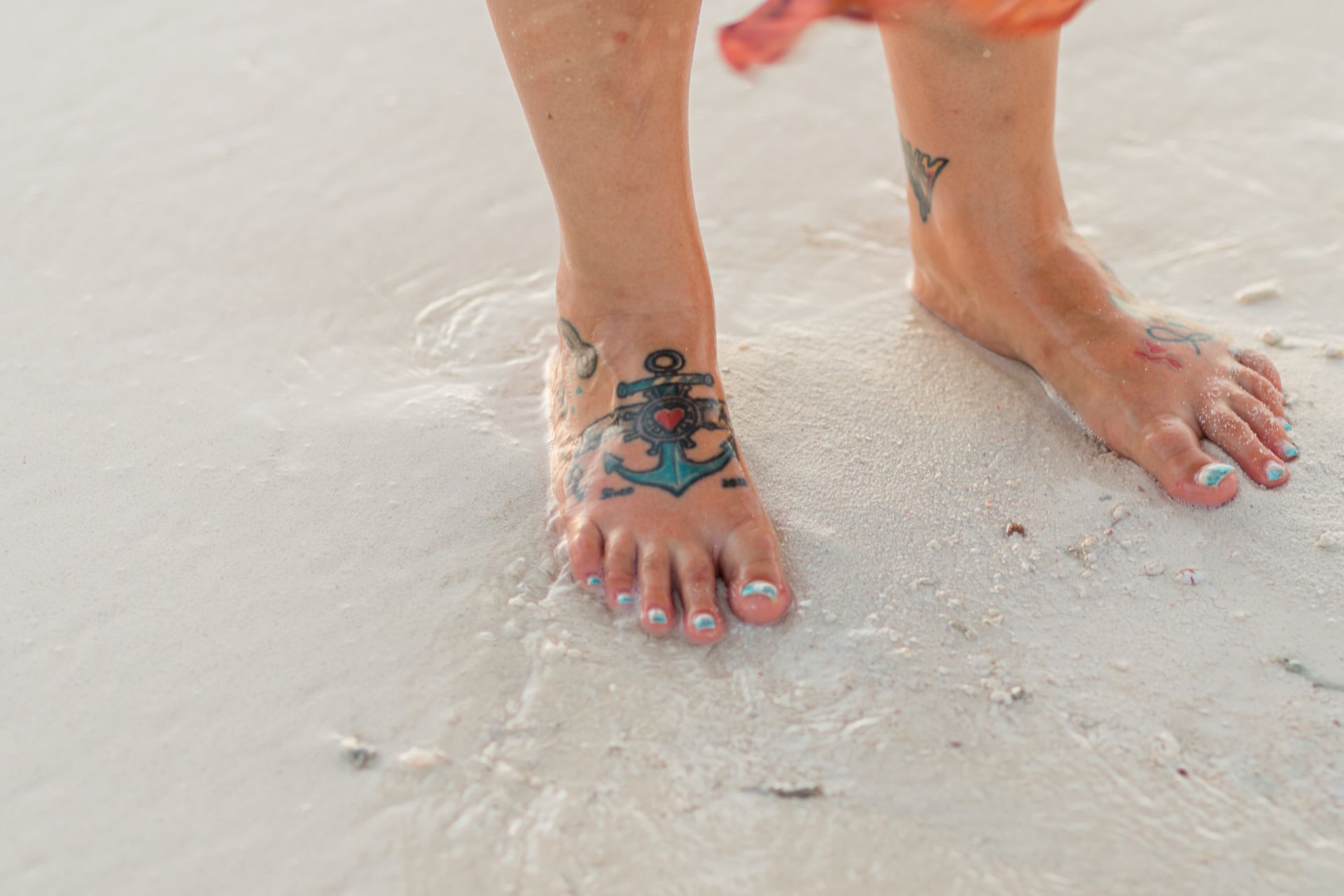
A foot tattoo looks effortless in a photograph: a small anchor on the top of the foot, a line of script along the arch, a flower blooming over the toes. What the photograph does not show is the work that placement does every day. Feet carry your whole weight, bend with every step, sweat inside shoes, and rub against socks, sandals, and pavement. A tattoo is a permanent mark made by inserting ink into the skin, and on the foot that ink sits in skin that is constantly being shed, stretched, and abraded. That is why foot tattoos have a reputation for fading, blurring, and needing touch-ups, and why the designs that survive there look very different from the designs that survive on an arm or a shoulder. This guide explains the problem honestly, then shows you the designs, the placements, and the healing routine that give a foot tattoo its best chance.
In This Guide
Feet are a high-friction placement, so the winning strategy is bold, simple work on the top of the foot, careful footwear during healing, and realistic expectations about touch-ups. Compare the joint above it in our guide to best ankle tattoo designs, and the softer skin below the knee in best calf tattoo designs, to see how much placement changes the result.
Key Takeaways
- The top of the foot is the only reliable zone. It has the flattest skin, the least direct friction, and the best ink retention on the foot.
- Bold and simple wins. Thick lines, open spacing, and solid black or dark shading survive; fine lines, tiny lettering, and soft shading blur first.
- Toes and soles fade fastest. Toe tattoos often lose detail within months, and sole tattoos rarely hold at all, because the skin there sheds and rubs constantly.
- Footwear is part of the design decision. Tight shoes, socks, and work boots rub a healing foot tattoo for eight hours a day, so plan your shoes before you book.
- Healing takes about two weeks of real care. Gentle washing, thin moisturizer, sun protection, and no swimming matter more on feet than anywhere else.
- Touch-ups are normal, not a failure. Budget for at least one touch-up, and judge a foot tattoo after it has fully settled, not on day one.
Table of Contents
- Why Foot Tattoos Fade Faster Than Almost Any Other Placement
- The Top of the Foot: Where Bold Designs Survive
- Toe Tattoos: Small, Charming, and the Fastest to Fade
- Sole Tattoos: The Placement That Almost Always Disappoints
- From Ankle to Foot: Designing Across the Joint
- Designs That Survive on Feet: Bold, Simple, and Spaced
- Footwear, Work, and the Healing Weeks
- Healing a Foot Tattoo Without Ruining It
- Touch-Ups, Costs, and When to Walk Away
- Choosing an Artist for a Foot Tattoo
Why Foot Tattoos Fade Faster Than Almost Any Other Placement
The foot is a machine for shedding skin. The foot contains 26 bones and 33 joints, and its skin is built for grip and protection rather than for display. The sole is thick, ridged, and constantly renewed, while the top of the foot is thin, mobile, and stretched over bone and tendon with very little fat underneath. Tattoo ink is held in the dermis, the layer below the surface, but the skin above it turns over continuously, and on the foot that turnover is accelerated by pressure, friction, and moisture. Every step presses the skin against a shoe or the ground, every sock drags across it, and every shower softens it. The result is that foot tattoos lose their crispness faster than tattoos on the upper arm, the thigh, or the back, where the skin is thicker, quieter, and better protected.
Three forces do most of the damage, and they work together. The first is friction: shoes and socks rub the same spots thousands of times a day, and that mechanical wear gradually pulls pigment out of the upper dermis and blurs the edges of lines. The second is shedding: the outer layer of skin renews itself constantly, and on weight-bearing skin the cycle is faster, so fine detail is carried away with the cells that hold it. The third is movement: the foot flexes, the toes curl, and the skin over the arch and the joints stretches and folds, which distorts thin lines and cracks delicate shading. Wound healing after a tattoo follows the same phases as any skin injury, and on the foot those phases are interrupted by walking, standing, and sweating, which is why a foot tattoo that looks perfect on day one can look soft and grey by month six.
None of this means foot tattoos are a bad idea. It means the placement has rules, and the people who are happy with their foot tattoos are usually the people who followed them. They chose the top of the foot, they chose bold work, they wore loose shoes while healing, and they accepted a touch-up as part of the price. The people who are unhappy usually chose the opposite: tiny script on a toe, a watercolor wash on the sole, or a fine-line mandala across the arch, and then wore tight trainers to a job on their feet. The table below summarizes how each part of the foot behaves, so you can see the whole problem at a glance before you choose a spot.
| Foot zone | Friction level | Skin turnover | Fading risk | Best use |
|---|---|---|---|---|
| Top of the foot | Moderate | Normal | Lowest on the foot | Bold symbols, flowers, script |
| Outer edge | High | Fast | Moderate to high | Simple bands and small marks |
| Inner arch | Low | Normal | Moderate | Hidden script and small designs |
| Toes | Very high | Very fast | Very high | Tiny symbols only, expect fading |
| Sole | Extreme | Extreme | Almost certain | Novelty only, not recommended |
| Heel and ankle bone | High | Fast | High | Small bold marks, not detail |
Age and sun exposure add to the effect. Feet spend summers bare in sandals, and ultraviolet light breaks down tattoo pigment over time, which is one more reason the top of the foot fades faster than a covered placement. The Mayo Clinic guide to tattoo risks notes that tattoos take about two weeks to heal and warns against sun exposure during that period, and the same advice holds for the life of the tattoo: sunscreen on a foot tattoo is not optional if you want it to keep its color. Add in the fact that the health effects of tattoos include allergic reactions and skin infections, which are more likely when a fresh tattoo is rubbed by dirty footwear, and the case for planning becomes clear. The foot is not a forgiving canvas, but it is a rewarding one for people who respect its limits.
The Top of the Foot: Where Bold Designs Survive
The top of the foot is the sweet spot, and every good foot tattoo starts there. The skin over the metatarsals is relatively flat when the foot is at rest, it is not weight-bearing, and it is not trapped inside a shoe all day in the same way the sides and the sole are. A design placed here can be seen when you look down, it photographs well, and it heals more predictably than any other spot on the foot. The best designs for this zone share a family resemblance: they are bold, they have clear shapes, and they leave breathing room between the lines. Think of a single anchor, a small compass rose, a sprig of lavender, a moth with open wings, or a short word in a strong, simple typeface. Each of these reads clearly at arm’s length, which is the distance that matters, because nobody admires a foot tattoo from two inches away.

Scale matters more on the foot than on the arm. A design that is too small will close up as the ink spreads slightly under the skin over the years, and a design that is too large will wrap around the curve of the foot and distort when you walk. The comfortable middle is a design about the size of a credit card or a little larger, centered on the flat of the foot, with its main shapes kept away from the ankle crease and the toe joints. Ask your artist to stencil the design while you are standing as well as sitting, because the skin over the foot changes shape dramatically between those two positions, and a design that looks centered on the table can slide sideways when you stand. A good artist will also check how the design moves when you point and flex your toes, since that is the motion that will pull at it every day.
Color can work on the top of the foot, but black does the heavy lifting. Solid black and dark grey hold their contrast longest, while pale colors and soft pastels fade fastest under sun and friction. If you want color, use it as an accent inside a strong black outline: a red flower with black linework, a blue wave under a black compass, a green leaf beside a black stem. That structure keeps the design readable even after the color softens, which it will. The tattoo machine deposits ink into the dermis with a cluster of needles, and on the thin skin of the foot an experienced artist will adjust the depth and speed so the ink sits evenly without blowing out into the surrounding tissue. That skill is one reason to choose an artist who has done many foot tattoos, not just many tattoos.
Toe Tattoos: Small, Charming, and the Fastest to Fade
Toe tattoos are the cutest idea on the foot and the least durable. A tiny heart on the second toe, a dot on the big toe, a miniature star between the toes: these designs photograph beautifully on the day they are done, and they are also the first to fade. The skin on the toes is thin, tight, and constantly moving, and the toes rub against each other and against the inside of shoes with every step. The ink has very little dermis to sit in, and what is there is shed quickly. Many toe tattoos lose their edges within a few months, and a surprising number develop pale patches where the ink has fallen out entirely. That does not make them a mistake, but it does make them a short-term tattoo, more like a favorite pair of shoes than a permanent piece.
If you still want a toe tattoo, keep it tiny, bold, and solitary. One small solid shape on one toe has a far better chance than a row of tiny letters across four toes, because each letter is a separate wound in skin that is already working hard. A single dot, a tiny star, or a small solid heart will age into a soft mark rather than a blurry smudge, and that is the best outcome available. Avoid fine linework, avoid script, and avoid anything that needs to be read, because lettering is the first thing to go. The same logic that makes finger tattoo ideas tricky applies here with interest: small, high-movement skin with thin dermis punishes detail, and the toes are even less forgiving than the fingers. If you love the look, go in with your eyes open, keep the design simple, and be ready to have it touched up or to let it fade gracefully.
Pain is part of the toe-tattoo calculation too. The toes have very little padding, and the bone is close to the surface, so the needle feels sharper there than on the top of the foot. Most people describe toe tattoos as brief but intense, and the sessions are short, which helps. The healing is the harder part: toes are hard to keep clean, socks press on them constantly, and closed shoes create a warm, damp environment that is exactly what a fresh tattoo does not need. If you work on your feet, a toe tattoo will demand a week of sandals or open shoes, and if you cannot arrange that, it is better to wait for a holiday or to choose the top of the foot instead.
Sole Tattoos: The Placement That Almost Always Disappoints
The sole is where foot tattoos go to disappear. The skin on the bottom of the foot is the thickest skin on the body, built to be walked on, and it renews itself at a remarkable rate. Tattoo ink placed there is carried away with the shedding skin, and the constant pressure of standing and walking pushes pigment out of the dermis. Most sole tattoos fade dramatically within weeks, and many are gone almost entirely within a few months, leaving only a faint shadow or a patchy grey mark. Artists who are honest will tell you this before they take your money, and artists who are not honest will take the booking and blame your aftercare when the ink vanishes. The calcaneus, the heel bone, and the thick pad beneath it make the heel one of the worst spots of all, because the skin there is both thick and under constant load.
There are two narrow exceptions, and both come with warnings. The first is a novelty sole tattoo done for a photograph or a special occasion, where the fading is part of the point and nobody expects it to last. The second is a very bold, very simple mark on the arch, the one part of the sole that does not bear weight, where a heavy black shape may hold for a year or two before softening. Even then, the result is unpredictable, and the touch-up cycle is endless. Compare that with the best rib cage tattoo designs, where the skin is protected by clothing and barely moves: the difference in longevity is not about the artist, it is about the skin. If permanence matters to you, the sole is the wrong canvas, and no amount of aftercare will change that.
Healing a sole tattoo is also uniquely miserable. You cannot walk normally without pressing on it, you cannot wear shoes without rubbing it, and you cannot keep it clean without staying off your feet. The FDA’s tattoo safety guidance notes that infections can come from unhygienic practices and that a tattoo that is not healing, or that develops a rash, needs medical attention, and a sole tattoo is at higher risk on both counts because it is in contact with floors, socks, and shoes all day. If you are determined to try it, choose a reputable artist who has done sole work before, keep the design large and bold, plan several days with almost no walking, and treat the result as an experiment rather than a keepsake.
From Ankle to Foot: Designing Across the Joint
The ankle and the foot belong to the same design, but they are not the same skin. The ankle is a hinge joint where the leg meets the foot, and the skin around it is thin, bony, and creased, while the top of the foot below it is flatter and quieter. A design that flows from the ankle onto the foot has to survive two different environments, and the part on the ankle will usually fade faster than the part on the foot. That is why the most successful ankle-to-foot designs treat the ankle as a frame and the foot as the picture: a band or a small motif around the ankle bone, with the main image sitting on the flat of the foot. Our guide to best ankle tattoo designs covers the joint itself in detail, including the bony spots to avoid and the small pieces that work with the joint rather than against it.
The Achilles area deserves special caution. The Achilles tendon runs down the back of the ankle to the heel, and the skin over it is thin, tight, and constantly moving as you walk. A design placed directly over the tendon will stretch and relax with every step, which blurs fine lines and makes healing slower. Small, bold marks to the side of the tendon do better than anything centered on it, and script across the back of the ankle is one of the fastest-fading choices you can make. If your design needs to cross from the leg to the foot, ask your artist to place the crossing point on the inner or outer side of the ankle, where the skin is a little looser, rather than over the tendon or the ankle bone itself.
Matching pairs are popular, and the foot is a good place for them. Two small matching designs, one on each foot, are a classic choice: two stars, two birds, two halves of a flower. The key is to keep both designs identical in size and placement, because feet are not perfectly symmetrical and the artist will need to adjust the stencil for each one. A pair also doubles the healing work, so plan your footwear for both feet at once. If you are thinking about a larger leg piece that ends at the foot, look at best calf tattoo designs for the upper part of the composition, and let the foot be the quiet ending of the design rather than its busiest part.
Designs That Survive on Feet: Bold, Simple, and Spaced
The designs that survive on feet all share the same DNA: thick lines, open space, and strong shapes. A bold anchor, a solid black moth, a simple flower with five clear petals, a compass with thick cardinal points, a small snake with a clean silhouette: these are the designs that still read clearly after two years of shoes and showers. The reason is simple. Tattoo ink spreads very slightly under the skin over time, and on the foot that spread is faster because the skin is thinner and more active. A line that starts out thick has room to soften and still look like a line, while a line that starts out fine softens into a blur. Spacing is just as important: two lines that start a millimeter apart will merge into one as the ink settles, so the shapes in a foot tattoo need air around them. Body modification is a broad field, but the same principle holds across it: the bolder the mark, the longer it survives in active skin.

Some styles are built for the foot, and some are built to fail there. Traditional and neo-traditional work, with their heavy outlines and solid fills, are the safest choice, and simple blackwork and tribal-inspired bold shapes do well for the same reason. Fine-line minimalism, micro-realism, watercolor, and delicate dotwork are the riskiest: they depend on exactly the detail that foot skin erases first. That does not mean you cannot have a delicate-looking foot tattoo, but it does mean the delicacy should come from the design, not from the line weight. A small flower drawn with thick, confident lines can look light and graceful, while a flower drawn with hairlines will look like a smudge within a year. Ask your artist to show you healed photographs of their foot work, not just fresh ones, and pay attention to how the lines have aged.
Script and lettering need the same discipline. One short word in a bold, simple font can survive on the top of the foot for years, especially if the letters are large and well spaced. A long quote in a thin script will not, because the letters will merge and the words will become unreadable. If the words matter to you, choose three or four of them, make them big, and put them where the skin is flattest. A name, a date, a single word like “breathe” or “wander”: these are the foot tattoos that age well. Longer text belongs on the forearm or the ribs, where the skin is quieter. For ideas about how lettering behaves on small, high-movement skin, the lessons in our guide to finger tattoo ideas apply almost word for word to the foot.
Footwear, Work, and the Healing Weeks
Your shoes are the single biggest factor in how a foot tattoo heals. A fresh tattoo is an open wound, and on the foot that wound spends most of the day inside a shoe, pressed against fabric, warmed by body heat, and damp with sweat. Tight trainers, work boots, and high heels all rub the same spot repeatedly, and that friction can pull ink out of the healing skin, cause scabbing, and invite infection. The FDA tattoo safety guidance warns that infections can come from unhygienic practices and that a tattoo that is not healing needs medical attention, and a foot tattoo trapped in a dirty work boot is one of the highest-risk situations a fresh tattoo can be in. The practical answer is to book your tattoo when you can wear open shoes for at least a week, and to treat your footwear as part of the aftercare, not an afterthought.

The ideal healing shoe is loose, clean, and open. Sandals with a soft strap that does not cross the tattoo are best, followed by loose canvas shoes worn with a clean cotton sock that you change daily. Avoid anything that presses directly on the tattoo, anything with a rough interior, and anything you have worn for sweaty work. If your job requires steel-toe boots or closed shoes, book the tattoo before a run of days off, or ask for time off: two or three days of open shoes make a measurable difference to the result. The same thinking applies to exercise. Running, long walks, and gym sessions in tight trainers should wait until the tattoo has finished peeling, which is usually around two weeks, because sweat and friction are the two things a healing foot tattoo can least afford.
Work, weather, and season all play a role. A foot tattoo done in summer heals faster in the warmth but faces more sun, more sweat, and more barefoot exposure to sand and dirt, while a winter tattoo heals in clean socks and closed shoes but is harder to keep dry and ventilated. There is no perfect season, only better planning: summer works if you can stay out of the sea and the pool and keep the tattoo covered from direct sun, and winter works if you can wear loose shoes and change your socks often. If you stand all day for work, the blood flow to your feet is higher and the swelling after a tattoo will be worse, so elevate your feet in the evening, keep the tattoo clean, and do not be surprised if the first few days are more uncomfortable than a tattoo on your arm. A design that sits quietly on the top of the foot, like the rose tattoo motifs many people choose there, is easier to protect than a design that wraps around the sides where shoes grip.
Healing a Foot Tattoo Without Ruining It
Foot tattoos heal like other tattoos, only with more opportunities to go wrong. The Mayo Clinic advice is to wash the tattoo gently with soap and water twice a day, apply a thin layer of moisturizer, keep it out of the sun, and avoid swimming while it heals, and every part of that advice is harder on a foot. Washing a foot means bending down to it twice a day and drying it thoroughly between the toes, where moisture lingers. Moisturizer must be thin, because a thick layer trapped under a sock will soften the scabs and pull ink out with them. Sun protection means sunscreen or a covering once the skin has closed, not a bandage during the first days. And no swimming means no pools, no hot tubs, and no sea for at least two weeks, which is a real sacrifice in summer but a necessary one.
Watch for the warning signs, and act on them early. Some redness, swelling, and warmth are normal in the first days, but a tattoo that becomes more painful after day three, that develops spreading redness, yellow crusts, or a bad smell, or that makes you feel unwell, needs medical attention rather than more moisturizer. The FDA advises contacting a health care professional if a tattoo is not healing or if a rash appears near it, and that advice matters more on the foot, where an infection can be harder to notice under a sock. Do not pick at peeling skin, do not scratch an itchy tattoo, and do not cover it with a tight bandage to hide it at work, because all three slow healing and pull ink out. If the tattoo itches, a thin layer of moisturizer and a loose sock are the answer, not your fingernails.
Long-term care is simple and cheap. Once healed, the two things that protect a foot tattoo are sunscreen and moisturizer. Sunlight breaks down pigment, and dry skin makes a tattoo look dull, so a daily moisturizer and sunscreen whenever the foot is bare will add years to the design. Reapply sunscreen after swimming or sweating, and remember that the top of the foot burns easily because it faces the sun directly. A lotus flower tattoo on the top of the foot, for example, will keep its petals crisp far longer with sunscreen than without it, and the same is true of any design in this placement. The care is not difficult; it is the remembering that is hard, so make it part of your morning routine in summer.
Touch-Ups, Costs, and When to Walk Away
Budget for a touch-up before you book, not after you are disappointed. Most reputable artists include one touch-up in the price of a foot tattoo, or offer it at a reduced rate within the first six to twelve months, because they know the placement. A touch-up is not a sign that the artist failed; it is the second pass that fills in the spots where ink fell out during healing and sharpens the lines that softened. Wait until the tattoo is fully healed, at least four to six weeks, before judging it, and wait the same period before a touch-up, because working on skin that is still healing causes more damage than it repairs. If your artist does not offer a touch-up for foot work, ask why, and consider it a warning sign.
Cost follows size, detail, and the artist’s experience, and foot tattoos are not cheap for their size. A small bold design on the top of the foot may cost the shop minimum, while a larger piece that wraps the foot can cost several hundred dollars, and a touch-up adds to that over time. The price is fair: foot tattoos are slow, fiddly work on difficult skin, and they demand more of the artist’s skill than the same design on an arm. Do not choose the cheapest artist for a foot tattoo, and do not try to save money by skipping the touch-up. The most expensive foot tattoo is the one you pay for twice because the first one was done badly. If the total cost, including a likely touch-up, is more than you want to spend, a temporary design such as henna tattoo designs for feet can give you the look for a special occasion without the commitment or the fading.
Know when to walk away from a design. If the artist tells you your chosen design will not survive on the foot, listen to them: they are protecting you from a blurry disappointment. If the design is a tiny portrait, a detailed mandala, or a long passage of script, the right answer is to move it to another placement or to simplify it radically. The rib cage and the thigh both hold fine detail far better than the foot, and a design that is beautiful there is better than a design that is illegible on your foot. Walking away from a bad placement is not giving up on the tattoo; it is choosing the version of it that will still look good in five years.
Choosing an Artist for a Foot Tattoo
Choose an artist who has healed foot tattoos to show you, not just fresh ones. Every tattoo looks good on the day it is done, and the difference between a good foot tattoo artist and an average one only shows up months later. Ask to see photographs of foot tattoos that are at least a year old, and look at how the lines have held, whether the black is still solid, and whether the shapes are still distinct. An artist who is proud of their healed foot work will have those photographs ready, and an artist who only shows fresh work is telling you something. Also ask how they adjust their technique for feet: the depth, the needle grouping, and the speed all change on thin, bony skin, and an artist who cannot explain those adjustments has probably not thought about them.
The consultation is where a foot tattoo succeeds or fails. Bring reference images, but be ready to hear that your reference needs to be bigger, bolder, or simpler. A good artist will stencil the design on your foot while you stand, check it from several angles, and warn you about the spots where it will fade. They will ask about your job, your shoes, and your plans for the next two weeks, because those answers change the advice. They will also be honest about pain: the top of the foot is tender, the toes are sharp, and the ankle bone is famously uncomfortable, and an artist who pretends otherwise is not being straight with you. The same care that goes into choosing a design for a visible, high-movement placement like the area behind the ear applies here: small skin, high movement, and nowhere to hide a mistake.
Finally, check the studio as carefully as the artist. The FDA tattoo safety guidance notes that infections can come from unhygienic practices and equipment that is not sterile, and that inks can be contaminated even when they look fine. A clean studio, single-use needles opened in front of you, fresh gloves, and a clear aftercare sheet are the minimum, and a studio that rushes you or will not answer questions is a studio to leave. Your foot will be in that chair for an hour or two, and your tattoo will be on your foot for decades; both deserve a careful choice.
Our View
Foot tattoos reward honesty and punish wishful thinking. Choose the top of the foot, choose bold work with room to breathe, wear loose shoes while it heals, and budget for a touch-up. Do that, and a foot tattoo can be one of the most charming pieces you own. Ignore it, and you will pay for a design that only you can read, and only in a photograph.
— The Editors, Tattoo Designs Pictures
Frequently Asked Questions
Do foot tattoos fade faster than other tattoos?
Yes. Feet shed skin quickly, rub against shoes and socks all day, and flex with every step, so foot tattoos lose crispness faster than tattoos on the arm, thigh, or back. Bold designs on the top of the foot fade slowest; toe and sole tattoos fade fastest.
What is the best placement for a foot tattoo?
The top of the foot is the best placement. It is flat, visible, and not weight-bearing, so ink holds better there than on the toes, the sides, or the sole. Keep the design centered on the flat of the foot, away from the ankle crease and the toe joints.
How painful is a foot tattoo?
Most people find it more painful than an arm tattoo because the skin is thin and the bone is close to the surface. The top of the foot is tender, the toes are sharp, and the ankle bone is uncomfortable, but sessions for foot designs are usually short.
How long does a foot tattoo take to heal?
About two weeks for the surface to close, and four to six weeks before you can fairly judge the result. During the first two weeks, wash it gently twice a day, use a thin layer of moisturizer, wear loose open shoes, and avoid swimming, sun, and tight footwear.
Will I need a touch-up on a foot tattoo?
Probably, and that is normal for this placement. Most artists include one touch-up or offer it at a reduced rate. Wait until the tattoo is fully healed, at least four to six weeks, before having it touched up.
Can I wear shoes after getting a foot tattoo?
Loose, clean, open shoes are best for the first week. Avoid tight trainers, work boots, and high heels that press on the tattoo. If your job requires closed shoes, book the tattoo before days off so the first days of healing happen in sandals.
Questions About Your Design?
If you are still deciding on placement, size, or style, browse the rest of the guides on the Tattoo Designs Pictures home page and bring your favorite references to your consultation. A good artist will tell you honestly what will survive on your foot, and what belongs somewhere else.
Sources
- Tattoo — Wikipedia
- Foot — Wikipedia
- Skin — Wikipedia
- Wound healing — Wikipedia
- Health effects of tattoos — Wikipedia
- Tattoo machine — Wikipedia
- Body modification — Wikipedia
- Ankle — Wikipedia
- Calcaneus — Wikipedia
- Achilles tendon — Wikipedia
- Tattoos: Understand risks and precautions — Mayo Clinic
- Think Before You Ink: Tattoo Safety — U.S. Food and Drug Administration