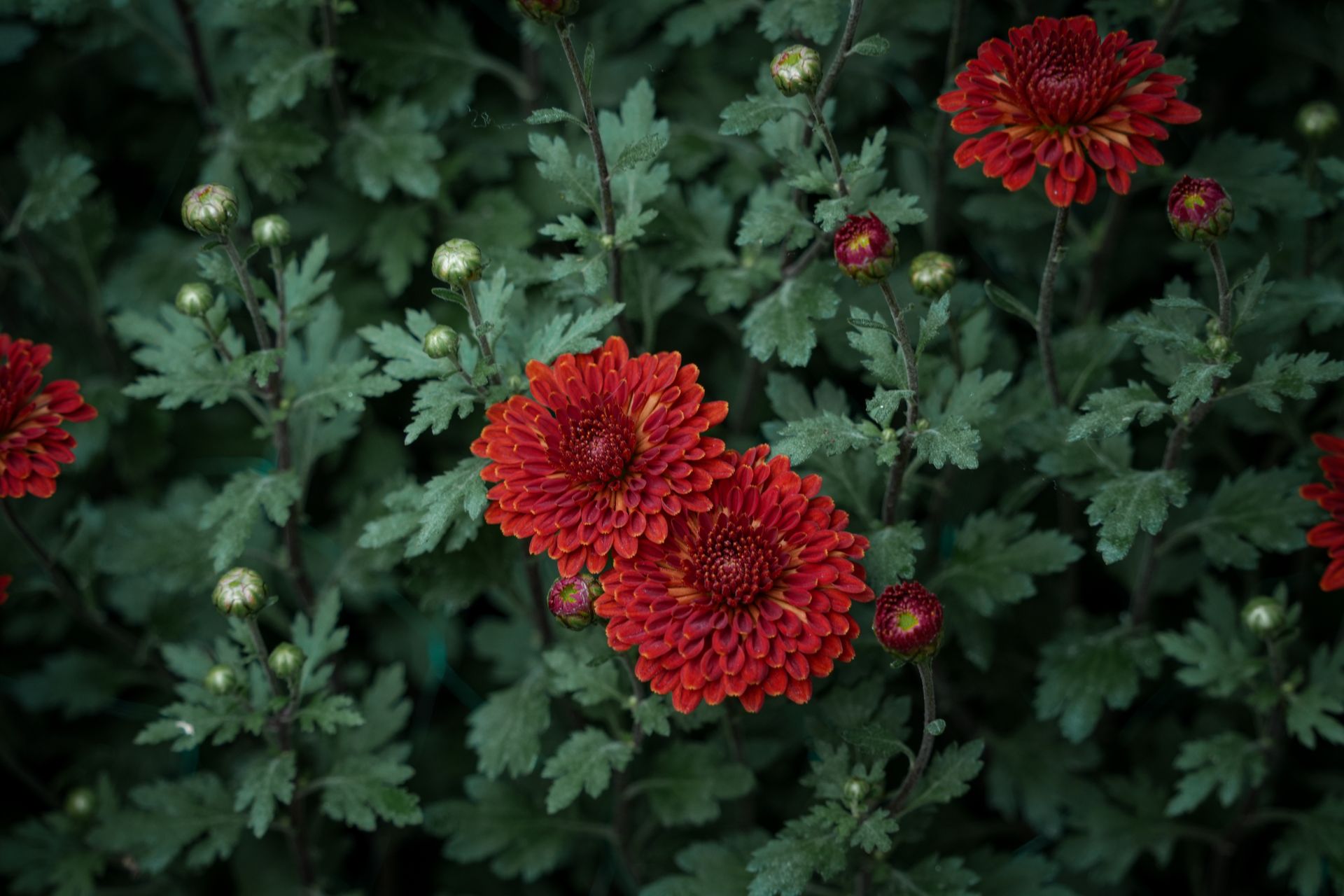
Of all the flowers in Japanese tattooing, the chrysanthemum is the most dignified, and the most misunderstood outside Japan. To a Western eye it is simply a pretty autumn flower, but in Japan the chrysanthemum, the kiku, is the flower of the Emperor, the symbol of longevity and perfection, and the centerpiece of the autumn season. A chrysanthemum tattoo is therefore not just a floral design: it is a statement about endurance, about the long view, and about a culture that has placed this flower at the very top of its symbolism for more than a thousand years. This guide explains what the chrysanthemum means in Japanese tattooing, how it differs from the cherry blossom and the peony, and how it is composed with maple, wind, and water in a traditional irezumi design.
In This Guide
The chrysanthemum means longevity, perfection, and imperial dignity, and it belongs to autumn, while the cherry blossom belongs to spring and means impermanence. Compare the two flowers in cherry blossom tattoo meaning and in the survey of Japanese tattoo flowers, then read on for the deep dive on the kiku alone.
Key Takeaways
- The chrysanthemum means longevity and perfection. In Japan the kiku symbolizes a long life, endurance, and the perfection of a flower that blooms when others fade.
- It is the imperial flower of Japan. The stylized chrysanthemum is the Imperial Seal, and the Japanese throne itself is called the Chrysanthemum Throne.
- It belongs to autumn. The chrysanthemum blooms in autumn, and in irezumi it is paired with maple leaves, wind, and water, the classic autumn backgrounds.
- It is the opposite of the cherry blossom. Sakura means impermanence and the briefness of life; the chrysanthemum means the long view, endurance, and nobility.
- Color changes the nuance. White means purity and truth, red means love and passion, yellow means happiness and royalty, and pink means affection.
- In irezumi it is a large, bold flower. The chrysanthemum is drawn big, with layered petals and strong shading, and it anchors a composition rather than filling a gap.
Table of Contents
- The Flower That Means Longevity: Chrysanthemum in a Single Table
- Kiku in Japan: The Imperial Flower
- The Imperial Seal: Sixteen Petals and What They Mean
- Longevity, Perfection, and the Autumn Season
- Chrysanthemum Colors and Their Meanings
- Chrysanthemum in Irezumi Composition: Wind, Water, and Maple
- Pairings: Maple, Peony, Cherry Blossom, Koi, and Dragon
- Placement and Size: Where a Chrysanthemum Belongs
- Designing Your Chrysanthemum Tattoo: Style, Color, and Line
- Aftercare and Aging: Keeping the Colors True
The Flower That Means Longevity: Chrysanthemum in a Single Table
Japanese flower tattooing is a language, and every flower is a word with a season and a meaning. The cherry blossom is spring and impermanence, the peony is wealth and bravery, the lotus is purity and rebirth, and the chrysanthemum is autumn and longevity. That is the first thing to understand about the kiku: it does not stand alone, it stands in a system, and its meaning comes from where it sits in that system. A flower that blooms in autumn, when other flowers are dying, is a natural symbol of endurance, and the Japanese reading of the chrysanthemum follows that logic exactly. It is the flower that outlasts the year, and in a tattoo it says that the wearer intends to do the same.
The table below sets out the main flowers of irezumi so you can see the chrysanthemum in context. Notice how each flower is tied to a season, because in Japanese art the season is part of the meaning: a flower out of season is a mistake, and a flower in season is a statement. The chrysanthemum and the maple share autumn, and that pairing, kiku and momiji, is one of the most classic combinations in Japanese tattooing, a pairing that says the wearer understands the language rather than merely liking the picture.
| Flower | Japanese name | Season | Core meaning | Classic pairing |
|---|---|---|---|---|
| Chrysanthemum | Kiku | Autumn | Longevity, perfection, nobility | Maple, wind, water |
| Cherry blossom | Sakura | Spring | Impermanence, beauty, the samurai | Koi, dragon, wind |
| Peony | Botan | Late spring | Wealth, bravery, good fortune | Lion, samurai, demon |
| Lotus | Hasu | Summer | Purity, rebirth, enlightenment | Water, Buddha, koi |
| Plum blossom | Ume | Late winter | Hope, endurance, new beginnings | Nightingale, snow |
That contrast with the cherry blossom is the heart of the chrysanthemum’s meaning. The cherry blossom is famous precisely because it is brief: it blooms for a week and falls, and in Japanese culture it has become the symbol of mono no aware, the bittersweet awareness of impermanence, and of the samurai who lived beautifully and died young. The chrysanthemum is the opposite pole of the same idea: it blooms late, it lasts, and it is associated with the Emperor, with long life, and with the perfection of a form that has been cultivated for centuries. To wear a cherry blossom is to say that life is short and beautiful; to wear a chrysanthemum is to say that life should be long, noble, and well-lived. Our guide to cherry blossom tattoo meaning tells the first half of that story in detail, and this guide tells the second.
Kiku in Japan: The Imperial Flower
The chrysanthemum arrived in Japan from China, and Japan made it its own. The flower was introduced from China, where it was already associated with longevity and with the autumn season, and in Japan it was cultivated with extraordinary care, bred into hundreds of varieties, and celebrated in festivals that continue today. The Chrysanthemum Festival, the Festival of Happiness, is held on the ninth day of the ninth month, and it is one of the five seasonal festivals of the old Japanese calendar, a day for drinking chrysanthemum wine, wearing chrysanthemum, and praying for long life. The flower became so closely associated with the imperial family that it is now impossible to separate the kiku from the throne, and a tattoo of a chrysanthemum carries a faint echo of that association wherever it is worn.

Chrysanthemums are also a garden flower of extraordinary variety, and that variety matters for tattoo design. Chrysanthemum is a genus of flowering plants in the daisy family, native to East Asia, with blooms that range from small, simple daisies to large, layered pompons with hundreds of petals. In Japanese tattooing, the classic chrysanthemum is the large, layered kind, drawn with many overlapping petals that curve outward from a dense center, because that form gives the artist room to show shading, depth, and movement. A small, simple chrysanthemum can work as an accent, but the flower’s meaning is best carried by a large bloom, drawn boldly, with the petals given the space they need. The history of tattooing in Japan shows the chrysanthemum appearing in woodblock prints and in tattooing together, as artists in the Edo period borrowed the flower from the prints and made it a staple of the bodysuit.
The flower’s association with longevity is not abstract: it is tied to real beliefs and real practices. Chrysanthemum petals were eaten and drunk in wine in the belief that they prolonged life, and the flower was planted in gardens as a charm against ill health. That belief survives in the tattoo’s meaning today: a chrysanthemum tattoo is often chosen by people who have survived something, who have reached a milestone, or who want to mark a long life well lived, and it is also chosen as a memorial, because a flower that means longevity is a fitting tribute to a life that was long and full. It is a quieter, more reflective choice than a dragon or a tiger, and that is part of its appeal: it says something serious without shouting.
The Imperial Seal: Sixteen Petals and What They Mean
The most famous chrysanthemum in Japan is not a flower at all: it is a seal. The Imperial Seal of Japan is a stylized chrysanthemum with sixteen petals, used by the Emperor and the imperial family, and it appears on Japanese passports, on the doors of the Diet building, and on the badges of the imperial household. The sixteen-petal form is reserved for the Emperor, while members of the imperial family use a fourteen-petal version, and the distinction is a matter of rank and tradition. The seal is so recognizable that it is often called the Chrysanthemum Seal, and the Japanese throne itself is called the Chrysanthemum Throne, a phrase that makes the flower and the monarchy inseparable in the language.
For a tattoo, the seal matters in two ways: as a design reference, and as a caution. As a design reference, the sixteen-petal seal is a beautiful, symmetrical motif, and many chrysanthemum tattoos borrow its geometry, drawing the petals in a regular, radiating pattern that echoes the seal without copying it. That is a legitimate and common approach, and it gives the tattoo a formal, heraldic quality that suits the flower’s meaning. As a caution, the seal itself is a national emblem, and a tattoo that reproduces the Imperial Seal exactly, petal for petal, is likely to be read in Japan as a claim to imperial status or as a piece of nationalist imagery, which is not the message most wearers want. The right approach is to draw a chrysanthemum, not a seal: a flower with layered, overlapping petals, some open and some in bud, rather than a flat, symmetrical emblem. Your artist will understand the difference, and a good Japanese-style artist will steer you toward the flower and away from the emblem.
The seal also explains why the chrysanthemum carries a sense of nobility that other flowers do not. The peony is associated with wealth and with the bravery of the samurai, and the cherry blossom with the samurai’s brief life, but only the chrysanthemum is associated with the Emperor, and that association gives it a dignity that is hard to overstate. In irezumi, the traditional Japanese tattoo, the chrysanthemum is therefore a flower of high status, and it is often placed in a prominent position in a composition, on the chest, the back, or the thigh, where it can be seen and respected. It is not a filler flower, and it should not be treated as one: in the language of Japanese tattooing, the chrysanthemum is a main subject, and it deserves the space and the care that a main subject requires.
Longevity, Perfection, and the Autumn Season
Longevity is the chrysanthemum’s first meaning, and perfection is its second. The flower blooms in autumn, when the year is ending and other flowers have finished, and its ability to flower late and to hold its bloom for a long time made it a natural symbol of a long life. The perfection comes from the flower’s form: the layered petals, arranged in a dense, symmetrical bloom, have been bred and cultivated for centuries to approach an ideal, and the Japanese appreciation of the chrysanthemum is partly an appreciation of that cultivation, of the human care that brings a flower to its best form. A chrysanthemum tattoo therefore carries two meanings at once: the hope of a long life, and the aspiration to live it well, to be cultivated rather than merely grown.
Autumn is the chrysanthemum’s season, and in Japanese art the season is never incidental. The flower belongs with the maple, with the wind that carries the leaves, and with the water that reflects the sky, and a chrysanthemum drawn with a cherry blossom or a peony out of season is a design error that a knowledgeable viewer will notice. The ukiyo-e woodblock prints that shaped Japanese tattooing were organized by season, and the artists who made them understood that a flower’s meaning depends on when it blooms. The chrysanthemum’s autumn companions are therefore part of its meaning: the maple leaf, which turns red as the year ends, the wind, which moves the leaves, and the water, which carries them away. Together they say that the year is ending, that the flower endures, and that endurance is beautiful.

The autumn association also gives the chrysanthemum a reflective, even melancholy quality. Autumn is the season of harvest and of preparation for winter, and a flower that blooms then is a reminder that beauty continues even as the year turns. That is why the chrysanthemum is often chosen as a memorial tattoo, or as a tattoo to mark a recovery: it is a flower for people who have been through a difficult season and are still standing. It is not a flower of triumph, like a dragon, or of defiance, like a tiger; it is a flower of endurance, and its message is quieter and, for many people, more honest. If you are choosing a chrysanthemum for that reason, tell your artist, because the design will be better if the artist understands the feeling behind it.
Chrysanthemum Colors and Their Meanings
Color is not decoration in a chrysanthemum tattoo: it is part of the meaning. The flower comes in many colors, and each color carries its own nuance, so the choice of color is a choice about what you want the tattoo to say. White chrysanthemums mean purity, truth, and honesty, and in Japan they are also associated with mourning and with funerals, so a white chrysanthemum tattoo can be a memorial, and should be chosen with that association in mind. Red chrysanthemums mean love and passion, and they are the boldest choice, a flower that demands attention. Yellow chrysanthemums mean happiness, joy, and royalty, and they are the most cheerful of the colors, while pink chrysanthemums mean affection, grace, and gentle love. Purple chrysanthemums, the rarest in nature, are associated with nobility and with a love that is deep and serious.
Most chrysanthemum tattoos use one dominant color with shading, rather than a rainbow of colors. A single red chrysanthemum with black and grey shading is a classic, and a single yellow or white bloom with dark green leaves is another, because a single color lets the flower’s form speak. Mixing colors in one flower is possible, but it should be done carefully: a flower that is half red and half yellow will read as a mistake rather than a meaning, while two separate blooms, one red and one white, can carry two meanings side by side. The Japanese art tradition favors restraint in color, and irezumi follows that tradition: a few strong colors, used boldly, are more effective than many colors used timidly. If you want color, choose it for a reason, and let your artist show you how it will look when it has healed, because tattoo colors soften with time and the color you see on day one is not the color you will have in five years.
Black and grey chrysanthemums are a legitimate and beautiful choice. A chrysanthemum drawn in black and grey, with the petals shaded in fine gradients, can be more elegant than a colored one, and it ages well, because black holds its contrast longer than color. The flower’s form, with its many layered petals, is well suited to black and grey work, and the shading can show the depth and the curl of each petal. That is also a practical choice: the skin holds black ink better than most colors, and a black and grey chrysanthemum on the back or the thigh will still be clear in ten years, while a pale pink one may have faded to a soft shadow. If you love color, use it, but do not feel that a chrysanthemum must be colored to be meaningful: the flower’s meaning is in its form and its season, not only in its hue.
Chrysanthemum in Irezumi Composition: Wind, Water, and Maple
In traditional irezumi, a chrysanthemum is never left floating in empty skin. Irezumi, the traditional Japanese tattoo, is a complete composition: a main subject, such as a flower or an animal, set against a background that fills the skin and ties the design together. The classic backgrounds are wind bars, water, clouds, and rocks, and the chrysanthemum’s companions are wind, water, and maple. Wind bars are the dark, curved bands that sweep across a bodysuit, and they give a static flower a sense of movement, as if a breeze were passing through it. Water, drawn as stylized waves with white crests, grounds the flower and gives it a setting, and maple leaves, scattered through the wind, tell the viewer that the season is autumn. Together, they turn a single flower into a scene.
The composition rules are simple, but they are strict. The chrysanthemum should be large enough to be the subject, usually the largest flower in the design, and it should be placed where the body’s shape supports it: on the shoulder, the chest, the back, or the thigh, where the skin is broad and the flower can open fully. The background should fill the space around it without crowding it, and the maple leaves should be smaller than the chrysanthemum, so the hierarchy is clear: the flower is the subject, the leaves are the season, and the wind and water are the setting. A design that reverses that hierarchy, with small chrysanthemums lost among large maple leaves, will look confused, and a design with no background at all will look unfinished to a knowledgeable eye. The wabori tattoo tradition, the hand-poked Japanese style, is where these rules were refined, and a wabori artist will compose a chrysanthemum with the same care as a painter composing a scroll.
Scale and placement follow from the composition. A chrysanthemum that is too small will lose its petals as the ink settles, and a chrysanthemum that is too large for its placement will wrap around a curve and distort. The comfortable size for a single bloom is about the size of a hand, and for a composition with maple and wind it is larger still, which is why the back, the chest, and the thigh are the classic placements. A small chrysanthemum can work on the forearm or the shoulder, but it should be drawn with fewer, bolder petals, so the design survives. The same logic that makes a Japanese tattoo bodysuit work, a large subject with a full background, applies in miniature to a single chrysanthemum: the flower needs room, and the background needs to fill the room around it.
Pairings: Maple, Peony, Cherry Blossom, Koi, and Dragon
Pairing a chrysanthemum with another motif is a statement, and the statement should make sense. The safest and most classic pairing is the maple leaf, because maple and chrysanthemum share autumn, and the combination is a standard seasonal pairing that any Japanese-style artist will recognize. The maple adds color and movement, its red leaves contrasting with the chrysanthemum’s bloom, and together they say autumn more clearly than either flower alone. The peony is another good pairing, because peony and chrysanthemum are both large, bold flowers, and they can be composed side by side as a pair of equals, with the peony’s wealth and bravery balancing the chrysanthemum’s longevity and nobility. Our guide to the peony tattoo meaning in Japanese tattooing explains the peony’s side of that pairing in detail.
Some pairings are more difficult, and they need a good reason. The cherry blossom can be paired with the chrysanthemum, but only as a deliberate contrast: spring against autumn, impermanence against longevity, and the design should make that contrast clear, perhaps by placing the two flowers on opposite sides of a composition or by separating them with wind or water. A design that mixes them without thought will look like a seasonal error. The koi is a natural companion, because koi swim in water and the chrysanthemum can be set above the water, and the combination of a koi and a chrysanthemum is a classic bodysuit element. The dragon is a stronger pairing: a dragon with a chrysanthemum is a design of power and nobility, and it suits a large back or chest piece, but it should not be attempted small, because both subjects need space. The Japanese tattoo meanings guide sets out the full vocabulary of these motifs, and it is worth reading before you combine them.

What not to pair is as important as what to pair. Do not pair a chrysanthemum with a flower from a different season without a reason, do not pair it with a motif that contradicts its meaning, such as a skull or a wilting flower, unless you intend that contradiction, and do not crowd it with too many companions: a chrysanthemum, a maple, and wind are enough, and adding a koi, a dragon, and a peony to the same small area will make a mess. The best Japanese compositions are restrained: one main subject, one or two companions, and a background that ties them together. If you are unsure, ask your artist to show you a composition with the same pairing, and look at how the elements balance. A good artist will be happy to explain why they chose a pairing, and an artist who cannot explain it is guessing.
Placement and Size: Where a Chrysanthemum Belongs
The chrysanthemum is a large flower, and it belongs on large skin. The back is the classic placement, because it offers the broadest canvas and the flower can be drawn at full size with its maple and wind companions, and a back piece with a chrysanthemum is one of the most impressive designs in Japanese tattooing. The chest is another good placement, with the flower centered over the heart or spread across the chest, and the thigh is a strong choice for a single large bloom, because the skin is broad and the design can be seen easily. The upper arm and the shoulder suit a medium bloom, and the forearm can carry a smaller one, but the flower should not be shrunk below the size of a palm, or its petals will merge as the ink settles.
Placement also changes the meaning slightly, because visibility is part of the message. A chrysanthemum on the back is a private statement, seen only when you choose to show it, and it suits the flower’s reflective, dignified character. A chrysanthemum on the chest or the arm is a public statement, and it suits a person who wants the flower’s meaning to be seen. A chrysanthemum on the thigh is a classic choice for a large floral piece, and it pairs well with other flowers in a leg composition. The Japanese tattoo history guide explains how the bodysuit developed as a full-body composition, and the chrysanthemum’s place in it, and it is worth reading if you are considering a larger piece. Whatever the placement, the flower should sit on flat, quiet skin, where its petals can be drawn clearly and where the design will age well.
Pain and healing follow the placement, not the flower. The back and the thigh are moderately painful and heal well, because the skin is thick and the area can be kept clean and covered. The chest is more tender, especially near the collarbone, and the inner arm is sensitive, so a chrysanthemum there will hurt more and heal more slowly. The Mayo Clinic guide to tattoo risks notes that tattoos take about two weeks to heal and that sun exposure and swimming should be avoided during that time, and that advice applies to a chrysanthemum as much as to any other tattoo. Color work, which a chrysanthemum often involves, can take longer to heal than black work, and the colors will look brightest after the skin has fully settled, which takes four to six weeks.
Designing Your Chrysanthemum Tattoo: Style, Color, and Line
There are three main styles for a chrysanthemum tattoo, and the choice is a matter of taste and of how you want the flower to age. The traditional irezumi style is the most faithful: bold black outlines, strong shading, and flat, saturated color, with the flower drawn large and the petals given clear, separate shapes. The neo-traditional style keeps the bold outline but adds more detailed shading and a wider color palette, and it suits a chrysanthemum well, because the flower’s layered petals reward careful shading. The black and grey style drops the color entirely and relies on shading to show the petals, and it is the most elegant and the longest-lasting of the three, because black holds its contrast. A fine-line chrysanthemum is possible, but it is the riskiest choice, because the flower’s many petals depend on clear lines, and fine lines will blur together as the tattoo ages.
Bring references, but let the artist draw the flower. A photograph of a real chrysanthemum is a useful starting point, but a tattoo is not a photograph, and the artist will need to translate the flower into line and shading that work on skin. Show your artist the colors you like, the size you want, and the placement, and then let them design the petals, the shading, and the background. A good Japanese-style artist will have drawn hundreds of chrysanthemums, and their version will be better than a copy of a photograph, because it will be drawn for skin, not for paper. The body modification tradition is full of designs that were improved by the artist’s hand, and the chrysanthemum is one of them: the flower’s beauty in a tattoo comes from the artist’s understanding of its form, not from a literal copy.
Ask to see healed chrysanthemums, not just fresh ones. Color, especially red and yellow, fades with sun and time, and a chrysanthemum that looks vivid on day one may look soft in five years. An artist who can show you a healed chrysanthemum, with its colors still clear and its petals still distinct, is an artist who knows how to pack color and how to shade for longevity. Also ask about touch-ups: a chrysanthemum with color may need a touch-up after a few years, and a reputable artist will offer one at a reduced rate. The health effects of tattoos include allergic reactions to pigments, which are rare but real, and a consultation is the place to discuss any sensitivity, especially to red pigments, which are the most common cause of reactions.
Aftercare and Aging: Keeping the Colors True
A chrysanthemum tattoo ages like any color tattoo, and the same care protects it. The Mayo Clinic advice is to wash gently twice a day, apply a thin layer of moisturizer, keep the tattoo out of the sun while it heals, and avoid swimming for about two weeks, and every part of that advice matters more for a color flower than for a black design, because color is more vulnerable to sun and to infection. Once healed, sunscreen is the single most important habit: ultraviolet light breaks down tattoo pigment, and red and yellow, the classic chrysanthemum colors, fade fastest in the sun. A daily moisturizer keeps the skin supple and the colors looking rich, and a chrysanthemum that is moisturized and protected will keep its petals crisp for years longer than one that is neglected.
Expect the colors to soften, and plan for it. A red chrysanthemum will become a softer red, a yellow one a warmer gold, and a white one a gentle grey-white, and that softening is normal and even beautiful, if the design was drawn boldly enough to survive it. The petals, if they were drawn with clear separation and strong shading, will remain distinct, and the flower will still read as a chrysanthemum in ten years. If the petals were drawn too finely, they will merge, and the flower will become a soft blur, which is why bold linework matters so much for this flower. A touch-up every few years can restore the color, and many people with chrysanthemum tattoos have them refreshed as a way of marking another year, which is fitting for a flower that means longevity: the tattoo, like the life it celebrates, is maintained rather than finished.
Finally, remember that a chrysanthemum tattoo is a long-term commitment to a long-term idea. The flower means longevity, and the tattoo will be with you for a long time, so choose the design, the artist, and the placement as if you were choosing something to live with for decades, because you are. A well-drawn chrysanthemum, in a good placement, with its maple and wind companions, is a design that will still make sense in twenty years, and that is the point: the flower outlasts the season, and the tattoo should outlast the fashion.
Our View
The chrysanthemum is the most grown-up flower in Japanese tattooing. It does not shout like a dragon or fade like a cherry blossom; it endures, and it asks the wearer to endure too. Draw it big, draw it bold, give it maple and wind for company, and let it mean what it has meant for a thousand years: a long life, lived well.
— The Editors, Tattoo Designs Pictures
Frequently Asked Questions
What does a chrysanthemum tattoo mean?
In Japanese tattooing, the chrysanthemum means longevity, perfection, and nobility. It is the imperial flower of Japan, associated with the Emperor and the Chrysanthemum Throne, and it blooms in autumn, so it also means endurance and the long view.
Is a chrysanthemum tattoo the same as a cherry blossom tattoo?
No. The cherry blossom means impermanence and the briefness of life, and it belongs to spring, while the chrysanthemum means longevity and endurance, and it belongs to autumn. They are opposite poles of the same Japanese flower language.
What colors are used for chrysanthemum tattoos?
White means purity and truth, red means love and passion, yellow means happiness and royalty, and pink means affection. Most designs use one dominant color with black and grey shading, and black and grey alone is also a classic choice.
Can I get a chrysanthemum tattoo if I am not Japanese?
Yes, and many people do. The chrysanthemum is a cultural symbol, not a restricted one, but it deserves respect: draw it as a flower, not as a copy of the Imperial Seal, pair it correctly with autumn companions like maple, and choose an artist who understands Japanese tattooing.
Where is the best placement for a chrysanthemum tattoo?
The back, chest, and thigh are the classic placements, because the flower is large and needs broad, flat skin. The upper arm and shoulder suit a medium bloom, and the forearm can carry a smaller one, but the flower should not be shrunk below the size of a palm.
How long does a chrysanthemum tattoo last?
As long as any well-made tattoo, with care. Black and grey work holds its contrast longest, while red and yellow colors soften over time, especially in the sun. Sunscreen and moisturizer, plus a touch-up every few years, will keep the flower clear for decades.
Questions About Your Design?
If you are still deciding on a flower, a color, or a placement, browse the rest of the guides on the Tattoo Designs Pictures home page and bring your favorite references to your consultation. A good Japanese-style artist will explain the seasonal rules and help you compose a design that will still make sense in twenty years.
Sources
- Chrysanthemum — Wikipedia
- Imperial Seal of Japan — Wikipedia
- Chrysanthemum Throne — Wikipedia
- Irezumi — Wikipedia
- Ukiyo-e — Wikipedia
- History of tattooing — Wikipedia
- Tattoo — Wikipedia
- Japanese art — Wikipedia
- Body modification — Wikipedia
- Skin — Wikipedia
- Health effects of tattoos — Wikipedia
- Tattoos: Understand risks and precautions — Mayo Clinic