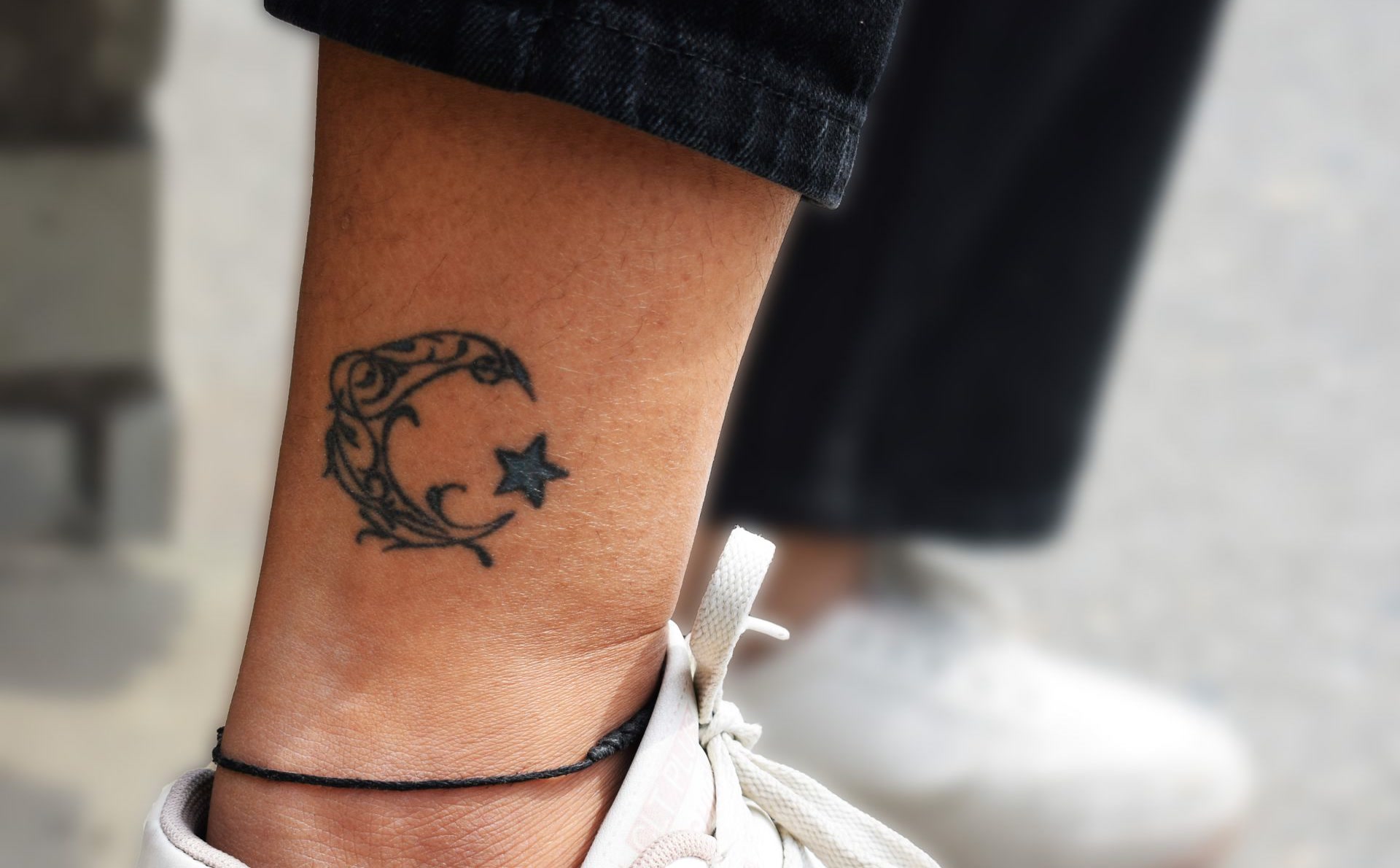
The ankle is the hardest small canvas in tattooing, and the easiest to get wrong. It is a joint that bends a hundred times a day, a patch of skin stretched tight over bone and tendon, rubbed by socks and shoes, and seen from every angle — and yet the tattoos that work there are some of the most elegant in the whole art form: a single crescent moon above the bone, a fine-line flower that follows the curve of the ankle, a tiny anchor that has sat in the same spot for twenty years. The problem is that most ankle tattoos are designed as if the ankle were a flat piece of paper. They are drawn too big, placed too low, or built from lines too fine to survive the friction of a shoe, and within a year they blur, fade, or look as if they are sliding off the foot. This guide fixes that. It explains how the ankle actually moves and heals, which designs work with the joint instead of against it, where exactly to place a piece for the best ageing, and how to look after it through the awkward first weeks when every step feels like a test.
In This Guide
Start with the anatomy of the ankle and why it challenges tattoo artists, then compare the designs that survive it, learn the placement rules, and finish with pain, healing and aftercare. For the closest comparison, read our guide to best rib cage tattoo designs, another spot where bone, movement and clothing all fight the tattoo, and for the flower that suits the ankle best, see rose tattoo on ankle.
Key Takeaways
- The ankle is bone, tendon and thin skin. There is almost no fat to cushion the needle, so the ankle hurts more than the forearm or calf, and the skin there is thin, tight and constantly moving.
- Small does not mean fine. The best ankle tattoos are small but bold: lines thick enough to survive shoe friction, shapes simple enough to read at a glance, and no detail smaller than a grain of rice.
- Placement is everything. A tattoo above the ankle bone ages far better than one wrapped around it, and a design that follows the line of the leg looks deliberate, while one that fights it looks lost.
- Shoes are the enemy of a fresh ankle tattoo. Tight shoes, socks and boots rub the healing skin for weeks, so the best time to get an ankle tattoo is when you can wear sandals or loose shoes for a fortnight.
- Ankle tattoos fade faster than most. Friction, sun, washing and the constant flexing of the joint all wear the ink down, so expect a touch-up after a few years and choose a design that can take one.
- The classics are classics for a reason. Anchors, moons, stars, small flowers and fine-line bands have worked on ankles for decades because their shapes suit the joint — start with them, then make the design your own.
Table of Contents
- The Ankle, Explained: Bone, Tendon and Thin Skin
- Designs That Work on the Ankle — and Designs That Do Not
- Placement Rules: Above, Around or Behind the Bone
- Size, Scale and Line Weight: The Numbers That Matter
- Pain and Healing: What the First Two Weeks Feel Like
- Styles That Suit the Ankle: Fine Line, Traditional, Blackwork
- Aftercare: Shoes, Socks, Sun and Swimming
- How Ankle Tattoos Age — and When to Get a Touch-Up
- Choosing an Artist for a Small, Difficult Spot
- Frequently Asked Questions
The Ankle, Explained: Bone, Tendon and Thin Skin
The ankle is a hinge joint with almost nothing between skin and bone. The two bony bumps you can feel on either side are the ends of the tibia and fibula — the medial and lateral malleoli — and between them run the tendons that lift and lower the foot, including the Achilles tendon at the back. As the anatomy of the ankle describes, the joint is built for movement, not for decoration: it flexes every time you walk, climb stairs or stand on tiptoe, and the skin over it stretches and folds with each movement. That matters for a tattoo because ink sits in the dermis, the layer of skin that moves with the joint — a design placed across a fold will stretch when the foot points and bunch when it flexes, and a line drawn on a bent ankle will look different when the foot is flat.
Thin skin changes everything about how ink behaves. The skin over the ankle bone is thin, tight and close to the bone, with very little fat underneath, which is why the structure of the foot makes ankle tattoos among the more painful small tattoos: the needle vibrates against bone, and there is no cushion to absorb it. Thin skin also holds ink differently. It takes fine detail well at first — which tempts artists into very delicate work — but it also sheds ink faster, because the skin is constantly rubbed by socks and shoes and because the top layers renew quickly. How skin is structured explains why: the dermis where tattoo ink sits is thinner over the ankle than over the calf or forearm, so the margin for error is smaller, and a needle that goes a fraction too deep will blow the line out, while one that goes too shallow will not hold.
The bone underneath is not flat, and the tattoo has to respect that. The ankle bone is a rounded, hard knob, and a design that wraps over the top of it will distort as the skin moves across the curve. That is why experienced artists treat the ankle bone as a landmark to design around, not over: the flat ground above the bone, the soft hollow behind it, and the straight run of the lower leg are the good canvases, while the peak of the bone itself is the place to avoid. The same principle applies to the heel bone, or calcaneus, at the back of the foot — a tattoo that sits on it will be rubbed by the heel of every shoe you own. Walk through any of these choices with your artist before the needle comes out: ask them to draw the design on with a pen while you stand, walk and point your toes, and look at it from every angle, because that is how the finished tattoo will be seen.
| Design type | Why it works on the ankle | What to watch out for |
|---|---|---|
| Small symbols | Moon, star, anchor, heart — simple shapes read instantly | Keep lines bold; tiny detail blurs fast |
| Small flowers | Petals follow the curve of the ankle naturally | Fine petals fade; choose a rose or daisy, not a peony |
| Fine-line bands | A thin band around the ankle looks like jewellery | A band must be perfectly level or it looks crooked |
| Small script | One word along the ankle bone is discreet and personal | Letters under 5 mm tall will blur into each other |
| Traditional flash | Bold black outlines and solid colour age best | Needs space; do not shrink a palm-sized design |
| Large portraits | Almost never — the ankle is too small and too curved | Faces, animals and landscapes belong on the calf |
Designs That Work on the Ankle — and Designs That Do Not
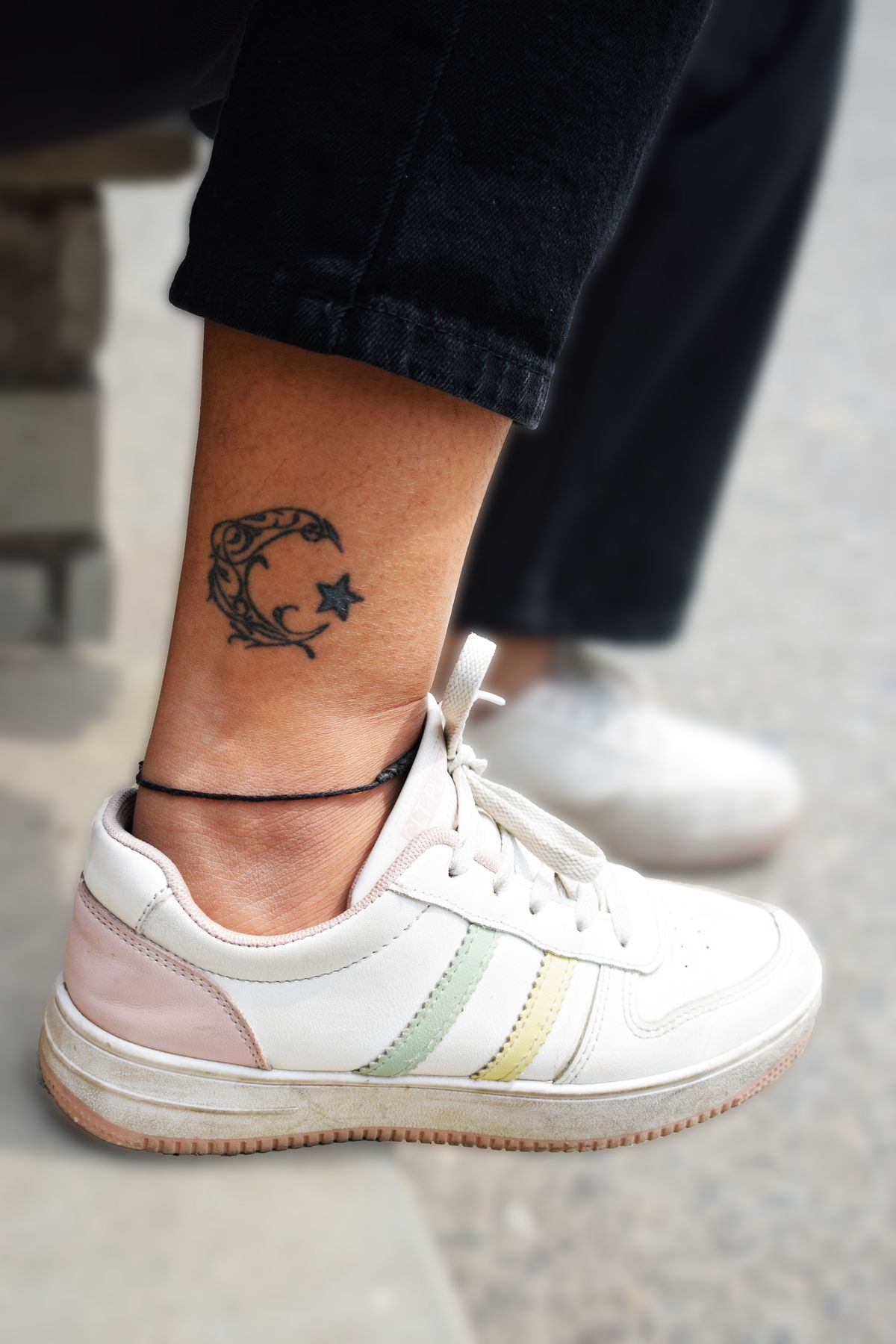
The moon, the star and the anchor are the ankle’s holy trinity. They have been ankle tattoos for generations because their shapes suit the spot: the crescent moon curves around the ankle bone, the star sits neatly in the hollow above it, and the anchor — the classic sailor tattoo — stands upright on the flat ground of the lower leg. A single crescent moon above the bone, like the one in the photograph above, is the safest first ankle tattoo there is: it is small, it is bold, it reads from across the room, and it will still read in ten years. Stars work the same way, alone or in a small scattered group, and a tiny heart or a simple cross has the same advantage — a shape the eye recognises instantly, drawn with lines thick enough to survive.
Small flowers work when the flower is drawn for the ankle, not shrunk from a bigger design. A rose is the best flower for the ankle, and our guide to rose tattoo on ankle shows why: the rose’s round, layered head sits naturally on the flat area above the bone, and a short stem can follow the line of the leg or trail towards the foot. Daisies, lavender sprigs and small cherry blossoms work the same way, especially in the fine-line style, as long as the petals are drawn large enough to hold — a petal thinner than a matchstick will blur into its neighbour within a year. What does not work is a flower designed for a shoulder or a thigh and simply shrunk: at ankle size the petals become a smudge, the leaves disappear, and the whole piece looks like a stain. Ask your artist to draw the flower at the size it will be tattooed, and if the drawing looks crowded on paper, it will look worse on skin.
Bands, chains and anklets are jewellery first and tattoos second. A fine-line band around the ankle, a delicate chain, or a row of tiny dots can look beautiful, but a band has to be drawn perfectly level while you are standing, because the ankle is not a cylinder — it is wider at the bone and narrower above it, so a band that is level on paper can slope on skin. The other risk is that a band crosses the ankle bone, where the skin moves most, and the line will break or blur there first. The safest bands sit entirely above the bone, on the flat of the lower leg, or entirely below it, on the foot. Script has the same rule: a single word in a clean, simple font, placed along the ankle or up the back of the leg, can be lovely, but letters smaller than about five millimetres will merge as the ink spreads with age. If the word matters to you, make it big enough to read from a metre away, and choose a font with open, uncluttered letters.
Placement Rules: Above, Around or Behind the Bone
Above the bone is the safest ground on the ankle. The flat stretch of the lower leg just above the ankle bone — the last few centimetres before the leg meets the foot — is the best place for a small ankle tattoo. The skin there is flatter, it moves less than the skin over the joint, and it sits clear of most shoe lines, so the tattoo is not rubbed every time you walk. A moon, a star, a small flower or a word placed here will age better than the same design placed anywhere else on the ankle, and it is visible in sandals, trainers and bare feet alike. This is also the spot that photographs best, because it sits on a straight, uncluttered run of skin rather than on a curve. When in doubt, go higher: a tattoo that starts two finger-widths above the ankle bone and runs up the leg will always look more deliberate than one crowded onto the bone itself.
Around the bone is for bands only, and only with care. A design that wraps around the ankle — a band, a chain, a vine — has to cross the bony bumps on both sides, and those are the points where the skin is tightest and moves most. If the band is drawn while you are sitting with the foot relaxed, it will look crooked when you stand; if it is drawn while you stand, it will bunch when you sit. The solution is to have the artist draw it while you stand, walk a few steps, and stand again, and to keep the band thin and simple so that any slight unevenness reads as part of the design rather than as a mistake. The same caution applies to designs on the front of the ankle, over the tendons that lift the foot: the tendons stand out when you point your toes, and a design drawn across them will distort. The back of the ankle, around the Achilles tendon, is softer ground — a small design there is hidden by most shoes and revealed by sandals, which suits people who want a tattoo they can show or hide at will.
The top of the foot is a different canvas altogether. Many ankle tattoos extend onto the top of the foot, and that changes the rules again: the skin on the top of the foot is thin and close to the bones of the toes, it swells when you stand for a long time, and it is rubbed by the top of every shoe. A small flower or a trailing vine on the top of the foot can be beautiful — our guide to henna tattoo designs for feet shows how the same area is decorated in henna, where the temporary stain forgives the friction that a permanent tattoo cannot — but a permanent design there needs bold lines and simple shapes, and it will fade faster than the same design above the ankle. Think of the ankle and the foot as two different placements, and design for each one separately, rather than letting a design spill from one onto the other by accident.
Size, Scale and Line Weight: The Numbers That Matter
Think in centimetres, not in feelings. A good ankle tattoo is usually between three and seven centimetres across — big enough to read at a glance, small enough to sit on the flat ground above the bone. Below three centimetres, even a simple symbol becomes a blur within a few years, because tattoo ink spreads slightly under the skin over time, and at that scale there is nowhere for it to spread to. Above seven centimetres, the design starts to wrap around the curve of the leg and the ankle, and it stops looking like an ankle tattoo and starts looking like a leg tattoo that ran out of room. The sweet spot for a first ankle tattoo is four to five centimetres: a moon, a flower or an anchor at that size has room to breathe, and the artist has room to draw lines that will hold.
Line weight is the difference between a tattoo that lasts and one that does not. Fine-line tattoos — lines thinner than a millimetre — look exquisite on the ankle when they are fresh, and they are the style most often shown on social media, but on the ankle they are the most fragile choice of all: the friction of shoes, the flexing of the joint and the thin skin all work against them, and a fine line on the ankle will often need a touch-up within two years. A line of one to two millimetres, by contrast, will hold its shape for years, and a bold traditional outline of two to three millimetres will hold for a decade. That does not mean every ankle tattoo must be bold — it means the design should be drawn with its future in mind. If you love fine line, choose a design with a little more space between the lines, a little less detail, and a willingness to return for a touch-up. For a comparison with a placement where fine line lasts longer, see our guide to best rib cage tattoo designs, where the skin is flatter and less rubbed.

Pain and Healing: What the First Two Weeks Feel Like
The ankle hurts more than its size suggests. On most pain charts the ankle sits in the upper half — not the worst spot on the body, but noticeably worse than the forearm, calf or shoulder, and the reason is the bone. With almost no fat to cushion the needle, every pass vibrates against the malleoli, and the thin skin over the tendons is sensitive in a way that surprises first-timers. The good news is that an ankle tattoo is small, so the pain is short: a simple moon or star takes fifteen to thirty minutes, and even a detailed small flower is usually done within the hour. The pain also comes in waves — sharpest over the bone itself, duller on the flat ground above it — so if you can breathe through the passes over the bone, the rest is manageable. Eat before your appointment, bring water, and do not arrive hungover or sleep-deprived, because both make pain worse.
Healing is awkward because you cannot rest an ankle. A new tattoo needs to stay clean, dry and undisturbed while the skin repairs itself, and the ankle is a joint you use with every step. How wounds heal explains the process: the skin first seals itself, then sheds the damaged top layer, then rebuilds — and for a tattoo that takes about two weeks on the surface and longer underneath. On the ankle, the first three days are the hardest: the area swells slightly, the skin feels tight, and every shoe feels like it is rubbing the wrong place. Wear loose, open shoes or sandals if you can, and if you must wear closed shoes, choose the loosest pair you own and a clean, thin sock that does not stick to the tattoo. Wash the tattoo gently with lukewarm water and fragrance-free soap, pat it dry, and apply a thin layer of the aftercare balm your artist recommends — never a thick layer, which traps moisture and slows healing.
Expect scabbing, flaking and a dull phase, and do not pick at it. Around day four or five the tattoo will start to flake, like a mild sunburn, and the colours will look dull and cloudy underneath — this is normal, and it is not the tattoo fading. The flakes are the top layer of skin coming away, and the ink underneath will brighten again once the skin has settled, usually by the end of the second week. Picking at flakes or scabs pulls ink out with them and leaves pale patches, so let them come away on their own, and keep the tattoo moisturised but not wet. If the skin becomes very red, hot, swollen or painful after the third day, or if you see pus or red streaks, see a doctor: Mayo Clinic’s guide to tattoo risks lists the signs of infection to watch for, and an infected ankle tattoo needs treatment quickly because the joint moves so much. Most ankle tattoos, though, heal without drama — they just demand more patience than a tattoo on a spot you can leave alone.
Styles That Suit the Ankle: Fine Line, Traditional, Blackwork
Fine line is the ankle’s most photographed style — and its most demanding. A single-needle flower, a delicate constellation, a tiny animal drawn in one continuous line: these look exquisite on the ankle, and they suit the spot’s elegance. But fine line on the ankle is a trade: you get delicacy now, and you accept a touch-up sooner, because the lines are thin, the skin is thin, and the friction is constant. If you choose fine line, choose an artist who specialises in it, ask to see healed photographs (not just fresh ones), and choose a design with generous spacing between the lines. A fine-line rose with petals that touch each other will become a blob; the same rose with space between the petals will stay a rose. Our guide to Japanese tattoo flowers shows how floral designs are built to hold their shape, and the same principles — bold centres, clear outlines, space between elements — apply here.
American traditional is the ankle’s toughest style. Bold black outlines, solid colour, simple shapes: the American traditional style was built for sailors, soldiers and working people whose tattoos had to survive sun, sea and hard work, and it survives the ankle for the same reasons. A traditional anchor, swallow, rose or dagger on the ankle will look almost as good in ten years as it does on the day, because the thick outlines hold the colour in and the simple shapes have nothing to blur into. The style also suits the ankle’s history: the anchor in particular has been an ankle tattoo since the days when sailors wore it to mark a crossing, and a traditional anchor above the bone is a design with a century of proof behind it. If you want a tattoo you will never have to think about again, traditional is the answer.
Blackwork and dotwork suit the ankle when they are kept simple. A solid black band, a small black flower, a geometric pattern in dots: blackwork reads beautifully on the ankle because the contrast with the skin is so strong, and a small black design can be the most striking thing in the room. The risk is the same as with fine line in reverse — a solid black shape that is too small will heal as a blob, and a dotwork pattern with dots too close together will merge. Keep blackwork shapes simple, keep dotwork dots spaced, and let the ankle’s curve work for you: a black band that follows the line of the leg, or a small black moon that echoes the curve of the bone, will look as if it belongs there. For a bolder, more decorative approach, the floral work in Japanese koi tattoo designs shows how black outlines and solid colour can carry a whole composition — scaled down, the same thinking makes a strong ankle piece.
Aftercare: Shoes, Socks, Sun and Swimming
Your shoes are the aftercare. For the first two weeks, the single most important decision is what you put on your feet. Sandals and loose trainers are ideal; tight boots, high heels and stiff leather shoes are the worst, because they press and rub exactly where the tattoo is healing. If you must wear boots for work, wear the loosest pair you have, put a clean, thin, non-stick covering over the tattoo if your artist advises it, and take the boots off as soon as you can. Socks should be clean, thin and changed daily — a dirty sock is an infection risk, and a sock that sticks to a healing tattoo will pull flakes off when you take it off. After the first two weeks, when the surface has healed, normal shoes are fine, but the tattoo will always prefer shoes that do not rub it: a tattoo that sits exactly where your shoe’s heel counter presses will fade faster than one that sits clear of it, so note where your shoes rub before you choose the placement.
Sun, water and exercise all have rules. Keep the tattoo out of direct sun for at least two weeks, and after that use sunscreen on it every time it will be exposed: ultraviolet light breaks down tattoo ink, and the ankle, which is often bare in summer, gets more sun than most placements. Do not swim, soak in a bath, or use a hot tub for two weeks, because soaking softens the healing skin and invites infection — a quick shower is fine, a long soak is not. Exercise is usually fine after a few days, but running, cycling and anything that makes the ankle sweat heavily should wait until the surface has healed, and anything that rubs the ankle — ski boots, hiking boots, tight football boots — should wait longer. The health effects of tattoos are mostly about infection and allergy, and almost all of the risk in the first fortnight comes from exactly these everyday things: water, friction and sun. Get those three right and the rest of the healing usually takes care of itself.
How Ankle Tattoos Age — and When to Get a Touch-Up
An ankle tattoo ages faster than a tattoo on the arm, and you should plan for it. The combination of friction, sun, washing and constant flexing means the ink spreads and fades sooner: a fine-line ankle tattoo may need a touch-up after two to three years, a bold traditional piece after five to eight, and a blackwork piece somewhere in between. That is not a failure — it is the nature of the placement, and the same is true of every tattoo on a joint or a high-friction spot. The history of tattooing is full of designs that were built to be reworked: sailors had their anchors and swallows touched up in every port, and the designs that survived were the ones simple enough to be redrawn. Choose a design that can be touched up — one with clear shapes, bold outlines and room between the elements — and a touch-up will make it look new again, rather than turning it into a heavier, darker version of itself.
Watch for the signs that a touch-up is due. Lines that have gone soft and grey at the edges, colour that has faded to a pale shadow of itself, a small flower whose petals have merged into one shape: these are the moments to book a touch-up, not to wait another year and hope it improves. A good artist will be honest about what a touch-up can and cannot do — it can sharpen lines and refresh colour, but it cannot rescue a design that was too small or too detailed to begin with, and it cannot make a blurred portrait sharp again. If your tattoo has reached that point, the honest options are a cover-up, a rework that simplifies the design, or removal. Most ankle tattoos never get there, because their owners chose simple designs in the first place. The lesson is the same one this whole guide has been making: on the ankle, simplicity is not a compromise, it is the design.
Choosing an Artist for a Small, Difficult Spot
Small tattoos are not easy tattoos, and the ankle proves it. A large tattoo forgives a wobble; a four-centimetre tattoo does not, and the ankle’s curves and bone make every line harder than it looks. Choose an artist who shows healed photographs of small tattoos — not just fresh ones, which always look perfect — and who has done ankle tattoos before. Ask how they would place the design: if they suggest a spot you had not considered, listen, because they are thinking about how the skin moves; if they agree to anything you suggest without a second thought, be cautious. A good artist will draw the design on your ankle with a pen, ask you to stand and walk, and adjust it until it looks right from every angle. They will also tell you honestly when a design is too detailed for the size, and suggest a simpler version rather than tattooing something they know will blur.
Price and timing are part of the choice. A small ankle tattoo is often priced at the studio’s minimum, and it is usually done in a single short session, but do not choose an artist by price alone: the cheapest ankle tattoo is often the one you pay to fix. Book a consultation if the design matters to you, bring reference photographs of healed ankle tattoos (not just fresh ones), and be ready to wait for the right artist rather than taking the first available slot. And remember that the ankle is a visible placement in summer and a hidden one in winter — if your workplace or family would object, think about whether the design will show in the shoes you actually wear. A design above the bone shows in sandals and trainers; a design behind the bone hides in almost everything. That choice, like the design itself, is yours to make, and it is worth making deliberately. For more on how meaning and placement interact, see our guide to Japanese tattoo meanings and our overview of cherry blossom tattoo meaning, where small, simple motifs carry a whole philosophy.

Our View
The best ankle tattoo is the one you design for the ankle, not the one you shrink to fit it. Keep it small but bold, put it above the bone, give it room to breathe, and accept that it will need a touch-up sooner than a tattoo on your arm. Do that, and the ankle will reward you with one of the most elegant tattoos you can own — a small piece that looks as if it has always belonged there. — The Tattoo Designs Pictures Team
Frequently Asked Questions
Do ankle tattoos hurt more than other tattoos?
Yes, more than most small tattoos. The skin over the ankle bone is thin and close to the bone, with almost no fat to cushion the needle, so the passes over the bone itself are sharp. The pain is short, though — most ankle tattoos take under an hour.
How long does an ankle tattoo take to heal?
About two weeks for the surface to heal and longer underneath. The first three days are the hardest, because every step moves the joint. Wear loose, open shoes, keep the tattoo clean and dry, and do not swim or soak it for two weeks.
What is the best placement for an ankle tattoo?
Just above the ankle bone, on the flat of the lower leg. The skin there is flatter, moves less and sits clear of most shoe lines, so the tattoo ages better than one placed on or around the bone itself.
Do ankle tattoos fade fast?
Faster than tattoos on the arm or calf, yes. Friction from shoes and socks, sun, washing and the constant flexing of the joint all wear the ink down. Fine-line designs may need a touch-up after two to three years; bold traditional designs last five to eight years or more.
Can I wear shoes after getting an ankle tattoo?
You can, but choose loose, open shoes or sandals for the first two weeks. Tight boots and stiff shoes rub the healing tattoo and can pull off flakes, taking ink with them. If you must wear closed shoes, pick the loosest pair you own and a clean, thin sock.
What size should an ankle tattoo be?
Usually three to seven centimetres across, with four to five centimetres the sweet spot for a first ankle tattoo. Below three centimetres, even a simple symbol blurs within a few years; above seven, the design wraps around the leg and stops looking like an ankle tattoo.
Questions About Your Design?
If you are choosing an ankle design, wondering about placement, or comparing the ankle with another spot, we are happy to help. Visit our home page to browse the full collection of tattoo guides, or start with our guide to rose tattoo on ankle.
Sources
- Ankle — Wikipedia
- Tattoo — Wikipedia
- History of Tattooing — Wikipedia
- Health Effects of Tattoos — Wikipedia
- Tattoos: Understand Risks and Precautions — Mayo Clinic
- Foot — Wikipedia
- Achilles Tendon — Wikipedia
- Calcaneus — Wikipedia
- Skin — Wikipedia
- Wound Healing — Wikipedia
- Sailor Tattoos — Wikipedia
- American Traditional — Wikipedia