Moroccan henna is easy to recognise once you know what to look for: straight lines, diamonds, triangles, and open space, instead of dense flowers and filled-in patterns. Where other henna traditions fill the hand with intricate floral work, the Moroccan style, and especially the Fassi style from the city of Fez, leaves skin showing between bold geometric shapes. That restraint is the point. The design is not trying to cover the hand; it is trying to draw a clear, protective pattern on it. This guide explains the geometry, the lines, and the Fassi style, the meanings behind the symbols, how Moroccan henna is used at weddings and life events, and how to choose a design that is genuinely Moroccan rather than a generic floral pattern.
In This Guide
- What Makes Moroccan Henna Different
- The Fassi Style and the City of Fez
- Geometry, Lines and Symbols
- Henna in Moroccan Weddings and Life Events
- The Plant, the Paste and the Stain
- Designs That Work: Hands, Feet and Arms
- Safety, Black Henna and Aftercare
- How to Choose an Artist and a Design
- Frequently Asked Questions
Key Takeaways
- Moroccan henna is geometric and abstract: diamonds, triangles, straight lines, lattice work, and bold bands, with open skin showing between the shapes.
- The Fassi style, from Fez, is the most distinctive Moroccan style: strong, simple, geometric patterns, often in bands across the hand and forearm.
- Moroccan designs are often protective and symbolic, with shapes that are traditionally believed to ward off the evil eye and bring good fortune, fertility, and protection.
- Arabic henna, by contrast, uses bold floral designs and open space, while Indian mehndi fills the hand with dense floral and paisley work. The three traditions are different, and the difference matters.
- Henna is a temporary stain from the henna plant, not a permanent tattoo, and it lasts one to three weeks on the skin.
- Never use black henna. It contains a chemical that can cause severe allergic reactions and scarring, and it is not traditional Moroccan henna.
Table of Contents
- What Makes Moroccan Henna Different
- The Fassi Style and the City of Fez
- Geometry, Lines and Symbols
- Henna in Moroccan Weddings and Life Events
- The Plant, the Paste and the Stain
- Designs That Work: Hands, Feet and Arms
- Safety, Black Henna and Aftercare
- How to Choose an Artist and a Design
- Our View
- Frequently Asked Questions
- Sources
- Recommended
What Makes Moroccan Henna Different
Henna is a dye made from the leaves of the henna plant, and it has been used for thousands of years across North Africa, the Middle East, and South Asia to stain skin, hair, and nails a reddish-brown colour. In Morocco, henna is part of everyday life and of celebration, and the Moroccan way of applying it is distinct. It is not a lesser version of Indian mehndi, and it is not the same as Arabic henna. It is a tradition with its own logic, its own shapes, and its own history, shaped by the Amazigh, or Berber, peoples of North Africa and by the Arab and Islamic cultures that came later.
The clearest difference is the amount of open space. Moroccan designs leave a lot of skin visible. A typical Moroccan hand design might have a band of diamonds across the wrist, a lattice on the back of the hand, and lines running down the fingers, with bare skin between each element. The Arabic henna designs guide on this site covers the Gulf tradition, which also uses open space, but with bold, flowing florals and large, open flowers rather than geometry. Arabic henna is floral and free-flowing; Moroccan henna is geometric and structured. That is the distinction to keep in mind when you are choosing a design or an artist.
Indian mehndi, by contrast, is dense. It fills the hand and forearm with fine, detailed floral and paisley patterns, with very little skin showing. That density is beautiful, and it is the right choice for a South Asian bridal design, but it is not Moroccan. If you ask a Moroccan artist for a Moroccan design and you are shown a dense, filled-in floral pattern, you are being shown an Indian design, not a Moroccan one. A dense, filled-in hand, shown later in this guide, is a useful contrast: the work is skilled and beautiful, but the coverage is the opposite of the Moroccan approach, which would leave the palm open and use a few bold shapes instead.
| Tradition | Main shapes | Coverage | Typical use |
|---|---|---|---|
| Moroccan, Fassi style | Diamonds, triangles, lines, lattice | Open, with skin showing | Weddings, protection, daily wear |
| Arabic, Gulf style | Bold florals, leaves, open flowers | Open, with large motifs | Weddings, celebrations |
| Indian mehndi | Fine florals, paisley, peacocks | Dense, filled in | Bridal, festivals |
| Berber, Amazigh | Geometric symbols, dots, lines | Open, symbolic | Protection, identity, ritual |
The table above is a simplification, and real designs often borrow from more than one tradition, especially in cities and in the diaspora. But it is a useful starting point, and it will help you recognise a genuinely Moroccan design when you see one. Look for straight lines, for diamonds, and for space. If the design is all curves and flowers, it may be beautiful, but it is probably not Moroccan.

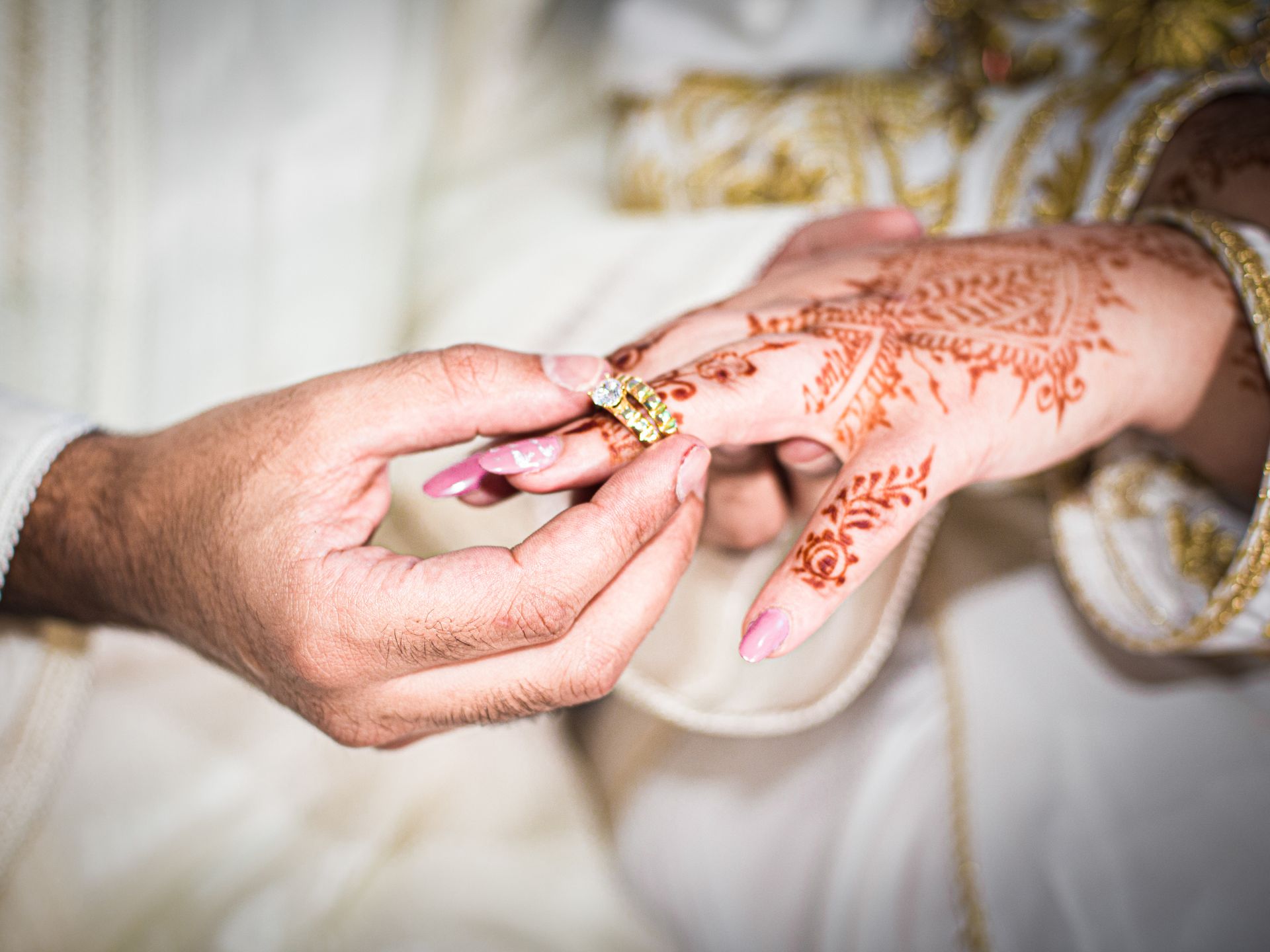
The photo above shows henna in its most important Moroccan context: a wedding. The woman’s hand is decorated with henna, and a ring is being placed on her finger. The henna is reddish-brown, the patterns are clear and open, and the design is part of a larger celebration, not a standalone fashion statement. That context matters, because Moroccan henna is not only decoration; it is part of a ritual, and the design is chosen for its meaning as well as for its beauty.
The Fassi Style and the City of Fez
Fez, or Fes, is one of the oldest cities in Morocco, and it is the home of the Fassi style of henna. Fez is known for its old medina, its tanneries, its ceramics, and its crafts, and its henna is part of that craft tradition. The Fassi style is characterised by strong, simple, geometric patterns, often applied in bands across the hand and forearm, with diamonds and triangles as the main motifs. It is a style that is easy to recognise and hard to copy well, because its simplicity leaves no room for a wobbly line.
The Fassi style is also associated with a particular way of applying henna. Traditionally, the paste is applied with a stick or a syringe-like applicator, rather than with a fine cone, which gives the lines a bolder, more graphic quality. Modern artists often use a cone, but a good Fassi design should still look bold and graphic, not fine and fussy. If you are looking for a Fassi design, ask the artist specifically for Fassi work, and look at their portfolio for geometric designs, not for floral ones. A portfolio that is all flowers is not a Fassi portfolio.
Fez is not the only place in Morocco with a henna tradition. Marrakesh, in the south, has its own style, and the Amazigh communities of the Atlas Mountains and the Sahara have their own geometric traditions as well. The Fassi style is the most famous, and it is the best starting point, but it is worth knowing that Moroccan henna is not a single, uniform style. It varies by region, by community, and by occasion, and a good artist will be able to tell you where their style comes from.
The diagram above shows the basic Fassi vocabulary: diamonds, straight lines, and dots. A real design will combine these elements into bands, lattices, and larger patterns, but the building blocks are simple. That simplicity is the strength of the style. A diamond is easy to draw badly and hard to draw well, and a Fassi artist’s skill shows in the straightness of the lines and the evenness of the shapes.
Geometry, Lines and Symbols
Geometry is not only decoration in Moroccan henna; it is a language. Islamic geometric patterns, which are found in Moroccan architecture, tilework, and textiles, use the same shapes as Moroccan henna: stars, diamonds, triangles, and repeating lattices. Those patterns are built on mathematics, and they are meant to suggest order, infinity, and the divine. When the same shapes appear on skin, they carry some of that meaning with them, even in a simple, everyday design.
The Berbers, or Amazigh peoples, have their own geometric tradition, which predates the Arab arrival in North Africa. Amazigh symbols include diamonds, triangles, dots, and lines, and they are found in tattoos, in jewellery, in textiles, and in henna. Many of those symbols are protective: they are believed to ward off the evil eye, to bring fertility, or to mark identity and belonging. A diamond can represent a woman, a triangle can represent a mountain or a tent, and a line of dots can represent a path or a journey. Those meanings are not universal, and they vary by community, so ask your artist what a particular symbol means to them, rather than assuming a single, fixed meaning.
The culture of Morocco is a blend of Amazigh, Arab, and Islamic influences, and Moroccan henna reflects that blend. A design might combine an Amazigh diamond with an Islamic lattice, or a Fassi band with a floral element borrowed from Arabic henna. That blending is normal, and it is part of what makes Moroccan henna interesting. The key is to understand which elements are geometric and which are floral, and to keep the geometric elements dominant if you want a Moroccan design, rather than letting the floral elements take over.
Henna in Moroccan Weddings and Life Events
Henna in Morocco is most closely associated with weddings, and the wedding henna ritual is a multi-day celebration in itself. The bride’s hands and feet are decorated, often by an older woman or by a professional henna artist, and the designs are meant to bring good luck, fertility, and protection to the marriage. The groom may also have henna applied, usually in a simpler pattern on the hands. The henna bridal designs guide on this site covers bridal henna across traditions, and the Moroccan wedding is one of the most elaborate examples: the henna night, or the night of henna, is a party in its own right, with music, food, and family, and the henna is applied as part of that celebration, not as a last-minute decoration.
Henna is also used at other life events in Morocco: at births, at circumcisions, at Eid celebrations, and as a regular beauty treatment. UNESCO lists henna rituals as part of the intangible cultural heritage of humanity, and Morocco is one of the countries that submitted the nomination, which was inscribed in 2024. UNESCO describes henna as a symbol of joy, used in everyday life and on festive occasions such as births and weddings, and as a practice that is perceived as sacred by communities in Northern Africa and the Middle East. That recognition is a reminder that Moroccan henna is not only a fashion trend; it is a living tradition, and it should be treated with respect.
The protective meaning of henna is important in Moroccan culture. Henna is traditionally believed to ward off the evil eye and to protect the wearer, especially at vulnerable moments such as a wedding or a birth. That is why the designs are often applied to the hands and feet, which are the parts of the body that are most exposed and most active. A design that is meant to protect should be bold and clear, not hidden or apologetic. That is another reason Moroccan designs use strong lines and clear shapes: they are meant to be seen, and they are meant to work.
The Plant, the Paste and the Stain
Henna comes from Lawsonia inermis, a flowering plant that grows in hot, dry regions. The leaves are dried, ground into a fine powder, and mixed with water, lemon juice, and essential oils to make a paste. That paste is applied to the skin, left to dry, and then removed, leaving a stain that darkens over the next day or two to a reddish-brown colour. The stain is temporary: it lasts one to three weeks, depending on the skin, the placement, and how well it is cared for. Hands and feet stain darkest, because the skin there is thicker, while the arms and other areas stain lighter.
A good henna paste is simple: henna powder, water, lemon juice, and a safe essential oil such as lavender or tea tree. It should not contain black hair dye, PPD, or any chemical that makes it black. Natural henna is never black; it is reddish-brown. If a paste is black, or if it stains black immediately, it is not natural henna, and it should not be used on skin. The Mayo Clinic guide to tattoos explains the risks of skin decoration in general, including allergic reactions, and those risks are especially relevant for henna, because a chemical reaction on the hands can be painful and can leave a scar.
Henna is different from a permanent tattoo in an important way: it does not break the skin. The dye stains the outer layers of skin, and it fades as those layers are shed. That makes it a good way to try out a design before committing to a permanent tattoo, and it is why many people use henna to test a motif, a placement, or a size. If you are considering a permanent geometric tattoo, try the design in henna first, and live with it for a week or two before you book a tattoo appointment.
Designs That Work: Hands, Feet and Arms
The hands are the classic canvas for Moroccan henna, and they are the best place to start. A Fassi hand design usually has a band across the wrist, a lattice or a diamond on the back of the hand, and lines down the fingers, with the fingertips stained solid. That last detail, solid fingertips, is a distinctive Moroccan and North African feature, and it is worth asking for if you want an authentic look. The henna tattoo arm designs guide on this site covers how henna can be extended from the hand up the arm, and a Moroccan arm design can be a continuation of the hand design, with bands and diamonds running up the forearm.

The photo above shows a dense, filled-in style, with the palms covered in intricate patterns. That work is skilled and beautiful, but the coverage is the opposite of the Moroccan approach. A Moroccan palm would usually be left mostly open, with a single diamond or a small lattice in the centre, rather than a filled-in pattern. Use the photo as a contrast: if you want a Moroccan design, ask for open space, and do not let the artist fill in every part of the hand.
Feet are the second classic canvas, especially for brides. A Moroccan foot design is similar to a hand design, with bands around the ankle, a lattice on the top of the foot, and lines on the toes. Feet stain darker than hands, and the design lasts longer there, because the skin is thicker and is less exposed to washing. Arms are a good canvas for a larger Moroccan design, with bands and diamonds running up the forearm, and they are a good place to try a design before committing to a permanent tattoo on the same placement. The best shoulder blade tattoo designs, the best rib cage tattoo designs, and the best sternum tattoo designs guides on this site all show placements where a temporary henna trial can help you decide on size and symmetry before you get a permanent piece.

The hand in the photo above shows a mix of floral bands and geometric elements, including a diamond lattice on the fingers. That lattice is the Moroccan element in the design, and it is the part to ask for if you want a Moroccan look. The floral bands around the wrist are a more general henna element, and they can be replaced with a straight geometric band if you want a more strictly Moroccan design.
Safety, Black Henna and Aftercare
Safety is the most important part of any henna guide, because the risks are real and they are avoidable. Natural henna is generally safe for most people, but it can cause an allergic reaction in some people, especially if they have sensitive skin. Do a patch test before you have a full design applied, especially if you have never had henna before. Apply a small amount of paste to the inside of your arm, leave it for a few hours, and wait a day to see if there is any reaction. If there is redness, itching, or swelling, do not proceed.
Black henna is the main danger. The black henna tattoo guide on this site explains the risk in detail: black henna is not henna at all, but a paste that contains PPD, a chemical hair dye that can cause severe allergic reactions, blistering, and permanent scarring. It is often sold at tourist markets and at festivals, and it is often marketed as a way to get a darker, longer-lasting stain. Do not use it, and do not let anyone apply it to you or to your children. If a henna artist offers black henna, walk away. A reputable artist will only use natural, reddish-brown henna, and will be happy to show you the ingredients.
Aftercare for henna is simple, and the henna tattoo aftercare guide on this site covers it in detail. Keep the paste on for as long as you can, ideally several hours or overnight, and keep it warm. Do not wash the area with water for the first day, and avoid soap, chlorine, and exfoliation while the stain is developing. Once the stain has darkened, moisturise the skin regularly, and avoid scrubbing the area. A henna design that is cared for will last longer and will fade more evenly.
How to Choose an Artist and a Design
Choose an artist who understands Moroccan henna specifically, not just henna in general. Look at their portfolio for geometric designs, for Fassi bands, and for open space. Ask them where their style comes from, and whether they have worked with Moroccan designs before. A good artist will be able to tell you about the Fassi style, about the difference between Moroccan and Arabic henna, and about the meanings of the symbols they use. If an artist cannot tell you the difference, they may not be the right artist for a Moroccan design.
When you choose a design, start simple. A single band of diamonds across the wrist, a lattice on the back of the hand, and lines down the fingers is a classic Moroccan design, and it is a good starting point. You can add more elements later, but it is better to start with a clear, simple design than to start with a crowded one. Bring reference photos, but be prepared for the artist to adapt them to your hand, your skin, and the occasion. A design that works on a model with long fingers may need to be adapted for shorter fingers, and a design that works for a wedding may be too elaborate for everyday wear.
Finally, consider the occasion. A Moroccan henna design for a wedding should be more elaborate than a design for everyday wear, and a design for a festival can be bolder than a design for work. Think about how long you want the design to last, and how visible you want it to be. Henna is temporary, so you can experiment, and you can try a different style next time. That is one of its advantages over a permanent tattoo, and it is worth using.
Our View
Moroccan henna is at its best when it is bold and open. A few clear diamonds, a straight line, and a lot of skin showing will say more about Morocco than a hand full of flowers ever will. Choose the geometry, trust the open space, and let the Fassi style speak for itself.
Frequently Asked Questions
What is Moroccan henna?
Moroccan henna is a style of henna design from Morocco, characterised by geometric shapes such as diamonds, triangles, and lines, with open space between the shapes. The Fassi style from Fez is the most distinctive version of it.
How is Moroccan henna different from Arabic henna?
Moroccan henna is geometric and structured, while Arabic henna is floral and free-flowing. Both use open space, but Moroccan designs use diamonds and lines, while Arabic designs use large, bold flowers and leaves.
How long does Moroccan henna last?
Moroccan henna lasts one to three weeks, depending on the placement, the skin, and aftercare. Hands and feet stain darkest and last longest, while arms and other areas fade faster.
Is Moroccan henna safe?
Natural henna is generally safe for most people, but it can cause an allergic reaction in some people. Do a patch test first, and never use black henna, which contains a chemical that can cause severe reactions and scarring.
What does a diamond mean in Moroccan henna?
A diamond is a common Amazigh and Moroccan symbol, and it is often associated with women, fertility, and protection. Meanings vary by community, so ask your artist what a particular symbol means to them.
Can I get Moroccan henna if I am not Moroccan?
Yes, henna is a shared tradition across North Africa and the Middle East, and Moroccan henna is widely practised and appreciated. Treat it with respect, choose an artist who understands the tradition, and do not claim a design as your own cultural heritage if it is not.
Questions about this guide? Visit the Tattoo Designs Pictures home page to browse more tattoo designs, placements, and meanings.
Sources
- Henna – Wikipedia, on henna, its history, and its use in Morocco.
- Mehndi – Wikipedia, on mehndi and its traditions.
- Lawsonia inermis – Wikipedia, on the henna plant.
- Morocco – Wikipedia, on the country and its history.
- Berbers – Wikipedia, on the Amazigh peoples of North Africa.
- Fez, Morocco – Wikipedia, on the city of Fez and the Fassi style.
- Islamic geometric patterns – Wikipedia, on geometric patterns in Islamic art.
- Culture of Morocco – Wikipedia, on Moroccan culture.
- Henna: rituals, aesthetic and social practices – UNESCO, on henna as intangible cultural heritage, inscribed in 2024.
- Tattoo – Wikipedia, on permanent tattoos and how they differ from henna.
- Tattoos: Understand risks and precautions – Mayo Clinic, on skin decoration risks and precautions.
- Marrakesh – Wikipedia, on the city of Marrakesh and its henna tradition.