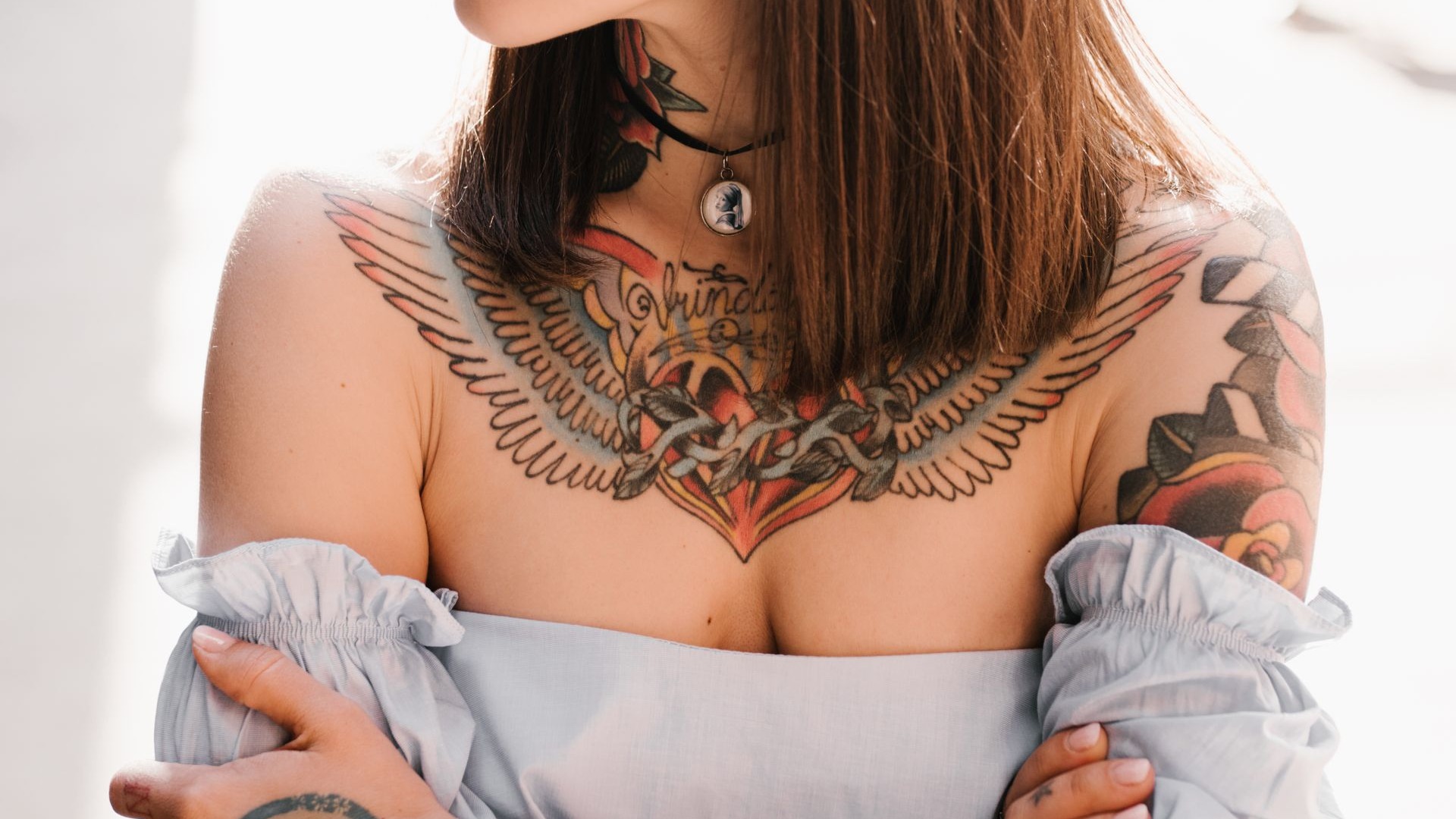
A chest tattoo is one of the most visible commitments a woman can make to a design, and one of the most personal. It sits close to the heart, it moves with every breath, and it is seen in full only by the people you choose to show it to. That combination of intimacy and impact is exactly why chest pieces are so popular, and exactly why they deserve more planning than a smaller, flatter placement. This guide walks through the best chest tattoo designs for women, placement by placement, so you can choose a design that fits your body, your wardrobe, your work, and the way you want the tattoo to age.
The chest is not one flat canvas. It is a curved, moving surface made of bone, muscle, soft tissue, and skin that stretches, and each part of it behaves differently under the needle and over time. A tattoo is made by placing pigment into the dermis, the layer of skin below the surface, and the skin on the chest is thinner in some places and thicker in others, which is why the same design can heal beautifully in one spot and blur in another. The sternum, the long flat bone down the centre of the chest, gives a firm surface for fine vertical work, while the softer tissue to either side moves more and needs bolder lines. Understanding that geography before you book is the difference between a chest tattoo you love for decades and one you wish you had placed a few centimetres differently.

Related guide: If you are drawn to the centre line, start with our best sternum tattoo designs for women guide, which covers vertical centre-chest work in depth, including pain, healing, and designs that suit a narrow canvas.
Key Takeaways
- The chest is several placements in one: centre-chest, underbust, sternum-adjacent, collarbone-adjacent, and full-chest pieces each suit different designs.
- Symmetrical designs work best on the centre chest, while asymmetrical floral and fine-line work suits the collarbone and the side of the chest.
- Bold lines age better on soft, moving chest skin than very fine detail, especially under the bust and over the breast.
- Chest tattoos hurt more over bone, near the sternum and collarbone, and less over softer tissue, but pain is short-lived compared with a lifetime of wear.
- Bras, sports bras, and tight clothing rub a healing chest tattoo, so plan loose clothing and time off from underwire for the first weeks.
- Sun exposure fades chest tattoos faster than almost any other placement, so sunscreen and cover are part of the design, not an afterthought.
- A good artist will draw the design on your body, standing and sitting, before the needle touches skin, because the chest changes shape as you move.
Table of Contents
- How Chest Tattoos for Women Are Different
- Centre-Chest Designs: Symmetry and the Space Between
- Underbust Designs: The Hidden Canvas
- Sternum-Adjacent Designs: Working Beside the Centre Line
- Collarbone-Adjacent Designs: Delicate Work That Shows
- Full-Chest Pieces: When the Whole Chest Is the Design
- Sizing, Pain, and Healing on the Chest
- Clothing, Work, and Visibility
- Choosing an Artist and Avoiding Common Mistakes
- Our View
- Frequently Asked Questions
- Sources
- Recommended
How Chest Tattoos for Women Are Different
The first thing to understand is that a chest tattoo is a design for a moving, curved surface, not a flat sheet of paper. When you stand, sit, raise your arms, or lie down, the skin of the chest shifts, and a design that looks perfect in a mirror can warp when you move. A skilled artist accounts for this by stencilling the design while you are standing in a natural posture, then checking it again while you sit, because most of the time you will be seen sitting or standing, not lying flat on a tattoo bed. That is also why photographs of chest tattoos can be misleading: a design photographed straight on, with the model posed, tells you little about how it will look when you reach for a shelf or bend to tie a shoe.
The second difference is the mix of surfaces. The clavicle, or collarbone, is a thin bone close to the surface, and tattooing over it is sharp and bony. The sternum is similar, a firm ridge that gives crisp lines but little padding. The tissue over the breast is soft and moves with weight, age, and hormonal change, which means a design placed there needs room to stretch and lines thick enough to stay readable. The skin under the bust is warm, folded, and prone to friction, which makes healing slower. Each of these surfaces rewards a different style, and the comparison below is the quickest way to see which placement fits the design you have in mind.
| Chest placement | Best for | Pain level | Visibility | Ageing risk |
|---|---|---|---|---|
| Centre-chest | Symmetrical motifs, sun, mandala, small script | Medium to high | Shows with open necklines | Low if bold |
| Underbust | Ornamental bands, lace, floral arcs | Medium | Hidden most of the time | Medium, friction |
| Sternum-adjacent | Vertical florals, chains, fine line | High over bone | Shows with low necklines | Low |
| Collarbone-adjacent | Fine line, sprigs, small birds, script | High over bone | Often visible | Medium, sun exposure |
| Full-chest | Large floral, Japanese, ornamental panels | High, long sessions | Shows with open tops | Low if bold and large |
| Side of chest | Floral sprays, butterflies, flowing lines | Medium | Hidden or peeking | Medium, stretch |
The table makes one point clear: there is no single best chest tattoo, only a best match between a design and a spot. A fine-line sprig that looks delicate on the collarbone would disappear under the bust, where friction and moisture blur thin lines. A large, bold floral that fills the full chest would overwhelm the centre-chest space between the collarbones, where a smaller, symmetrical motif belongs. The best rib cage tattoo designs guide on this site makes a similar point about long, vertical placements, and the same logic applies here: let the shape of the body choose the shape of the design, rather than forcing a design onto a spot that does not suit it.
Stretch is the other factor women are rarely warned about honestly. The chest changes with weight gain and loss, with pregnancy and breastfeeding, and with age, and a tattoo placed over soft tissue will change with it. That does not mean you should avoid a chest tattoo if you plan to have children or if your weight fluctuates; it means you should choose a design that can stretch a little without losing its meaning. Bold, flowing designs with open space cope far better than dense, detailed work with tiny text, because a small distortion in a flowing floral is invisible, while a small distortion in a tiny word is obvious. The dermis, where the ink sits, is a living layer, and the Mayo Clinic guide to tattoos explains that tattoos are permanent precisely because the pigment is held in that layer, which also means the design will move as that layer moves over the years.
Finally, chest tattoos are intimate in a way that arm or leg tattoos are not. They are close to the heart, they are often chosen to mark a personal event, a loss, a recovery, or a belief, and they are revealed selectively. That intimacy is part of their appeal, and it is worth honouring in the design. A chest tattoo that means something to you will still mean something when the trend that inspired it has passed, while a design chosen only because it looked good on someone else may not. Take the time to choose a motif, a placement, and an artist that all feel right together, and the result will be a tattoo you are glad to carry.
Centre-Chest Designs: Symmetry and the Space Between
The centre of the chest, between the collarbones and above the bust, is the most naturally symmetrical spot on the body, and symmetrical designs belong there. A sun with rays spreading evenly, a mandala, a small moth or butterfly with its wings spread, a diamond or an eye, or a short line of script centred on the midline all work because the body itself is symmetrical there. The eye expects balance in that spot, and a design that is off-centre by even a few millimetres will look like a mistake, while a balanced design looks intentional and calm. That is why artists spend so long measuring this placement: they will mark the centre line, measure from each collarbone, and check the stencil from across the room before they start.
Size matters here more than in almost any other chest placement. The space between the collarbones is not large, and a design that is too big will crowd the neckline and look cramped, while a design that is too small will look lost. A good rule is to keep a centre-chest piece between about five and twelve centimetres wide for a first tattoo, and to let the artist scale the design to your frame rather than copying the size from a photograph of someone else. A rose tattoo on the chest shows how a single motif can fill this space without overwhelming it, and the same principle applies to a sun, a moon, or a small floral sprig: one clear motif, well placed, beats a crowded composition every time.
Motifs that suit the centre chest include the sun, which the first photograph in this guide shows, the moon and stars, a small mandala, a moth, a bee, a heart, a diamond, and short script. Script needs care here, because the chest curves and the skin moves, so long sentences will warp and tiny letters will blur. Keep any wording to a few words, in a clear font, with generous spacing between letters. If the words matter more than the image, consider placing the text slightly lower, where the skin is flatter, and keeping the image above it. The best collarbone tattoo designs guide on this site shows how a design can sit just above the centre chest and frame it, and the two placements work well together when they are planned as a pair rather than as two separate tattoos.
Healing a centre-chest tattoo is usually straightforward, because the area is flat, open to the air, and easy to wash and moisturise, but it is also one of the first places to catch the sun. A sunburn on a healing tattoo can damage the ink and slow healing, and the Cleveland Clinic tattoo aftercare guide advises keeping a new tattoo out of direct sun and away from water while it heals. Once healed, sunscreen is the single best thing you can do for a centre-chest tattoo, because an open neckline puts it in the sun every day. A design that is protected from the sun will stay sharp for years longer than one that is not.
Underbust Designs: The Hidden Canvas
Underbust tattoos sit in the fold beneath the breast, and they are the most private chest placement, visible mainly when you choose to show them. That privacy is their appeal: an ornamental band, a lace-like arc, a row of small flowers, or a mandala that peeks from beneath a bra line can feel like a secret, even when the design is large. Underbust work is almost always horizontal, following the natural curve of the underbust, and the best designs echo that curve rather than fighting it. A straight, rigid design will look wrong on a curved fold, while a design that arcs gently with the body will look as if it belongs there.
The practical challenge of an underbust tattoo is friction and moisture. The fold under the bust is warm and can sweat, and a bra, especially an underwire bra, will rub the healing tattoo for hours a day. That means healing takes longer and needs more care: loose, soft clothing, no underwire for at least two weeks, gentle washing, and patience with itching and flaking. The Cleveland Clinic tattoo aftercare guide stresses keeping a healing tattoo clean and dry, and that advice matters most in a fold, where moisture can linger. If you wear a sports bra for work or exercise, plan your tattoo for a time when you can take a break from tight support, or be ready to wear a soft, wireless bralette while it heals.
Designs that work under the bust include ornamental bands inspired by jewellery, with dots, lines, and small geometric shapes; floral arcs, where a stem curves along the fold and flowers open upward; mandalas centred under the sternum, with the pattern spreading sideways; and lace or filigree work, which looks delicate but needs bold enough lines to survive the friction. Fine, pale lines will blur here faster than anywhere else on the chest, so ask your artist to keep the line weight a little heavier than you think you need, and to leave open space between the elements so the design does not close up as it heals. A sternum tattoo that extends downward can meet an underbust piece in the middle, and when the two are planned together they can form a single, flowing composition rather than two tattoos that happen to be near each other.

One more thing to know about underbust tattoos is that they are often more painful than people expect, not because the skin is thin, but because the area is sensitive and the artist must work close to the ribs. The Cleveland Clinic tattoo pain chart places the chest and ribs among the more painful areas, and an underbust session can be long if the design is detailed. Bring water, eat beforehand, and tell your artist if you need a break. A good artist would rather pause for five minutes than have you tense up and move, because movement is what causes a line to wobble.
Sternum-Adjacent Designs: Working Beside the Centre Line
Sternum-adjacent designs sit just to one side of the centre line, or frame it, rather than sitting directly on the bone. This is a useful distinction, because a full sternum tattoo runs straight down the bone from the chest to the stomach, while a sternum-adjacent design might be a vertical floral stem that runs a few centimetres to the side, a chain that drapes from one collarbone to the other, or a small motif placed just above the bust, beside the sternum. These designs borrow the elegance of the sternum line without the pain and commitment of a full centre piece, and they suit women who want a vertical accent without a long, central tattoo.
The best sternum-adjacent designs are vertical and flowing: a stem with leaves and a flower at the top, a string of small stars or dots running down from the chest, a feather, a snake, or a vine that follows the line of the body. Because the area is narrow, the design needs to be simple, with one clear direction of travel, and the artist should draw it while you are standing so the line follows your posture. Our best sternum tattoo designs for women guide covers the full centre-line version in detail, including the ornamental mandalas and the fine-line florals that suit the bone itself, and it is worth reading alongside this section if you are deciding between a design on the bone and one beside it.
Pain beside the sternum is still high, because the skin is thin and the bone is close, but it is usually a little less intense than directly on the ridge, and the sessions are shorter because the designs are smaller. Healing is similar to a centre-chest tattoo: keep the area clean, avoid tight clothing that rubs the line, and protect it from the sun. The main risk is the same as with any fine-line work on thin skin, which is that the lines can spread over time if they are too close together. Ask your artist to leave a little more space between the lines than feels necessary on the day, because that space is what keeps the design readable in five years. The keloid page on Wikipedia is also worth a quick read before any chest tattoo, because chest skin is one of the places where raised scarring is more likely, and anyone with a history of keloids should discuss it with their artist and a doctor first.
Collarbone-Adjacent Designs: Delicate Work That Shows
Collarbone-adjacent tattoos are the most visible chest placement, and they are often the first chest tattoo a woman chooses. A small sprig, a bird in flight, a line of script, a tiny constellation, or a single flower placed just below or just above the collarbone can be seen with almost any top, and it frames the neck and shoulders in a way that feels elegant rather than bold. The collarbone is a natural line, and a design that follows it, rather than crossing it at a sharp angle, will look as if it was always meant to be there. Our best collarbone tattoo designs guide shows how fine-line sprigs, small birds, and delicate script sit on the bone, and the same ideas apply to the skin just beside it, where the surface is a little softer and the pain is a little lower.
The trade-off for that visibility is sun exposure and pain. The collarbone is close to the surface, with little fat over it, and tattooing directly on the bone is sharp and uncomfortable, especially near the centre where the bone is most prominent. Designs placed just below the bone, on the softer skin of the upper chest, hurt less and heal a little more easily, and they are often the better choice for a first tattoo. The Cleveland Clinic tattoo pain chart notes that bony areas tend to hurt more, and the collarbone is a classic example. If you are worried about pain, ask your artist to place the design a centimetre below the bone and to keep the session short.
Style matters here too. Fine line is the most popular style for the collarbone, because it suits the delicate area, but fine line also fades fastest in the sun, and the collarbone is in the sun whenever you wear an open neckline. That does not mean you should avoid fine line, but it does mean you should keep the design simple, avoid tiny text, and commit to sunscreen. A slightly bolder line, or a design with a little blackwork to anchor it, will last longer than a whisper-thin sprig, and it will still look delicate from a normal distance. The Japanese tattoo flowers guide on this site shows how a single cherry blossom or a small peony can work at a small scale, and a flower like that, placed beside the collarbone, can be a beautiful, lasting choice.
Full-Chest Pieces: When the Whole Chest Is the Design
A full-chest piece treats the entire chest as one canvas, from collarbone to underbust and from shoulder to shoulder, and it is the boldest choice in this guide. These pieces are usually large florals, Japanese-inspired panels with waves and flowers, ornamental work that frames the bust like a necklace, or a combination of a central motif with designs spreading to the shoulders. They need multiple sessions, a significant budget, and a high tolerance for pain, but they also give the artist the most room to create something that truly fits your body, because there is no wasted space and no awkward gap between separate tattoos.
Full-chest work suits women who already know they want a large tattoo and who have thought about how it will look with the clothes they wear every day. A full-chest floral, for example, will show with an open neckline, a swimsuit, or a low-cut dress, and it will be hidden by a crew neck or a high collar. That is a good balance for many women: the tattoo is there, it is large and beautiful, but it is not on show at work unless you choose to show it. The chrysanthemum tattoo meaning guide and the peony tattoo meaning guide on this site are good places to start if you are considering a large Japanese floral chest piece, because those flowers are the classic choices for a full chest, with meanings that suit a large, committed design.
Planning a full-chest piece starts with a consultation, not a booking. Bring reference images, talk about the flowers or motifs you love, and let the artist draw a design that follows your shoulders, your collarbones, and the curve of your bust. A good artist will draw the design on paper first, then stencil it on your body and photograph it from several angles, because a full-chest piece needs to look right from the front, from the side, and in a mirror. Expect the work to take three or more sessions, with healing time between them, and expect the cost to reflect the size and the skill involved. Rushing a full-chest piece, or choosing an artist because they are cheap, is the fastest way to regret it.
Sizing, Pain, and Healing on the Chest
Sizing is the decision that affects every other decision, so get it right first. A chest tattoo that is too small will look tentative, and a design that is too large will crowd the area and lose its detail. The best way to judge size is to have the artist print the design at two or three sizes, place each stencil on your chest, and look at them in a mirror from a normal distance, not close up. Step back, wear the top you will usually wear with it, and ask a friend to take a photograph. A design that looks right in a photograph from two metres away will look right in real life, because that is how most people will see it. A design that only looks right when you are inches from a mirror will not.
Pain on the chest varies by spot, and it is honest to say that most chest tattoos hurt more than an arm or leg tattoo. The Cleveland Clinic tattoo pain chart puts the chest, ribs, and sternum among the more sensitive areas, and the Mayo Clinic guide to tattoos notes that tattooing involves risks including pain, infection, and allergic reaction, so it is worth going in with realistic expectations. The pain is usually described as a sharp, scratching sensation over bone and a deeper, duller ache over soft tissue, and it tends to get harder toward the end of a long session, when the skin is raw. Eating well, sleeping well, staying hydrated, and avoiding alcohol the night before all help, and so does breathing steadily and telling your artist when you need a break.

Healing a chest tattoo follows the usual pattern, with a few chest-specific twists. The surface heals in about two to four weeks, but the deeper layers take longer, and the Cleveland Clinic tattoo aftercare guide advises washing gently, moisturising lightly, and keeping the tattoo out of sun and water while it heals. On the chest, that means no swimming, no hot baths, no tight bras, and no scratching, even when it itches. It also means sleeping on your back if you can, so you do not rub the tattoo against the sheets, and wearing soft, loose cotton rather than lace or synthetic fabrics that can catch on flaking skin. If the tattoo is under the bust, keep the fold as dry as you can, and change into a clean, dry bralette if you sweat. The American Academy of Dermatology guide to tattoos gives similar advice on caring for new ink, and it is worth reading before your appointment so you know what to expect in the first days.
Clothing, Work, and Visibility
A chest tattoo is easy to hide and easy to show, and that flexibility is one of its greatest strengths. A crew-neck top, a high collar, or a scarf will cover almost any chest tattoo, while an open neckline, a V-neck, or a swimsuit will show it. That means you can usually keep a chest tattoo private at work, even in a job with a strict dress code, and show it in your own time. The exception is a collarbone tattoo, which can peek above many necklines, and a full-chest piece, which may show at the sides of a low-cut top. If your workplace has a policy on visible tattoos, check it before you book, and choose a placement that you can cover with the clothes you actually wear to work, not the clothes you wish you wore.
Clothing also affects healing, and the first two weeks are when it matters most. Underwire bras, tight sports bras, lace, and rough fabrics can rub a healing tattoo, pull off scabs, and blur lines. Plan to wear soft, wireless bralettes or loose tops, and to avoid anything that presses directly on the tattoo for long periods. If you exercise, take a break from high-impact workouts that make you sweat heavily, and if you must wear a sports bra, choose one that is soft and clean, and change out of it as soon as you finish. The henna tattoo arm designs guide on this site makes a similar point about letting a design heal without friction, and the same patience applies to a permanent chest tattoo, only more so, because the result is permanent.
Visibility is also a personal choice, and it is worth thinking about who will see your chest tattoo and when. Some women choose a chest tattoo precisely because it is intimate, a design for themselves and for the people they are closest to, rather than a design for the world. Others choose it because they love the way it looks with the clothes they wear, and they are happy for it to be seen. Both are good reasons, and neither is better than the other. What matters is that you choose a placement and a design that match your own comfort with visibility, rather than copying a placement that looked good on someone with a different life, a different job, and a different wardrobe.
Choosing an Artist and Avoiding Common Mistakes
The artist matters more than the design, because a great artist can make a simple design beautiful, and a poor artist can ruin a beautiful design. Look for an artist whose portfolio includes healed chest tattoos on women, not just fresh photographs taken on the day, because a fresh tattoo always looks sharp, and it is the healed result that tells you whether the lines will hold. Ask to see photographs of chest work that is at least a year old, and ask how the artist handles the specific placement you want, whether it is centre-chest, underbust, or full-chest. A good artist will be honest about what will and will not work, and will suggest changes to your design if they think it will age badly.
The most common mistakes with chest tattoos are easy to avoid once you know them. The first is choosing a design that is too small for the detail it contains, so that the detail blurs into a smudge within a few years. The second is choosing tiny text, which is almost always a mistake on the chest, where the skin moves and the letters are small. The third is copying a design from a photograph without adjusting it for your own body, so that a design that was symmetrical on someone else is asymmetrical on you. The fourth is choosing an artist based on price alone, rather than on their experience with chest work. And the fifth is neglecting aftercare, especially sun protection, which is the single biggest cause of fading on the chest. The tattoo page on Wikipedia is a useful reminder of how permanent this decision is, and the maple leaf tattoo meaning guide on this site shows how a simple, bold motif can age well when it is drawn with enough space and line weight.
Before your appointment, have a consultation, bring reference images, talk about size and placement, and ask the artist to draw the design on your body before the needle touches skin. On the day, eat a good meal, bring water, wear clothes that give the artist easy access to the area, and be ready to sit still for a long session. Afterward, follow the aftercare instructions your artist gives you, keep the tattoo clean and moisturised, stay out of the sun and water, and go back for a touch-up if the artist recommends one. A chest tattoo is a significant commitment, but with the right design, the right artist, and the right aftercare, it can be one of the most beautiful and personal tattoos you will ever have.
Our View
“A chest tattoo should be chosen for your body, not for a photograph. The best chest designs follow the collarbones, respect the centre line, and leave room for the skin to move, because a tattoo that fights the body will always lose. Choose a bold, simple motif, a placement you can live with at work and at home, and an artist who has healed chest work to show you. If you do that, the tattoo will still look like it belongs to you in ten years, and that is the real test.” — Tattoo Designs Pictures
Frequently Asked Questions
Do chest tattoos hurt more for women?
Chest tattoos are among the more painful placements for everyone, because the skin is thin over the sternum and collarbone and close to bone. Pain varies by spot, with the sternum and collarbone hurting most and softer tissue hurting less. The pain is manageable for most people, and it is short-lived compared with the life of the tattoo.
How big should a chest tattoo be?
It depends on the placement. A centre-chest piece usually works best at about five to twelve centimetres wide, a collarbone piece is often smaller, and a full-chest piece can cover the whole chest. Have your artist stencil the design at two or three sizes and look at it from a normal distance before you decide.
Will a chest tattoo stretch if I gain weight or become pregnant?
A chest tattoo can stretch if the skin underneath stretches, especially over soft tissue. Bold, flowing designs cope better than dense detail or tiny text. If you plan to become pregnant, talk to your artist about placement and design, and choose a motif that can stretch a little without losing its meaning.
Can I wear a bra while a chest tattoo heals?
You can, but you should wear a soft, wireless bralette rather than an underwire bra for at least two weeks, and avoid anything tight that rubs the tattoo. Loose, soft clothing is best while the tattoo heals, especially for an underbust tattoo.
How do I keep a chest tattoo from fading?
Sunscreen is the most important step, because the chest is often in the sun with an open neckline. Use a high-factor sunscreen once the tattoo has healed, reapply it often, and cover the tattoo in strong sun. Good aftercare in the first weeks also helps the ink settle well.
Are chest tattoos easy to hide at work?
Yes, in most cases. A crew-neck top or a high collar will cover almost any chest tattoo, while a collarbone tattoo may peek above some necklines. Check your workplace policy and choose a placement you can cover with the clothes you wear to work.
Questions about this guide? Visit the Tattoo Designs Pictures home page to browse more tattoo designs, placements, and meanings.
Sources
- Tattoo – Wikipedia, on how tattoos are made and how they age.
- Sternum – Wikipedia, on the bone at the centre of the chest.
- Clavicle – Wikipedia, on the collarbone and its anatomy.
- Breast – Wikipedia, on breast anatomy and tissue.
- Skin – Wikipedia, on the structure of the skin.
- Dermis – Wikipedia, on the layer of skin where tattoo ink sits.
- Keloid – Wikipedia, on raised scarring and where it is most likely.
- Sunburn – Wikipedia, on sun damage to the skin.
- Tattoos: Understand risks and precautions – Mayo Clinic, on tattoo risks and precautions.
- Tattoo Aftercare: Instructions and Healing Tips – Cleveland Clinic, on how to care for a healing tattoo.
- Tattoo Pain Chart – Cleveland Clinic, on which placements hurt most.
- Tattoos – American Academy of Dermatology, on tattoo care and safety.