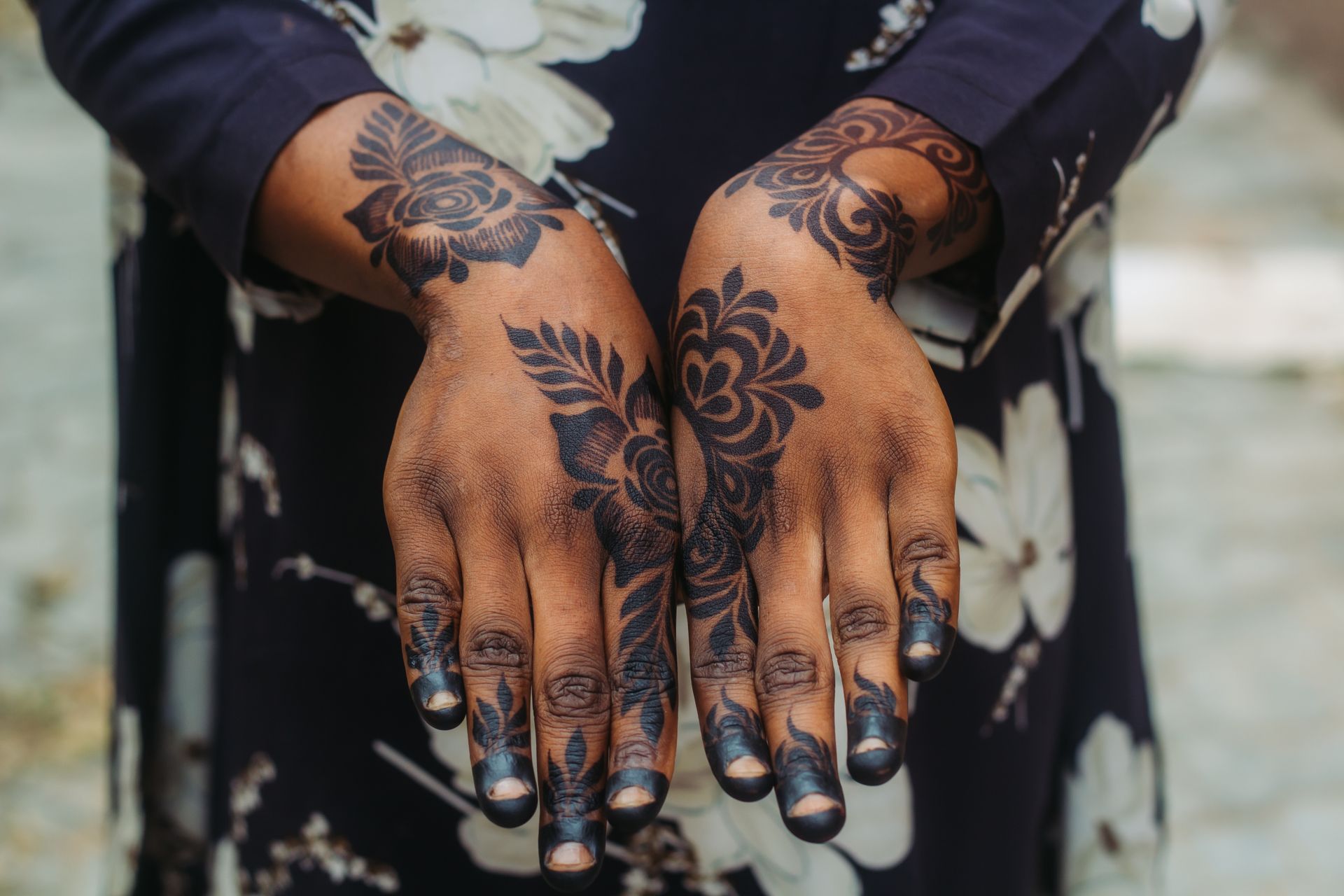
Arabic henna is the style you recognise in a single glance: a bold flower on the back of the hand, a vine trailing up the wrist, a fingertip stained dark, and a lot of bare skin left untouched between the lines. It is not a simplified version of Indian mehndi, and it is not a sketch waiting to be filled in. It is a complete tradition of its own, from the Gulf and the wider Arab world, built on confidence, open space and flowers drawn large enough to read from across a room. This guide explains what makes Arabic henna different, where it comes from, which motifs define it, how the stain develops, and how to wear it well, whether you are choosing a design for a wedding, for Eid, or simply for the pleasure of it.
In This Guide
We start with the style at a glance, then trace its roots, its motifs and its occasions. If you know Indian mehndi first, read our Indian henna tattoo designs guide alongside this one, because the contrast between the two traditions is the fastest way to understand what Arabic henna is. For the other temporary option, see our jagua vs henna guide, which compares henna with blue-black jagua.
Key Takeaways
- Open space is the signature. Arabic henna leaves bare skin between bold motifs, while Indian mehndi fills the skin almost completely.
- Florals lead the design. Large flowers, trailing vines and leaves do most of the work, with geometric fillers used sparingly.
- The back of the hand is the classic canvas. Arabic designs favour the backs of the hands, the wrists and the forearms over the palms.
- The stain deepens over two days. Fresh henna looks orange, then darkens to a rich reddish brown by the second day if the paste stays on long enough.
- Natural henna is the only safe henna. Real henna is reddish brown, never black, and black henna can cause serious skin reactions.
- Occasion shapes the design. Weddings, Eid and family gatherings each call for a different scale and a different level of formality.
Table of Contents
- Arabic Henna at a Glance
- Where the Style Comes From
- The Floral Trail
- Vines, Leaves and Open Space
- Backs of Hands
- Colour, Paste and How the Stain Develops
- Occasions, Dress and Respect
- Safety, Black Henna and Aftercare
Arabic Henna at a Glance
Look for the bare skin first. The quickest way to tell Arabic henna from Indian mehndi is not the flowers but the gaps. An Arabic design leaves wide areas of skin untouched, so each flower, vine and leaf stands alone and the eye can follow the trail from one motif to the next. Henna is a dye made from the leaves of the henna plant, and the same dye is used in both traditions, so the difference is not the material but the drawing. Arabic artists use the bare skin as part of the design, in the same way a painter uses the white of the paper.
Bold lines carry the design. Arabic henna is drawn with a heavier line than Indian mehndi, and the flowers are drawn larger, with fewer petals and more space inside each petal. That boldness is practical as well as beautiful: a heavy line stains more deeply, it reads clearly on the skin, and it suits a design that will be seen from a distance at a celebration. Fine, dense detail would be lost in open space, while a bold flower holds its shape even as the stain fades.
Compare the three temporary traditions. The table below sets Arabic henna against Indian mehndi and jagua, so you can see how coverage, line weight and duration differ. Each tradition has its own strengths, and the right choice depends on the occasion, the placement and how long you want the design to last.
| Style | Coverage | Line weight | Classic placement | Colour and duration |
|---|---|---|---|---|
| Arabic henna | Open, lots of bare skin | Bold, heavy lines | Backs of hands, wrists, forearms | Reddish brown, one to two weeks |
| Indian mehndi | Dense, skin almost fully covered | Fine, detailed lines | Palms, backs of hands, feet | Deep reddish brown, one to two weeks |
| Jagua | Open to dense, varies by artist | Bold to fine, varies by artist | Arms, hands, anywhere flat | Blue-black, one to two weeks |
Arabic henna is not a shortcut. Some people assume that open space means less work, but a good Arabic design is harder to draw well than a dense one, because there is nowhere to hide a wobbly line. Every flower has to be confident, every vine has to flow, and the balance between the motifs and the bare skin has to be planned. Mehndi is the art of applying henna to the skin, and in the Arabic tradition that art is judged by the clarity of each motif, not by how much skin is covered.
Where the Style Comes From
Henna is an old plant with a wide geography. The henna plant grows in hot, dry climates across North Africa, the Middle East and South Asia, and people have used its leaves to stain skin, hair and cloth for thousands of years. The dye molecule in the leaves is the lawsone molecule, which binds to the keratin in skin and hair and produces a reddish brown stain. Traders, travellers and families carried henna across the region, and each place developed its own way of drawing with it, shaped by local art, dress and celebration.
The Gulf style grew from its own visual language. Arabic henna draws on the floral and geometric patterns of Islamic art, where flowers, leaves and vines are drawn large and flowing, and where open space is part of the pattern rather than an empty gap. The same taste for bold florals and open space appears in textiles, in architecture and in jewellery from the region, and henna follows that taste. The result is a style that feels at home in the Gulf, in the Levant and in North Africa, with local variations in each place but a shared preference for clarity over density.
It is a living tradition, not a museum piece. Arabic henna is still worn for weddings, for Eid, for family gatherings and for everyday beauty, and it changes with each generation. Modern artists mix traditional florals with new motifs, with initials, with small geometric borders and with designs that follow the shape of the hand rather than a fixed pattern. That change is part of the tradition, not a break from it, and the best artists know the old patterns well enough to vary them without losing them.
Respect the tradition when you wear it. Henna is not a costume, and it is not a permanent tattoo. It is a temporary art form with a cultural home, and wearing it well means understanding where it comes from and what it means to the people who wear it. Ask your artist about the motifs they are drawing, learn the names of the flowers and the occasions they suit, and wear the design as it was meant to be worn, as a celebration, not as a novelty.
The Floral Trail
Start with one flower. The heart of an Arabic henna design is a single large flower, usually placed on the back of the hand, with petals that open outward and a centre that anchors the whole design. The flower is drawn with a heavy outline and a few strong inner lines, not with the dense shading of Indian mehndi, and it is left with bare skin inside the petals so the stain stays clear and readable. From that flower, a vine trails up the wrist and onto the forearm, with smaller flowers and leaves along the way.

Roses, peonies and simple blossoms lead the way. The rose is the most common Arabic henna flower, because its layered petals can be drawn large and bold, and because it is a familiar flower across the region. Simple five petal blossoms are also common, because they can be drawn quickly and repeated along a vine without losing their shape. Larger, more elaborate flowers are reserved for the centrepiece, while smaller blossoms fill the trail. The photo above shows this balance clearly: a large flower on each hand, with smaller motifs on the fingers and bare skin between them.
Petals should be few and strong. A common mistake in Arabic henna is to draw too many petals, or to fill the petals with dense lines. The style works best when each petal is a single, confident shape, with a clear outline and at most one or two inner lines. That restraint is what makes the flower read as a flower rather than a filled shape, and it is what allows the stain to develop evenly, because the paste is not too thick in any one place.
Let the flower set the scale. The size of the centre flower decides the size of everything else in the design. If the centre flower is large, the vine and the smaller flowers should be large too, so the design feels balanced. If the centre flower is small, the whole design should stay small and delicate. A design that mixes a huge centre flower with tiny, cramped details looks unfinished, while a design that keeps one scale throughout looks intentional and calm.
Vines, Leaves and Open Space
The vine is the thread that holds the design together. In Arabic henna, a single vine often runs from the back of the hand, across the wrist and up the forearm, with flowers and leaves branching off it at intervals. The vine should be drawn in one flowing line if possible, with a gentle curve that follows the shape of the arm, not a straight line that fights it. The vine gives the eye a path to follow, and it connects the separate flowers into a single composition rather than a collection of isolated motifs.
Leaves do the turning. Leaves are placed where the vine changes direction, where it meets a flower, and where a gap needs to be filled without crowding the design. Long, pointed leaves suit the forearm, where they can stretch along the arm, while small, round leaves suit the wrist and the fingers. A leaf should be drawn with a single outline and a central vein, not with dense filling, so it stays light and readable as it fades.
Open space is a design choice, not an accident. The bare skin in an Arabic design is not empty, it is the background against which the flowers are seen. A good artist plans the open space as carefully as the motifs, leaving wide gaps between the flowers, keeping the vine clear of the edges of the hand, and letting the skin show through the centre of each flower. That planning is what gives Arabic henna its airy, elegant feel, and it is why the style photographs so well: the dark stain stands out against the pale skin, and each motif can be seen clearly.
Beginners should start with the vine. If you are learning Arabic henna, practise the vine first, then the leaves, then the flowers. Our simple henna tattoo designs guide explains how to build a vine and leaf design step by step, and the same principles apply here, with a heavier line and larger flowers. Practise on paper before you practise on skin, and keep your first designs small, with one flower and one vine, until your lines are confident.
Backs of Hands
The back of the hand is the Arabic canvas. While Indian mehndi often covers the palms, Arabic henna favours the backs of the hands, where the skin is flatter, the stain develops more evenly, and the design is visible to the wearer and to others. The back of the hand also suits the style, because it is a broad, open surface that can hold a large flower without crowding, and because the fingers give the artist a natural place to add smaller motifs that trail from the main flower.
Fingertips are often stained dark. In many Arabic designs, the fingertips are filled with solid henna, so they appear as dark caps at the end of each finger. This is a distinctive feature of the style, and it frames the hand beautifully, because the dark fingertips balance the large flower on the back of the hand. The fingertips stain darkest because the skin there is thick, and the colour there often lasts longest. If you do not like solid fingertips, ask the artist to leave them bare or to add a small motif instead, but know that the dark tips are part of the classic look.
Wrist bands and forearm trails extend the design. A common Arabic composition starts with a flower on the back of the hand, continues with a vine across the wrist, and ends with a smaller flower or a leafy trail on the forearm. The wrist is a natural place for a band or a bracelet of henna, and the forearm gives the artist room to let the vine breathe. Our henna tattoo arm designs guide shows how arm designs are built from wrist to shoulder, and many of those ideas apply to an Arabic forearm trail as well.
Feet follow the same logic. Arabic henna is also drawn on the feet, usually on the tops of the feet rather than the soles, with a large flower on the top of the foot and a vine trailing toward the ankle. The same principles apply: bold flowers, open space, and a vine that follows the shape of the foot. Our henna tattoo designs for feet guide covers foot placements in more detail, including how the stain develops on the tops of the feet.
Colour, Paste and How the Stain Develops
Henna stains the skin, it does not paint it. Body painting traditions use colour on the surface of the skin, but henna works differently: the lawsone in the paste binds to the keratin in the outer layer of skin, so the colour develops from inside the skin and lasts until that skin is shed. That is why henna looks orange at first and deepens over a day or two, as more lawsone binds and the stain oxidises in the air. A design that looks pale when the paste comes off can still become a rich brown by the next day.

Good paste makes good colour. Fresh, natural henna paste, made from finely sifted henna powder mixed with lemon juice or another acidic liquid, gives the deepest stain. The paste should be smooth, dark greenish brown, and free of lumps, and it should be used within a day or two of mixing. Old paste, or paste made from poor quality powder, gives a pale, orange stain that fades quickly. Ask your artist what is in their paste, and avoid any paste that is black, that smells chemical, or that promises an instant stain.
Time on the skin is the biggest factor. The longer the paste stays on the skin, the deeper the stain, because the lawsone keeps transferring for as long as the paste is in contact. Most artists recommend leaving the paste on for at least four to six hours, and overnight if you can. Once the paste is dry, it can be sealed with a sugar and lemon spray, which keeps it on the skin longer and helps the stain develop. When you remove the paste, scrape it off rather than washing it, and avoid water for the first day if you can.
Colour varies by person and by placement. Henna stains darkest on the palms and the fingertips, where the skin is thick, and lightest on the upper arms and the back, where the skin is thin. Your own skin chemistry, your body heat and how long the paste stays on all change the result, so the same paste can look different on two people. That variation is normal, and it is part of what makes henna a living art rather than a printed pattern.
Occasions, Dress and Respect
Weddings are the grand occasion. At a wedding, Arabic henna is usually large and formal, with flowers on both hands, vines up the forearms, and sometimes designs on the feet as well. The bride often has the most elaborate design, while guests have smaller, simpler versions. The henna is applied the night before the wedding, so it has time to deepen to its richest colour by the ceremony. If you are a guest, ask the bride or the artist what scale is appropriate, so your design complements rather than competes with hers.
Eid is the family occasion. For Eid al-Fitr, the festival that ends Ramadan, and for Eid al-Adha, families often gather for henna the night before, with designs that are festive but not as formal as a wedding. Children often have small flowers on their hands, and adults have a single flower and a vine, or a pair of matching hands. The henna is part of the celebration, worn with new clothes and shared with family, and it is a time when the artist is often working with a whole family at once.
Dress and henna work together. Arabic henna is often worn with an abaya, a dress or a kaftan, and the design should suit the clothes you will wear with it. A design on the back of the hand shows beautifully with short sleeves, while a forearm trail suits a three quarter sleeve that reveals the vine as you move. The photo in our guide shows henna worn with a blue abaya, and the contrast between the dark stain and the fabric is part of the beauty. Think about your sleeves and your jewellery when you choose a placement, so the henna and the outfit enhance each other.
Henna is for everyone who is invited to it. Henna is worn by women, men and children in the Arab world, and the designs differ by age and by occasion. Men often have a single small motif, or a fingertip stain, rather than a full hand design. Children often have a simple flower or a small vine. If you are not from the culture, the kindest way to wear henna is to learn about it, to ask questions, and to wear it at an occasion where it is welcomed, rather than treating it as a fashion accessory with no context.
Safety, Black Henna and Aftercare
Natural henna is reddish brown, never black. The most important safety rule in henna is also the simplest: real henna stains reddish brown. Any product called black henna is not henna at all, it is henna mixed with a chemical dye, usually para-phenylenediamine, which can cause severe allergic reactions, blistering and permanent scarring. Our black henna tattoo guide explains the danger in full, and it is worth reading before you accept henna from a stall or a market. If a design is black, if it stains instantly, or if it is offered as a quick, cheap option, walk away.

Test the paste before a big occasion. Even natural henna can cause a reaction in a small number of people, so a patch test a few days before a wedding or a festival is a sensible precaution. Apply a small amount of paste to the inside of your arm, leave it on for a few hours, remove it, and watch the area for a day. If there is no redness, itching or swelling, the paste is likely safe for you. If there is any reaction, do not use that paste, and seek advice from a doctor if the reaction is severe.
Aftercare is about patience. After the paste comes off, avoid water for as long as you can, ideally for the first twelve to twenty four hours, because water stops the stain from deepening. Apply a natural oil, such as coconut oil or olive oil, to the design before you wash your hands, and reapply it through the day. Avoid scrubbing, exfoliating and swimming, all of which fade the stain faster. Our henna tattoo aftercare guide sets out the full routine, and our how long a henna tattoo lasts guide explains why some placements fade faster than others. Unlike a permanent tattoo, henna fades as the skin renews itself, so gentle care is the best way to keep it looking good for as long as possible.
Know when to seek help. The risks and precautions set out by Mayo Clinic include advice on choosing a safe practitioner and watching for signs of infection or allergy, and the same caution applies to henna. If a henna design becomes very red, swollen, blistered or painful, or if you develop a rash that spreads, seek medical advice promptly, and tell the doctor what was in the paste if you know. A reaction to black henna can be serious, and it needs treatment, not waiting.
Our View
Arabic henna is a lesson in restraint. It shows that a single flower, drawn boldly and given room to breathe, can be more beautiful than a whole hand covered in detail. The open space is not a gap in the design, it is the design, and the artist who understands that will give you a piece that looks elegant on the day and still looks clear a week later. Choose natural paste, choose a confident artist, and let the flowers speak for themselves.
Open space is not empty skin. It is the part of the design that lets each flower be seen.
— The Editors, Tattoo Designs Pictures
Frequently Asked Questions
How is Arabic henna different from Indian henna?
Arabic henna uses bold lines, large flowers and a lot of bare skin, while Indian mehndi uses fine lines, dense detail and almost full coverage. Arabic designs favour the backs of the hands, while Indian designs often cover the palms as well. Both use the same natural henna dye, so the difference is in the drawing, not the material.
How long does Arabic henna last?
Most Arabic henna lasts one to two weeks, depending on the placement, the paste quality and how long the paste stayed on the skin. Designs on the backs of the hands fade faster than designs on the palms, because the hands are washed often. Gentle aftercare, oil before washing and avoiding scrubbing will help it last longer.
Is Arabic henna safe?
Natural henna is safe for most people, but black henna is not. Black henna contains a chemical dye that can cause severe allergic reactions, blistering and scarring. Always check that the paste is natural, reddish brown henna, and do a patch test before a big occasion if you have sensitive skin.
What does Arabic henna mean?
Arabic henna is worn for beauty, for celebration and for good fortune. The flowers and vines are symbols of growth, fertility and joy, and the designs are worn for weddings, for Eid and for family gatherings. The meaning is in the occasion as much as in the motifs, so the same flower can mean different things at a wedding and at Eid.
Can men wear Arabic henna?
Yes. Men in the Arab world often wear a small henna motif, a fingertip stain or a simple design on the hand, especially for weddings and for Eid. The designs for men are usually smaller and simpler than those for women, but the tradition is shared.
How do I make Arabic henna last longer?
Leave the paste on for as long as possible, at least four to six hours and overnight if you can. Avoid water for the first day, apply natural oil before washing, and avoid scrubbing, exfoliating and swimming. The stain will deepen over the first two days, so be patient and let it develop.
Questions About Your Design?
If you are choosing between Arabic and Indian henna, or if you are planning henna for a wedding or for Eid, start by browsing the guides on the Tattoo Designs Pictures home page, where you will find henna guides, aftercare advice and design ideas for hands, arms and feet. Bring the designs you like to your artist, and ask them to adapt the style to your hands, your occasion and your skin.
Sources
- Henna — Wikipedia
- Mehndi — Wikipedia
- Lawsonia Inermis — Wikipedia
- Lawsone — Wikipedia
- Body Painting — Wikipedia
- Tattoo — Wikipedia
- Skin — Wikipedia
- Eid al-Fitr — Wikipedia
- Para-Phenylenediamine — Wikipedia
- Eid al-Adha — Wikipedia
- Islamic Art — Wikipedia
- Tattoos: Understand Risks and Precautions — Mayo Clinic