In a Japanese tattoo, nothing is decoration. The koi is not there because it looks pretty, the cherry blossom is not there because it is pink, and the wind is not there to fill a gap. Every motif is a word in a language that has been spoken on skin for more than two centuries, and the masters who choose them follow rules as strict as any grammar: water flows one way, wind blows one way, and the seasons do not mix. A bodysuit that gets the language right tells a story that any knowledgeable eye can read at a glance. A bodysuit that gets it wrong is just a collection of pretty pictures. This guide explains how Japanese tattoo motifs are chosen — how water, wind and season work, what the great motifs mean, and how a master builds them into a single composition that covers the body and tells one story.
In This Guide
Start with what a motif is, then follow water, wind and the four seasons, and finish with how a master chooses and places them. For the tradition itself, read Japanese tattoo history, Wabori Tattoo and the comparison in Wabori vs Tebori, and for one motif worked in depth, see Wabori Hebi.
Key Takeaways
- A motif is a word, not a picture. In Japanese tattooing, koi, dragons, snakes, cherry blossoms, maple leaves, peonies and chrysanthemums each carry a fixed meaning, and they are chosen for what they say.
- Water, wind and season are the three background languages. Waves, wind bars and clouds are not filler; they are the grammar that connects the main motifs and gives the composition its movement.
- Seasons do not mix without a reason. Cherry blossom belongs to spring and maple to autumn, and a master will not put them together unless the story demands it.
- The background makes the bodysuit. The dark background that fills the spaces between motifs — the gakubori — is what turns a collection of tattoos into a single garment.
- The body is the canvas and the composition follows it. Motifs are placed according to the body’s own lines: the back for the great scenes, the arms for the journeys, the chest for the centre.
- Choosing motifs takes time and conversation. A traditional master will talk with you for hours before drawing anything, because the motifs have to match your life, not just your taste.
Table of Contents
- What a Motif Is — and Why It Is Not Decoration
- Water: Koi, Waves and the Journey Upstream
- Wind: Wind Bars, Clouds and the Unseen Force
- Season: Cherry Blossom, Maple, Peony and Plum
- How a Master Chooses: The Rules Behind the Choice
- Placing Motifs on the Body
- Common Mistakes to Avoid
- Frequently Asked Questions
What a Motif Is — and Why It Is Not Decoration
Every motif has a meaning, and the meaning comes first. Irezumi, the Japanese word for the traditional full-body tattoo, is built from a fixed vocabulary of motifs: dragons, koi, tigers, snakes, flowers — cherry blossoms, maple leaves, peonies and chrysanthemums — and the elements of nature, water, wind and clouds. Each motif carries a meaning that is widely understood in Japan, and the meanings are not vague. The koi stands for perseverance, because it swims upstream against the current; the cherry blossom stands for the briefness of life, because it falls within days of opening; the dragon stands for wisdom and strength; the snake stands for protection, transformation and good fortune. A master does not choose a motif because it looks good. The master chooses it because it says something true about the person who will wear it, and the looking good follows from the truth of the choice.
The language comes from woodblock prints. The motifs of Japanese tattooing did not appear from nowhere. They came from ukiyo-e, the woodblock prints of the floating world, which were the popular art of Edo-period Japan and the sourcebook for the first tattoo masters. The great print artists — Hokusai, Kuniyoshi, Hiroshige — drew the heroes, the monsters, the flowers and the waves that tattooists then carried onto skin, and the influence ran both ways: tattooed heroes became print subjects, and print subjects became tattoos. Japanese art has always treated nature as a language rather than a backdrop, and tattooing inherited that habit completely. When you see a wave in a Japanese tattoo, you are seeing Hokusai’s wave; when you see a cherry blossom, you are seeing a thousand years of poetry about impermanence, drawn in a single flower.
Water, wind and season are the three great families. The motifs of Japanese tattooing fall into three families, and the whole art is the art of combining them. Water gives movement and struggle: waves, rain, rivers, koi swimming upstream, dragons rising from the sea. Wind gives power and invisibility: the wind bars that streak across the skin, the clouds that carry the gods, the storms that bend the trees. Season gives time and feeling: the cherry blossom of spring, the peony of summer, the maple of autumn, the plum of winter. The table below is the map of the whole guide, and once you can read it, you can read a Japanese tattoo.
| Family | Main motifs | Symbolism | Best placement | Colour |
|---|---|---|---|---|
| Water | Koi, waves, rain, dragons | Perseverance, struggle, transformation | Arms, legs, back — flowing lines | Blues, blacks, reds |
| Wind | Wind bars, clouds, storms | Power, change, the unseen | Background, shoulders, chest | Black, grey, soft blue |
| Season | Cherry blossom, maple, peony, plum | Time, beauty, impermanence | Anywhere, as accents and frames | Pinks, reds, oranges |
Water: Koi, Waves and the Journey Upstream
Water is the engine of the Japanese tattoo. More than any other element, water gives a Japanese composition its movement. Waves curl, rain falls, rivers run, and the koi swims against all of it. The koi, the ornamental carp, is the most famous water motif in tattooing, and its meaning is one of the most specific in the whole tradition. According to legend, a koi that swims upstream and climbs the waterfall at the Dragon Gate becomes a dragon — and that is why the koi stands for perseverance, ambition and transformation. A koi swimming up the arm says that its wearer is still climbing. A koi swimming down says something else entirely: that the wearer has already arrived, or that the struggle is over. The direction of the fish is the meaning, and a master will ask you which way your koi is swimming before drawing a single scale.
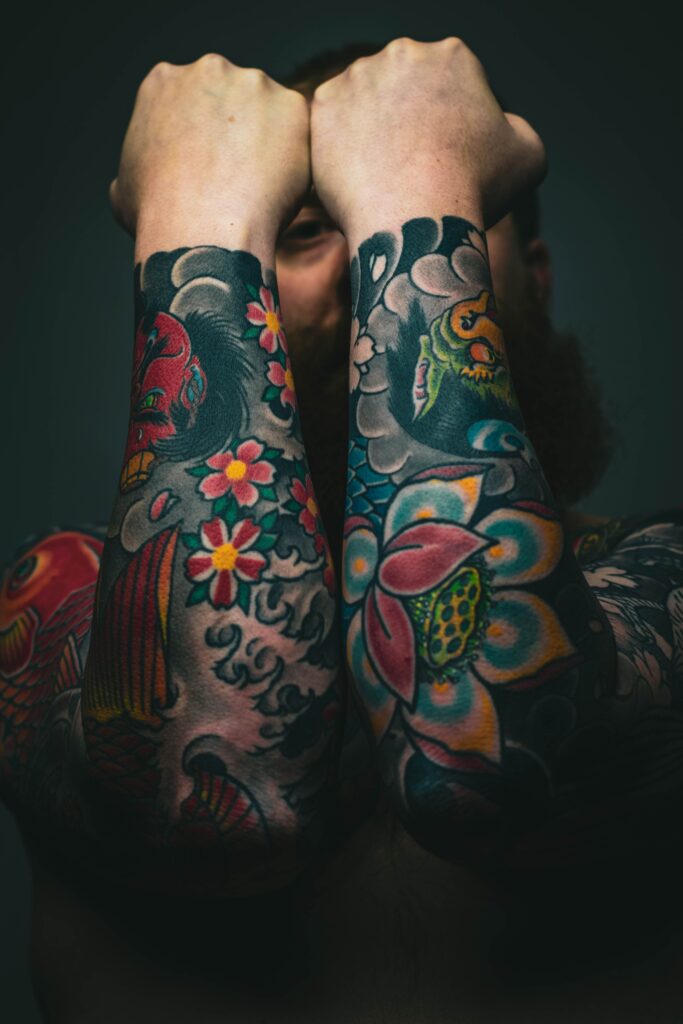
Waves are the grammar, not the decoration. The great wave — the curling, claw-like wave that Hokusai made famous — is the most recognisable shape in Japanese art, and in tattooing it does the work of a frame and a road at once. Waves carry the eye across the body, connect separate motifs, and fill the spaces that would otherwise be empty. They are drawn with a particular discipline: the wave always breaks in the same direction, the foam is drawn as claws and fingers, and the water never flows backwards. The photograph below shows a pair of forearms covered in koi, flowers and waves, worn as sleeves: the fish move in the water, the flowers sit above it, and the waves tie the whole composition together. It is a textbook example of how water works in this tradition — not as a background, but as the medium the whole story swims in.
Rain and rivers complete the water language. Rain, drawn as fine parallel lines, is used to fill the upper parts of a bodysuit, to suggest weather and mood, and to give the eye somewhere to rest between the big motifs. Rivers are rarer, because a river needs a long run of skin, but on a leg or a back they can carry a whole composition from one end to the other. And the dragon, the great water creature of Japanese myth, rises from the sea in a spray of waves: where the koi is the struggle, the dragon is the arrival, and the two are often drawn as a pair — the koi below, the dragon above — telling the whole story of transformation in a single image. Our guide to the Japanese tattoo bodysuit shows how water is used to join the separate panels of a full-body piece into one continuous garment, and it is worth reading before you plan anything large.
Wind: Wind Bars, Clouds and the Unseen Force
Wind is drawn, not implied. In Japanese tattooing, wind is not a vague feeling. It is drawn as wind bars — the long, curved, parallel streaks that sweep across the skin — and as clouds, which are drawn as rounded, overlapping scales. Wind bars are the most abstract element in the whole tradition, and the most powerful, because they can connect anything to anything: they carry cherry blossom petals across a back, they push waves against a shore, they sweep around a dragon and give it speed. A master uses wind bars the way a composer uses a bridge between two melodies — to carry the eye from one motif to the next without breaking the rhythm. They are always drawn flowing in one direction, usually following the body’s own lines, and they are never drawn at random, because a wind bar that fights the body’s movement looks like a mistake.
Clouds carry the gods. In Japanese art, clouds are the vehicle of the divine: the wind god Fujin and the thunder god Raijin ride on clouds, and the great heroes descend from them. In tattooing, clouds are used as a background for the gods and the great figures, and as a frame that separates the earthly motifs below from the heavenly ones above. They are drawn in a stylised, almost architectural way — rounded forms built up in layers, with a dark outline and a light interior — and they give a bodysuit its sense of height. A cloud that is drawn well looks solid enough to stand on; a cloud drawn badly looks like a smudge. The difference is in the edges: the good cloud has a firm, confident outline, and the bad one does not.
Wind is the hardest element to wear well. Because wind bars and clouds are abstract, they are also the easiest to get wrong. Too many wind bars and the tattoo looks busy; too few and the composition falls apart. A master will use wind sparingly, to join the motifs that need joining and to give the composition its direction, and will leave the rest of the skin to the water and the season. If you are planning a large piece, ask your artist to show you how the wind will flow across your body before you commit. The answer should be a drawing, not a promise.
Season: Cherry Blossom, Maple, Peony and Plum
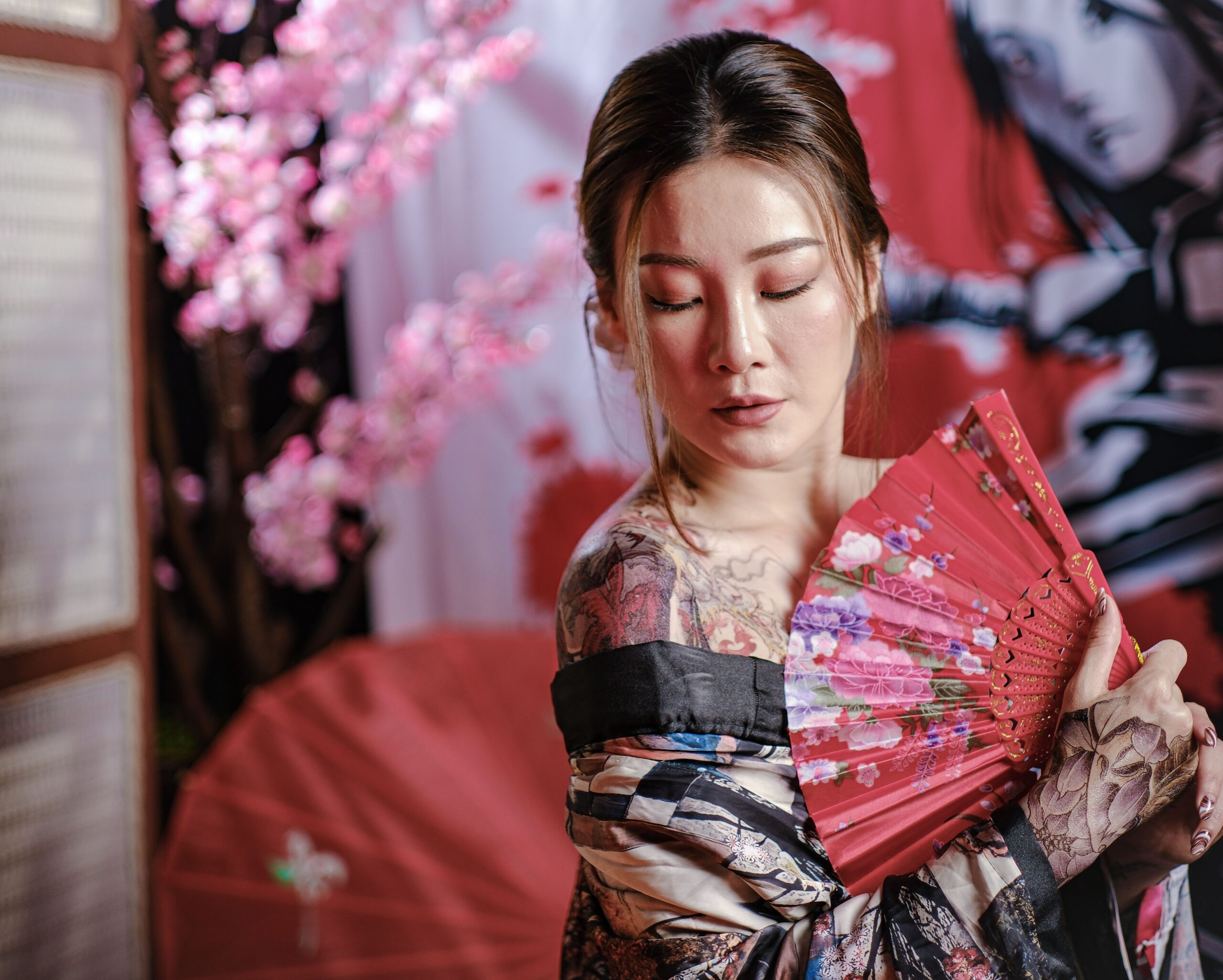
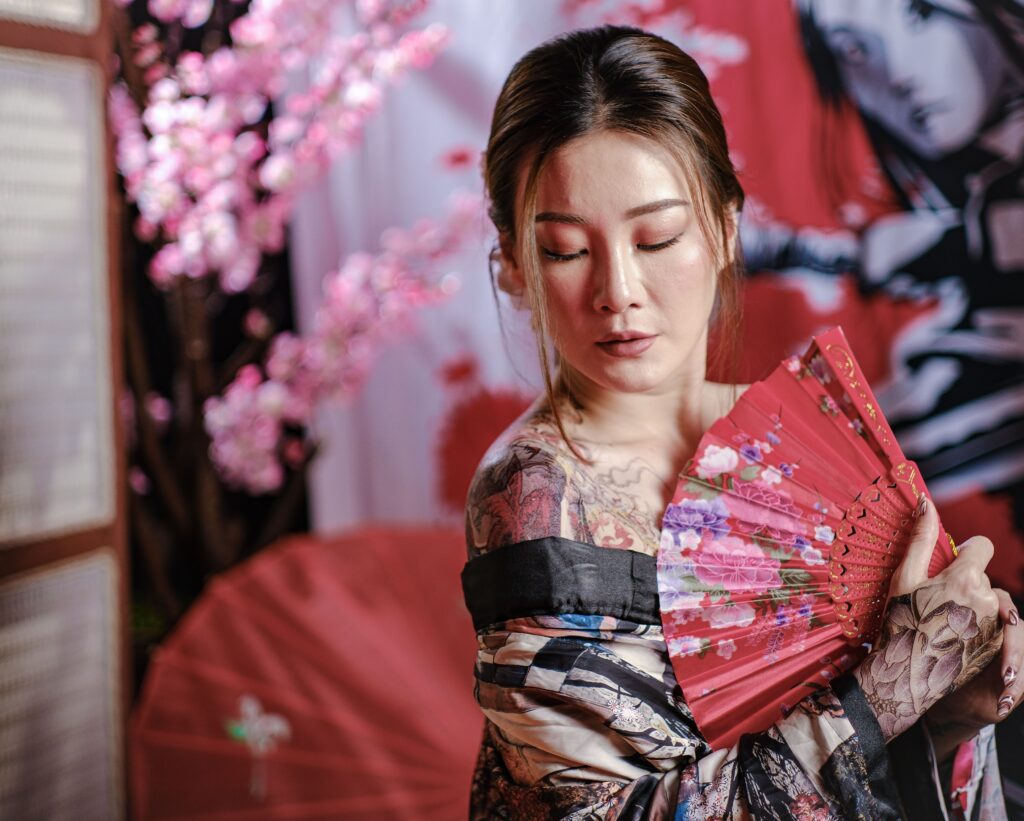
Each season has its flower, and the flower has its meaning. The cherry blossom, sakura, is the flower of spring and the most famous motif in Japanese tattooing. It blooms for a week and falls, and for that reason it stands for the beauty and the brevity of life — the idea, central to Japanese culture, that things are beautiful precisely because they do not last. The photograph at the top of this guide shows cherry blossom with a red fan: spring, celebration and impermanence in a single image. The peony, botan, is the flower of summer and stands for wealth, honour and good fortune; it is large, lush and unapologetic, and it is often drawn as the companion of the lion or the hero. The maple leaf, momiji, is the flower of autumn — it is not a flower at all, but it is treated as one — and it stands for the beauty of change and the passage of time. The plum blossom, ume, is the flower of winter, blooming while snow is still on the ground, and it stands for endurance and hope. Together, the four flowers are the calendar of a Japanese tattoo, and a master who knows them can tell you what time of year your tattoo is set in.
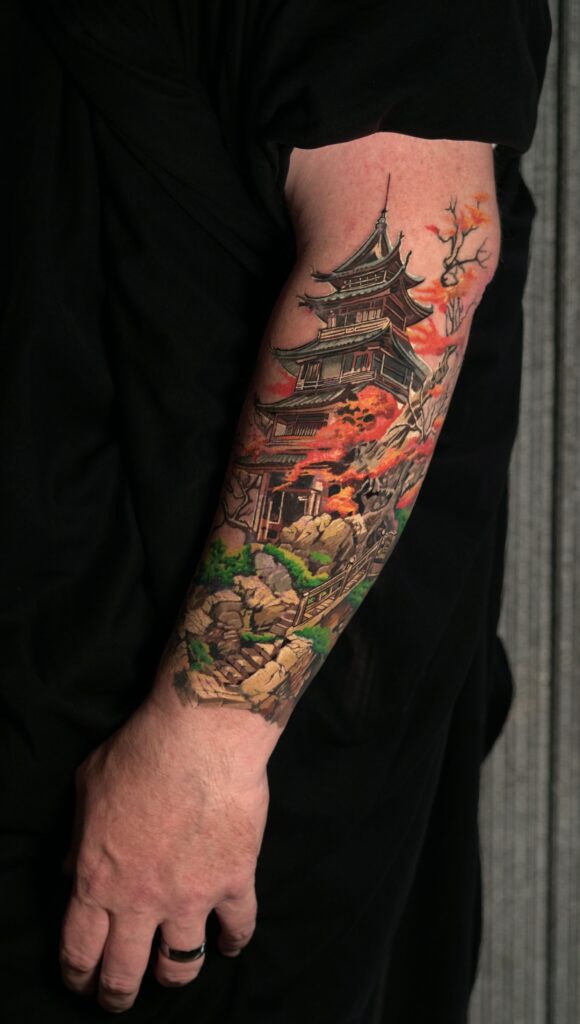
Animals belong to seasons too. The butterfly, which the butterfly article describes as a creature of transformation in cultures around the world, is a summer motif in Japanese tattooing — a soul, a fleeting beauty, a creature that lives for a season and is gone. The snake, which our guide to Wabori Hebi explores in depth, belongs to water and to the boundary between the seasons, shedding its skin as the year turns. The tiger belongs to autumn and to the wind; the dragon belongs to water and to the storm. When a master chooses an animal, the season is part of the choice: a tiger in cherry blossom would be a contradiction, and a butterfly in snow would be a mistake, unless the story being told is precisely about a creature out of its season — which is itself a story, but one that has to be told deliberately.
How a Master Chooses: The Rules Behind the Choice
The choice starts with a conversation, not a catalogue. A traditional Japanese master — a horishi — does not ask you to pick a design from a wall. The process begins with talking: about your life, your family, your work, your losses and your ambitions. The motifs are chosen from that conversation, because they have to match the person, not just the body. A koi is for someone still climbing; a dragon is for someone who has arrived; a cherry blossom is for someone who has learned that beauty is brief; a snake is for someone who has changed their skin. The horimono tradition, the art of the full-body tattoo as a single work, treats the body as a garment that is made to measure, and the fitting starts with the story. If a tattooist offers you a Japanese bodysuit in a single sitting of choosing, they are selling you a picture, not a horimono.
Coherence is the first rule. The motifs in a single composition must belong together. That means one season at a time, one story at a time, and water that flows in one direction. A bodysuit with spring cherry blossom on the chest and autumn maple on the back is not a mistake if the story is about the passage of a year — but it is a mistake if the two seasons were chosen because both looked pretty. A dragon and a koi can share a body, because the koi becomes the dragon; a tiger and a dragon can share one, because they are the traditional rivals of wind and water. But a dragon and a butterfly on the same arm, with no wind and no water to join them, is a sentence with no grammar. The irezumi tradition is strict about this because the strictness is what makes the work legible: anyone who knows the language can read the story, and anyone who does not can still feel that the story is there.
The background is chosen, not left over. The dark background that fills the spaces between the motifs is called gakubori, and it is one of the most important choices a master makes. It is not filler. It is the garment itself — the dark cloth against which the bright motifs are set — and it is what turns separate tattoos into a single bodysuit. The background is built up slowly, in layers, with wind bars and clouds and waves, and it is the part of the work that takes the most sittings. A bodysuit without a proper background looks like a collection of stickers; a bodysuit with one looks like clothing. When you look at a master’s portfolio, look at the backgrounds first. If they are confident and even, the master is good. If they are patchy or missing, the master is not finished learning.
Colour follows meaning, not fashion. Traditional Japanese tattooing uses a limited palette — black, grey, red, and the soft colours of the flowers — because the colours mean something. Red is the colour of life and of the koi; pink is the colour of the cherry blossom; black is the colour of water and of the background. A master will not use a colour because it is fashionable this year; the colour is chosen because the motif demands it. That discipline is part of why these tattoos age so well: the palette is restrained, the black is solid, and the design does not depend on a colour that will fade in five years. The tattoo itself is made the same way it has been made for generations, and the Mayo Clinic’s guidance on tattoos still applies to it — choose a licensed studio, check the hygiene, and follow the aftercare — because the oldest traditions are also the ones that take safety most seriously.
Placing Motifs on the Body
The back is the great canvas. In a traditional bodysuit, the back carries the main scene: the dragon, the hero, the great wave, the landscape. It is the largest flat surface on the body, and it is where the story is told in full. The chest carries the centre — often a smaller version of the back’s theme, or a motif that faces the back’s motif across the body. The arms carry the journeys: the koi swimming up the arm, the snake coiling down it, the flowers trailing along it. The legs carry the foundations: the waves, the rocks, the water at the bottom of the scene. This is not arbitrary. It is the composition of a garment, and the body is the frame. Our guide to the Japanese tattoo bodysuit explains the full layout, including the open space left down the centre of the chest — the munewari — which is itself a design choice, a deliberate emptiness in the middle of a full body of ink.
Small pieces follow the same rules. You do not need a bodysuit to use this language. A single koi on a forearm, a cherry blossom branch on a shoulder, a small snake on the ribs — each follows the same rules as the great compositions, in miniature. The motif must face the right way: a koi swims upstream, toward the head or the heart, not away from it. The season must be coherent: a cherry blossom branch should not be paired with a maple leaf unless the story demands it. And the background, even on a small piece, should be present: a little wind, a little water, a few petals carried on the air, to give the motif its world. A small Japanese tattoo that follows these rules looks like a piece of the great tradition. A small one that does not looks like a souvenir. The difference is in the wind and the water, and it is worth learning to see it.
Placement changes with the body. The same motif means something different on different parts of the body, because the body moves differently there. A dragon on the back is a guardian; a dragon on the arm is a companion; a dragon on the chest is a protector of the heart. A cherry blossom on the shoulder is a decoration; a cherry blossom falling down the spine is a meditation on time. When you plan a piece, think about how you will see it and how others will see it. The upper back is the place for the great scenes because it is seen by others; the shoulder blade is the place for a single motif because it is a natural frame; the rib cage is the place for a vertical composition — a snake, a branch, a waterfall — because it follows the line of the ribs. The body is not a blank wall. It is a landscape, and the motifs are placed the way a gardener places trees: where they belong.
Common Mistakes to Avoid
Mixing seasons without a reason. The most common mistake in Japanese-style tattooing is also the most visible: cherry blossom with maple, peony with plum, spring with autumn, all on the same arm, because each flower looked pretty on its own. A master will notice in a second, and so will anyone who knows the tradition. If you love two seasons, choose the one that matches your story, or commission a piece that is explicitly about the turning of the year, with the seasons arranged in order. Do not mix them by accident.
Choosing a motif for its looks alone. A dragon is not a decoration. It is a symbol of wisdom and power, and wearing it without understanding it is like wearing a military decoration you did not earn. The same is true of the koi, the tiger, the snake and the cherry blossom. Learn what the motif means before you wear it — this guide is a start — and make sure the meaning is one you are willing to carry. The health effects of tattoos are the same whatever the motif, but the social effects are not: a motif you do not understand will be noticed by the people who do.
Rushing the master. A traditional Japanese bodysuit takes years — sometimes five or ten — and a single large motif takes months of sittings. The time is not a delay; it is the work. The background is built up slowly, the colours are layered, and the composition is adjusted as it grows. An artist who promises a full Japanese back piece in a weekend is not a traditional master, and the result will show it. Choose an artist whose work you have seen healed, whose backgrounds are even, and whose clients speak of the conversations as fondly as they speak of the tattoos.
Our View
Japanese tattooing is the most literate tradition in the art, and it rewards the wearer who learns to read it. A bodysuit chosen in the old way — story first, season second, placement third — is not just a tattoo. It is a biography written in a language that has been spoken for two hundred years, and it will still be legible when the fashion of this year is forgotten. Take the time to learn the language before you speak it. Talk to your master, choose your season, and let the water, the wind and the flowers do the rest.
— Muse, Tattoo Designs Pictures
Frequently Asked Questions
What are the main motifs in Japanese tattoos?
Dragons, koi, tigers, snakes, and flowers — cherry blossoms, maple leaves, peonies and chrysanthemums — set against water, wind and clouds. Each motif has a fixed meaning: the koi stands for perseverance, the cherry blossom for the brevity of life, the dragon for wisdom and strength, and the snake for protection and transformation.
Can you mix cherry blossom and maple leaves in one tattoo?
Only if the story demands it. Cherry blossom is spring and maple is autumn, and a traditional master will not mix seasons without a reason — for example, a piece that is explicitly about the passage of a year, with the seasons arranged in order. Mixing them by accident is the most common mistake in Japanese-style work.
What do wind bars mean in a Japanese tattoo?
Wind bars are the curved, parallel streaks that represent wind. They are not filler: they carry the eye across the composition, join separate motifs, and give the tattoo its sense of movement. They always flow in one direction, following the body’s lines.
How long does a traditional Japanese bodysuit take?
Years — often five to ten — with sittings spread over months. The background alone takes many sessions. The time is part of the tradition, and a bodysuit promised in a weekend is not a traditional piece.
What is the dark background in a Japanese tattoo called?
It is called gakubori. It is the dark background built up between the motifs, and it is what turns separate tattoos into a single garment. A good background is even, confident and layered; a missing or patchy one is a sign of unfinished work.
Do I need a full bodysuit to wear Japanese motifs?
No. A single koi, a cherry blossom branch or a small snake follows the same rules in miniature: the motif must face the right way, the season must be coherent, and a little wind or water should give the motif its world. Small pieces done well are part of the same tradition.
Questions About Your Tattoo?
Visit Tattoo Designs Pictures for more placement guides, design ideas and tattoo meanings, and bring your questions to your artist before you book.
Sources
- Irezumi — Wikipedia
- Ukiyo-e — Wikipedia
- Horimono — Wikipedia
- Koi — Wikipedia
- Cherry blossom — Wikipedia
- Japanese art — Wikipedia
- Butterfly — Wikipedia
- Tattoo — Wikipedia
- History of tattooing — Wikipedia
- Health effects of tattoos — Wikipedia
- Tattoos: risks and precautions — Mayo Clinic