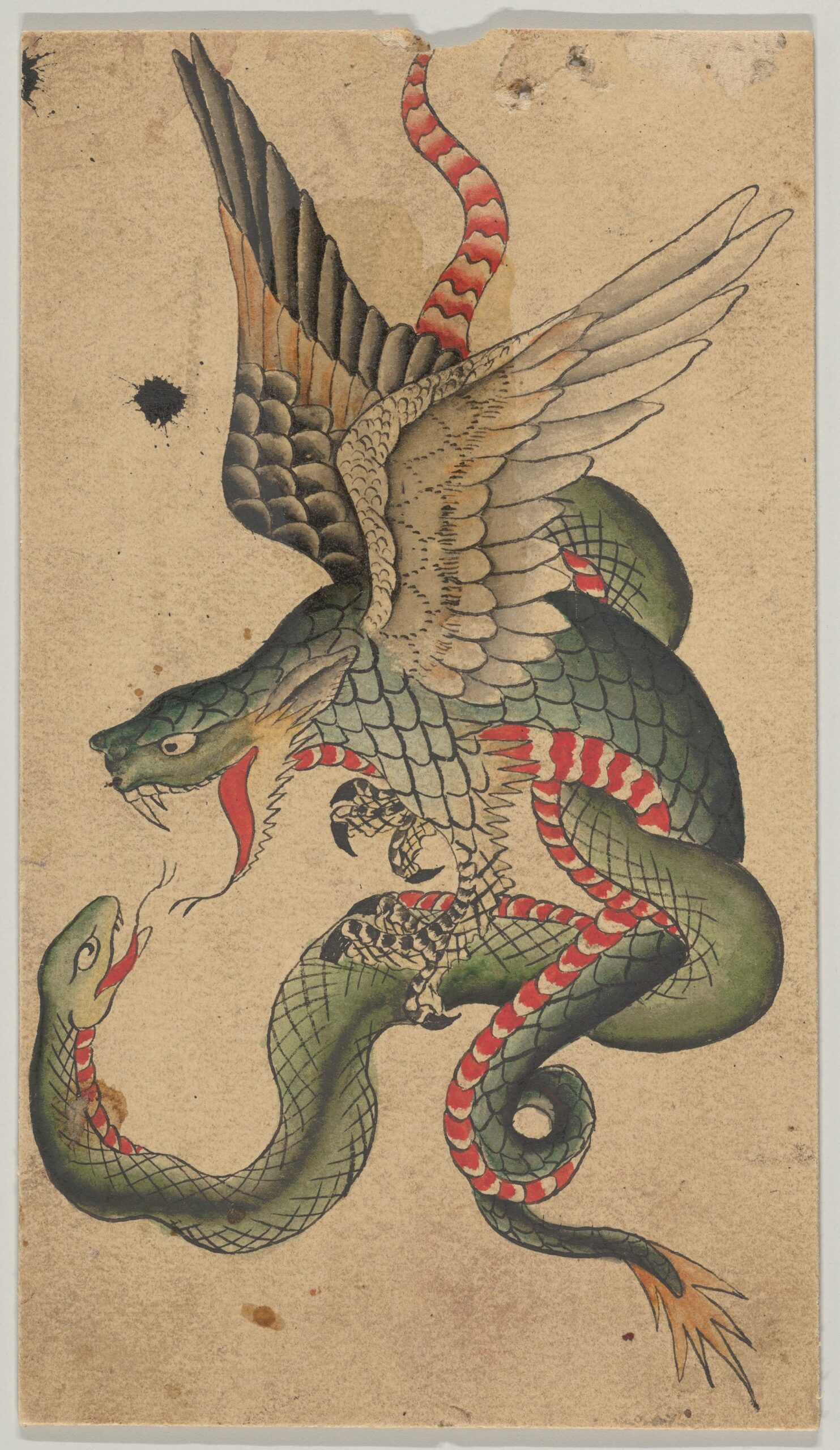
Of all the creatures in Japanese tattooing, the snake is the one most often chosen for its looks and least often understood. A coiled serpent winding around an arm looks striking in any style, but in the wabori tradition the snake — hebi — is never just decoration. Its coil, its direction, the tilt of its head and the company it keeps all change what the tattoo says. A snake paired with a peony tells a different story from a snake paired with a skull, and a snake that winds up the body means something different from one that strikes downward. This guide explains what hebi means, how the hand-poked tebori technique shapes it, where it belongs on the body, and how to choose a design you will still be glad to wear in twenty years.
Related reading: For the wider tradition behind this motif, see our overview Wabori Tattoo: The Art and History of Japanese Tattooing — the style, the technique and the motifs that define it.
Key Takeaways
- Hebi means snake, and in wabori the snake is a guardian and a symbol of rebirth — it sheds its skin and begins again, which is why it stands for renewal as well as protection.
- The design changes the meaning. A coiled snake, a striking snake, a snake with peonies and a snake with a skull are four different tattoos with four different messages.
- Tebori suits the snake better than almost any other motif, because the hand-poked method follows the body’s curves and builds the soft shading that makes scales and coils look alive.
- Placement is part of the design. A hebi that winds around an arm, a thigh or a full back reads as movement; the same snake flattened onto a small flat area loses its power.
- Snakes pair with other motifs for a reason. Peonies, water, dragons and skulls each add a layer of meaning — choose the pairing deliberately, not by accident.
- Both hand-poked and machine hebi carry the same health risks. A licensed studio and sterile equipment matter far more than the tool.
Table of Contents
- What Hebi Means in Japanese Tattooing
- The Snake in Japanese Myth: Protection, Rebirth and Power
- How Tebori Shapes a Snake: Coils, Scales and Flow
- Placement: Where a Hebi Belongs on the Body
- Hebi With Other Motifs: Peonies, Skulls, Dragons and Water
- Choosing Your Hebi: Size, Style and Artist
- Safety and Aftercare
- Frequently Asked Questions
What Hebi Means in Japanese Tattooing
The first thing to understand is that hebi is not a single design but a family of designs, and the family has a shared core. In Japanese tattooing, the snake stands for protection, wisdom, good fortune and rebirth. The rebirth meaning comes from the snake’s most visible habit: it sheds its skin and emerges new, which made it a natural emblem of renewal and of surviving hardship. The Snake article describes how snakes appear as symbols in cultures around the world, often tied to fertility, healing and the earth, and Japan is no exception — white snakes in particular were regarded as messengers of the gods and as bringers of luck. A hebi tattoo, then, is a protective charm as much as a picture, and many wearers choose it after a difficult period in their lives, as a mark of having come through something and started again.
But the core meaning is only the beginning, because the design changes the message. A snake coiled at rest suggests patience, watchfulness and coiled power held in reserve. A snake rearing to strike suggests aggression, defence and a warning to anyone who comes too close. A snake wrapped around a peony softens the image, pairing danger with beauty and wealth. A snake around a skull turns the image toward mortality and the cycle of life and death. The artist’s choices — the direction of the coil, whether the mouth is open or closed, whether the eyes are calm or fierce — are not decorative details. They are the grammar of the tattoo, and a good artist will ask you what you want the snake to say before a single line is drawn. Our guide to snake tattoo meanings covers the wider symbolism in more detail, including how the same animal is read in other tattoo traditions.
The wabori context matters too. The Irezumi article explains that traditional Japanese tattooing builds large, connected compositions in which each motif has a place in a larger story, and the snake is one of the great travelling motifs of that story: it winds through water, around flowers and across the body, tying the composition together. The Tattoo article places this in a global context, noting that hand-poked methods like tebori survive alongside machine tattooing in several traditions. In a wabori bodysuit, the snake is often the element that gives the piece its movement — the eye follows the coil from shoulder to hip, and the whole composition seems to move with the wearer. That sense of motion is the reason the snake has survived as a motif for so long: no other animal fits the human body so naturally.
| Design variant | Core meaning | Best placement | Tebori note |
|---|---|---|---|
| Coiled snake at rest | Patience, protection, coiled power | Upper arm, thigh, shoulder | Soft shading shows the coil’s depth |
| Striking snake | Defence, aggression, warning | Forearm, calf, chest | Bold outline keeps the head sharp |
| Snake and peony | Beauty and danger, wealth, good fortune | Back, sleeve, thigh | Colour contrast: red flower, dark snake |
| Snake and skull | Mortality, rebirth, the life cycle | Back, chest, full sleeve | Graduated shading links the two subjects |
| Snake and water | Flow, adaptability, good luck | Full back, bodysuit, leg | Wind bars and waves suit hand shading |
The table is a starting point, not a rule book. Your artist may suggest a different pairing or a different placement, and you should listen: a design that works on paper can fail on a real body, and a design that seems odd at first can turn out to be the right one once it is drawn to fit your shape. The point is to choose deliberately. A snake chosen only because it looks fierce is a missed opportunity; a snake chosen because its meaning matches your story is a tattoo you will defend for the rest of your life.
The Snake in Japanese Myth: Protection, Rebirth and Power
Snakes have lived in Japanese story for as long as there have been Japanese stories. Japanese mythology is full of serpent figures: the great eight-headed serpent Yamata no Orochi, slain by the storm god Susanoo; the white snakes that serve Benzaiten, goddess of water, music and good fortune; the serpent messengers that guard shrines and springs. In these stories the snake is rarely a simple villain. It is a guardian of water and of hidden places, a creature that belongs to both the earth and the world beneath it, and a bringer of luck to those who treat it with respect. That ambiguity — dangerous and protective at once — is exactly what makes the snake such a rich tattoo subject. It does not mean one thing. It means several things at once, and the wearer decides which of them to emphasise.
The white snake deserves special mention, because it carries the strongest luck association. In Japanese folklore, a white snake is a messenger of Benzaiten and a sign of prosperity; some shrines keep white snakes, and seeing one is considered a blessing. A white or pale snake tattoo is therefore a quieter, luckier choice than the more common dark snake, and it is often chosen by people who want the protection of the motif without the aggression of a striking black serpent. The colour choice changes the tone of the whole piece: a black snake reads as power and warning, a red snake as passion and danger, a pale snake as luck and spiritual protection. Your artist can show you how each colour heals, because reds and pale inks behave differently in skin over time, and the choice is not only symbolic.
Encyclopaedia Britannica’s account of tattooing helps explain why such meanings attach themselves to skin in the first place: Britannica’s tattoo overview describes tattooing as body decoration with deep cultural roots, and notes the Japanese tradition among the world’s great tattoo cultures. In Japan, the tattoo was never a fashion accessory in the modern sense. It was a marker of identity, of belonging, of a story the wearer had chosen to carry. The snake, as a creature of water and earth, of shedding and renewal, fitted that purpose perfectly, and it still does. When you wear a hebi, you are not borrowing a pretty picture. You are joining a conversation about protection, luck and survival that is centuries old.
The same animal carries different weight in different company. A snake alone is a guardian; a snake with a skull is a meditation on death and renewal; a snake with a dragon is a contest of powers; a snake with a peony is a balance of danger and beauty. This is why the consultation matters so much. Tell your artist what the snake means to you, and let them choose the companions that say it best. An artist who simply copies a picture from the internet is not doing this work; an artist who asks about your story and then draws a snake that tells it is.
How Tebori Shapes a Snake: Coils, Scales and Flow
If there is one motif that shows off what tebori can do, it is the snake. A snake is all curves and all surface: a long body that must bend around an arm or a torso without kinking, and a skin of scales that must read as texture rather than as a flat pattern. The hand-poked method suits this work because the artist can feel the curve of the body under the needle and adjust the line as it goes, following the muscle rather than fighting it. The Tebori entry describes the hand-poking technique, and anyone who has watched a tebori artist work on a snake will have seen the method at its best: the rod moving in a steady rhythm, the line of the coil appearing almost as if the snake were swimming into being under the artist’s hand.
Scales are the test of the technique. A snake’s scales can be drawn as a repeated pattern, but a good artist treats them as shading: each scale is a small, overlapping shape with a dark edge and a lighter centre, and the whole body gains its roundness from the way the shading graduates from the top of the coil to the underside. Tebori’s soft, graduated wash — bokashi — is made for this. The hand-poked needle lays pigment in a slightly irregular stipple, and that irregularity reads as living texture in a way that a perfectly even machine fill sometimes does not. The machine can do this work well, and many fine snake tattoos are made by machine; the tattoo machine article explains how the electric machine’s even puncture pattern produces crisp, consistent results. But the snake is the motif where the difference between the two methods is easiest to see, and where a tebori master’s hand is most visible in the finished piece.
The design starts, as always, on paper. The Ukiyo-e article covers the woodblock print tradition that gave Japanese tattoo artists their snakes: the great print artists drew serpents with the same bold outlines and flat colour that tattooing adopted, and their compositions — a snake coiled around a branch, a serpent rising from water — are still copied in studios today. A modern artist will draw the snake to fit your body, not simply copy a print, and that fitting is the most important part of the work. The snake must follow your anatomy: the coil should sit where the muscle curves, the head should land where it can be seen, and the tail should taper where the body narrows. A snake drawn without regard to the body looks pasted on; a snake drawn to the body looks as if it belongs there.
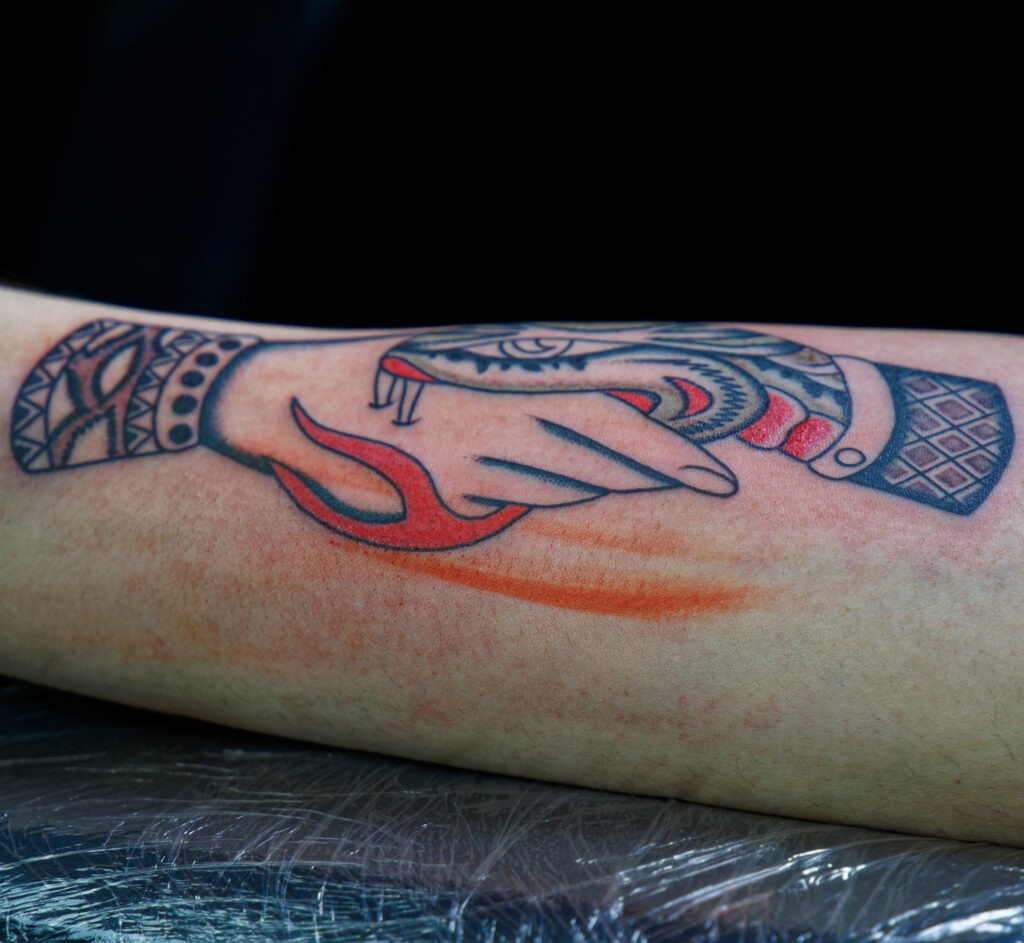
Colour choices change the snake’s character as surely as its pose does. A black-and-grey snake is the classic, restrained choice, and it ages well because black is the most stable pigment. A red snake is bolder and more aggressive, and it draws the eye immediately — but reds fade faster and are more likely to provoke a reaction, so they need more care. A green snake, less common, reads as a creature of water and vegetation. Some artists use a pale, almost white snake for the luck association, though pale ink needs a skilled hand and realistic expectations about how it will heal. Whatever colour you choose, ask to see healed examples of the same colours in the artist’s portfolio. Fresh colour always looks vivid; healed colour tells you what you will actually be wearing.
Placement: Where a Hebi Belongs on the Body
A snake is a long animal, and it needs a long canvas. The best hebi tattoos use the body’s length: an arm, a leg, a full back, a side that runs from ribs to hip. The coil winds around the limb, the head lands on the shoulder or the hand, and the tail tapers away where the limb narrows. This is why the forearm and the upper arm are the most popular placements for a first snake: they give the design room to move, they are easy to show or cover, and they are relatively forgiving to tattoo. A snake that wraps the forearm, with the head near the wrist or the elbow, reads as a living bracelet — and it is a design that works in almost any size, from a small, simple coil to a full, detailed serpent with scales, eyes and fangs.
The back is where the great snakes live. A full back piece gives the artist room for a snake that coils through water, around peonies or alongside a dragon, and the size allows the detail that makes the animal convincing: the scales, the forked tongue, the pattern of the belly. Our guide to full back tattoo designs shows how the great compositions use the whole back as a single picture, and a hebi is one of the best subjects for that format. The thigh is the other great canvas: it is large, relatively flat, and easy to cover, and a snake that coils around the thigh has the same winding energy as one on the arm, with more room for companions. The ribs are a harder choice — the skin is thin, the bone is close, and the sessions are painful — but a snake that follows the ribs can be spectacular, and our guide to the best rib cage tattoo designs explains how to plan for the pain.
Small snakes are a different proposition, and they need honesty about what they can do. A tiny snake on a wrist or an ankle can be charming, but it cannot carry the detail of a large piece: the scales become dots, the eyes become specks, and the coil becomes a wavy line. If you want a small snake, choose a simple design — a single smooth coil, a clean outline, minimal detail — and accept that it will be a suggestion of a snake rather than a portrait of one. A machine is often the better tool for very small work, because its fine lines hold detail at a scale the hand-poked method struggles to match. There is no shame in that: the right tool for a small snake is the machine, and the right tool for a large snake is often the hand. The design and the body should choose the tool, not the other way round.
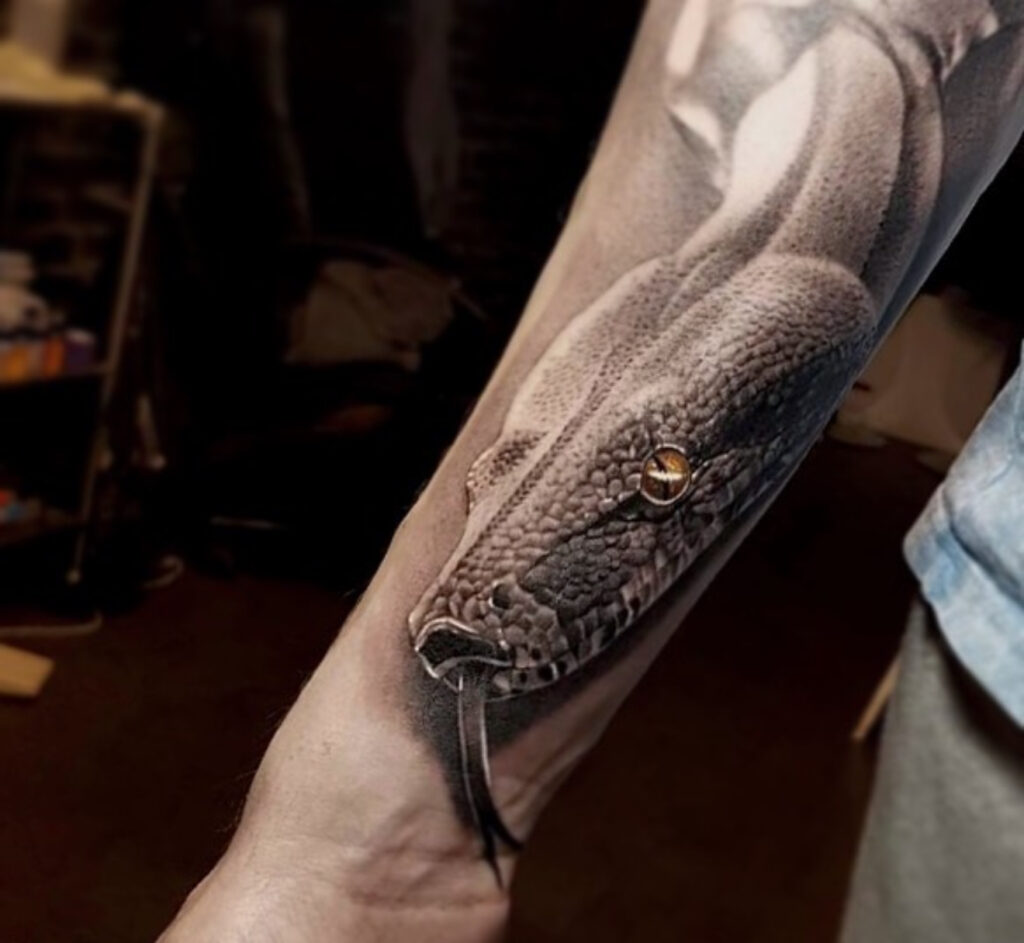
Think about how the tattoo will be seen, and by whom. A forearm snake is visible in a short-sleeved shirt; a back snake is private until you choose to show it; a thigh snake is yours alone most of the time. There is no right answer, but there is a right question: do you want this snake to be a public statement or a private one? In Japan, the answer was historically private — the bodysuit was hidden under clothes and shown only to those who understood it — and that history still shapes how many people think about large Japanese work. A snake on the hand or neck, by contrast, is a public declaration that cannot be hidden, and it carries consequences for work and for daily life. Choose the visibility as deliberately as you choose the design.
Hebi With Other Motifs: Peonies, Skulls, Dragons and Water
Snakes rarely travel alone in wabori, and the companions matter as much as the snake itself. The peony is the classic partner: a large, lush flower that stands for wealth, good fortune and a bold, unapologetic beauty, and its red petals against a dark snake make one of the most striking colour combinations in Japanese tattooing. Our guide to peony tattoo designs explains the flower’s own symbolism, and the pairing works because the two subjects balance each other — the flower is soft and open, the snake is hard and coiled, and together they say that beauty and danger live side by side. A snake and peony sleeve is one of the most reliable of all Japanese compositions, and it is a good first choice for anyone who wants a traditional piece without committing to a full bodysuit.
The skull pairing tells a darker story. A snake wrapped around a skull speaks of death and rebirth together: the skull is what remains, the snake is what renews, and the image as a whole is a reminder that endings and beginnings are the same process. It is a popular choice for people marking a loss, a recovery or a major change, and it works best at a large scale, where both subjects have room to be drawn properly. The dragon pairing is a contest: in Japanese art, the dragon and the snake are related powers, and a design that shows them together — sometimes fighting, sometimes circling each other — is a picture of forces in balance. Our guides to dragon tattoo designs and koi fish tattoo designs cover the two great companions of the snake in the water, and both pair naturally with a hebi that swims rather than strikes.
Water is the snake’s natural element in Japanese art, and it is also the element that ties a composition together. Wind bars, waves and clouds fill the background of a traditional piece, and a snake moving through water has a logic that a snake on a blank background lacks. The Koi article explains how the carp swimming upstream became a symbol of perseverance, and a snake and koi together make a picture of two creatures fighting the same current — a design that suits anyone who has had to keep swimming. Cherry blossom, by contrast, adds a note of impermanence: the flower falls, the snake remains, and the piece becomes a meditation on what lasts and what does not. Our guides to cherry blossom tattoo designs, samurai tattoo designs and tiger tattoo designs show how the same background elements serve very different subjects, and a good artist will use them to make your snake part of a larger picture rather than a lone animal on a blank field.
The geisha is a less obvious companion, and it works for a particular reason. A snake with a geisha pairs the most beautiful figure in Japanese tattooing with its most dangerous animal, and the contrast is the point: the geisha’s calm face against the snake’s coiled threat makes a picture of composure under pressure. Our guide to geisha tattoo designs covers the figure’s own meanings, and a hebi that winds around a geisha’s robes is a design that rewards a large canvas — a back, a thigh, a full sleeve — where both figures can be drawn at a scale that does them justice.
Choosing Your Hebi: Size, Style and Artist
Start with the story, then the size, then the artist — in that order. What do you want the snake to say? Protection after a hard time, a fresh start, a warning, a piece of luck? The answer decides the pose, the companions and the colour. Then decide how big the story needs to be: a small forearm coil can say “protection” in a single image, but a story about rebirth after loss may need a back piece with a skull, water and flowers to say it properly. A design that is too small for its story will feel cramped, and a design that is too large for a simple idea will feel empty. Your artist’s job is to match the size to the story, and a good consultation will spend more time on that question than on any other.
Then choose the artist with the same care you would choose a surgeon. Look for healed snake work in their portfolio, not just fresh photographs, and look specifically at the scales and the shading — those are where a weak snake falls apart. Ask how they learned, whether they work by hand or by machine, and how they would draw your snake to fit your body. The great masters of the tradition set a standard that is still the measure of the work: Horiyoshi III’s biography tells how one artist took the traditional bodysuit to its highest level and opened the tradition to the world, and his snakes — coiled, shaded, alive — remain the benchmark. You do not need a master of his standing, but you do need an artist who has drawn snakes before, and drawn them well, on bodies like yours.
Festivals and tradition are worth remembering when you choose, because they remind you what the tattoo is for. At the Sanja Matsuri festival in Tokyo, full bodysuits are worn openly in the streets, and the snake is among the motifs on display — not as a fashion statement, but as part of a living tradition. A hebi is a serious commitment, and it is worth treating it as one: take your time, save for the right artist, and do not rush the design. The snake will be with you for the rest of your life, and the difference between a good snake and a great one is usually the time spent before the first needle touches the skin. If you are still settling the overall style, our history of Japanese tattooing and our Japanese sleeve tattoo designs guide will help you place the snake in the wider picture.
Safety and Aftercare
A snake tattoo is a wound first and a picture second, and the wound needs the same care whatever the tool. Every tattoo breaks the skin, and every broken skin carries the same risks: infection, allergic reaction, and, where equipment is shared or reused, blood-borne disease. Mayo Clinic’s tattoo safety guidance advises checking that the studio is licensed, that it uses sterile, single-use needles and fresh ink for each client, and that the artist wears gloves and works on clean, disinfected surfaces — and it warns that tattoos can cause allergic reactions, skin infections and complications with MRI scans. Those checks apply to a tebori studio and a machine studio alike. A hand-poked snake made with reused needles is far more dangerous than a machine snake made with sterile equipment.
Ask the questions before you book. Is the studio licensed? Are needles single-use and opened in front of you? Is the ink from sealed, reputable bottles? Does the artist explain aftercare in writing? Tell the artist about any skin condition, allergy or medication, and mention it again on the day. Red ink deserves a particular mention with snake designs, because the bold reds often used for a striking snake are among the pigments most likely to provoke a reaction — if you have sensitive skin, discuss the colours before the design is finalised. And if anything about the studio feels wrong, walk away. There will always be another artist, and a tattoo is permanent.
Aftercare is the same for both methods and it is not optional. Keep the tattoo clean and lightly moisturised, avoid sun, pools, baths and saunas until the surface has healed, and do not pick at peeling skin. Expect soreness, redness and itching for a few days, and peeling for a week or two. See a doctor promptly if you notice spreading redness, swelling, heat, pus or a fever — those are signs of infection, and early treatment matters. A snake’s fine scale work is particularly unforgiving of poor aftercare: picking at a peeling scale can pull ink out of exactly the detail that makes the design work. Look after the healing, and the snake will keep its scales.
Our View: The snake is the motif we would most like to see chosen slowly. It is easy to pick a snake because it looks fierce, and it is easy to regret a fierce snake that means nothing to you. The hebi rewards the client who knows their story: the person who has shed a skin of their own and wants the mark of it, the person who wants a guardian rather than a decoration. If that is you, take the time to find the right artist, give the snake room to coil, and let the design grow out of your story rather than out of a picture you saw online. A snake chosen that way is not just a tattoo. It is a companion, and it will age with you.
— The Tattoo Designs Pictures editorial team
Frequently Asked Questions
What does a hebi snake tattoo mean?
In Japanese tattooing, the snake stands for protection, wisdom, good fortune and rebirth — the rebirth meaning comes from the snake shedding its skin. The exact message depends on the design: a coiled snake suggests patience and protection, a striking snake suggests defence, and the companions (peony, skull, dragon, water) add further layers.
Is a snake tattoo bad luck in Japan?
No — quite the opposite. Snakes, especially white snakes, are regarded as messengers of the gods and bringers of good fortune in Japanese folklore. The snake’s association with the underworld is a Western reading; in Japan the animal is a guardian as much as a danger.
Does a tebori snake hurt more than a machine snake?
Most people say it feels different rather than worse: a deep, rhythmic pressure instead of a constant scratching burn. Pain depends far more on placement — ribs and hands hurt more than arms and thighs — and on session length than on the tool.
Where is the best place for a snake tattoo?
The forearm, upper arm, thigh and full back suit the snake best, because they give the coil room to wind and the design room to move. Small, flat areas suit a simple snake; large, curved areas suit a detailed one. The placement should follow the snake’s length.
How long does a large hebi piece take?
A sleeve or back piece takes many sessions over months, and a full bodysuit takes years. Tebori is slower per session than machine work, so a hand-poked snake usually needs more appointments — plan for the long term and budget accordingly.
Questions or corrections? Have a question about hebi snakes, or spotted something we should fix? Visit Tattoo Designs Pictures and leave a comment — we read every one, and corrections from readers help keep these guides accurate.
Sources
- Encyclopaedia Britannica, “Tattoo” — britannica.com/art/tattoo
- Mayo Clinic, “Tattoos: Understand risks and precautions” — mayoclinic.org
- Wikipedia, “Irezumi” — en.wikipedia.org/wiki/Irezumi
- Wikipedia, “Tebori” — en.wikipedia.org/wiki/Tebori
- Wikipedia, “Tattoo” — en.wikipedia.org/wiki/Tattoo
- Wikipedia, “Ukiyo-e” — en.wikipedia.org/wiki/Ukiyo-e
- Wikipedia, “Horiyoshi III” — en.wikipedia.org/wiki/Horiyoshi_III
- Wikipedia, “Snake” — en.wikipedia.org/wiki/Snake
- Wikipedia, “Sanja Matsuri” — en.wikipedia.org/wiki/Sanja_Matsuri
- Wikipedia, “Koi” — en.wikipedia.org/wiki/Koi
- Wikipedia, “Japanese mythology” — en.wikipedia.org/wiki/Japanese_mythology
- Wikipedia, “Tattoo machine” — en.wikipedia.org/wiki/Tattoo_machine