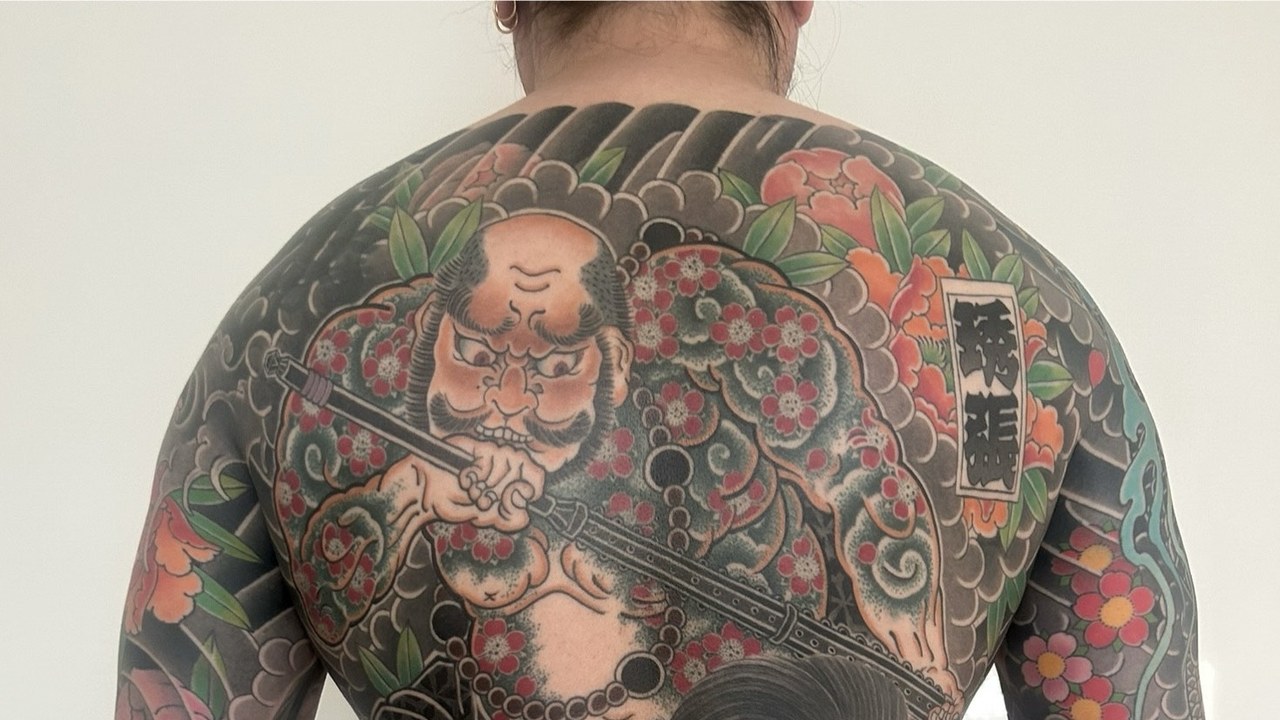
Ask three tattoo artists what wabori and tebori mean and you may get four answers. The confusion is understandable: the two words describe different things, yet they are used as if they were rivals. Wabori is the Japanese word for the traditional style of tattooing itself — the bold, full-body art of warriors, koi, dragons and peonies. Tebori is the method — hand-poking the ink into the skin with a rod and needle, without a machine. So the real question is not which one wins. It is whether the style you want should be made the old way, by hand, or the modern way, by machine, and what that choice changes about the pain, the healing, the price and the finished tattoo. This guide separates the two ideas, compares them honestly, and helps you decide which route fits your design, your body and your patience.
Related reading: New to the style? Start with our overview Wabori Tattoo: The Art and History of Japanese Tattooing — what wabori is, where it came from, and the motifs that define it.
Key Takeaways
- Wabori is the style; tebori is the technique. A wabori tattoo can be made by hand-poking or by machine, and the style does not change with the tool.
- Tebori uses a rod with grouped needles, pushed by hand. A tattoo machine uses an electric motor to drive the needles up and down many times a second.
- Hand-poked work is usually slower and often costs more per piece, because the artist covers less skin per hour.
- Tebori tends to produce softer shading and a slightly different healed texture, while machines give crisper, more uniform lines.
- Both methods carry the same health risks. Sterile equipment and a licensed studio matter far more than which tool is used.
- Choose the artist first and the method second. A master of either tool will give you a better tattoo than a novice with the “right” one.
Table of Contents
- Wabori and Tebori, Defined
- The Tools: Needles, Rods and Machines
- How the Ink Gets In: Technique and the Skin
- Pain, Healing and the Finished Look
- History: From Ukiyo-e to the Modern Studio
- Choosing Between Wabori and Tebori
- Safety and Aftercare: What to Check Before You Commit
- Frequently Asked Questions
Wabori and Tebori, Defined
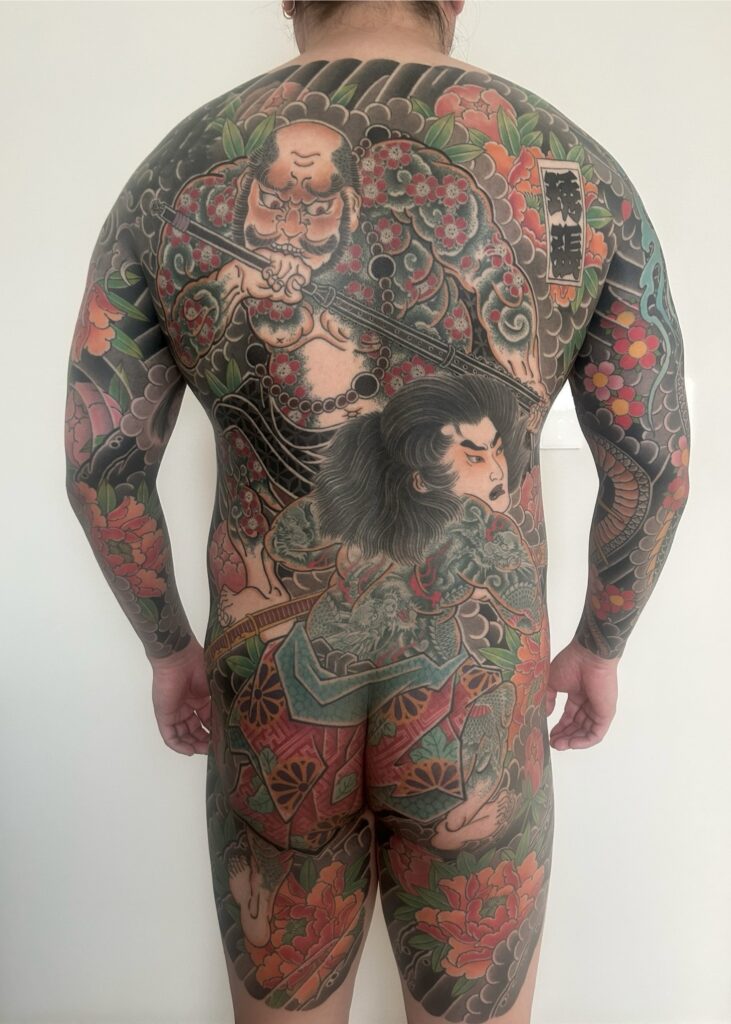
The first thing to get straight is that these two words answer different questions. Wabori — literally “Japanese carving” — is the name for the traditional Japanese tattoo style: large, flowing compositions that cover the back, chest, arms and legs in a single connected design. Tebori — “hand carving” — is the technique of pushing ink into the skin by hand, without electricity. The Irezumi article explains that irezumi is the broader Japanese word for tattooing, and wabori sits inside that tradition as its classic, full-body form. A tattoo can therefore be wabori in style and tebori in method, wabori in style and machine in method, or neither. Most of the confusion online comes from writers treating the two words as if they were two competing styles, when they are really a style and a tool.
Encyclopaedia Britannica describes tattooing as a form of body decoration made by inserting pigment into the skin, a practice found in cultures around the world and stretching back thousands of years — Britannica’s tattoo overview notes the famous Iceman, whose skin carried tattoos from around 3300 BCE. Japanese tattooing is one branch of that long history, and it developed its own tools, its own motifs and its own rules about what belongs where on the body. Wabori designs follow those rules: a background of wind bars, water and clouds ties separate motifs together, and the composition respects the body’s shape instead of fighting it. A dragon winds around the ribs, a koi swims up the arm, peonies fill the gaps. The result reads as one picture, not a collection of separate tattoos.
Tebori, by contrast, is a verb as much as a noun. The Tebori entry describes the hand-poked method in which the artist holds a rod tipped with a bundle of needles and drives it into the skin with a rhythmic pushing motion. There is no motor, no buzz, and no foot pedal. The artist controls depth and speed entirely by feel, which is why the method takes years to learn and why experienced practitioners guard their technique closely. The Tattoo article places this in context: most modern tattooing uses an electric machine, but hand-poking methods survive in several traditions, and Japan’s is among the most refined.
| Aspect | Wabori | Tebori |
|---|---|---|
| What it is | A style of Japanese tattooing | A hand-poking technique |
| The tool | Any tool — hand rod or machine | A rod with grouped needles, pushed by hand |
| Typical designs | Bodysuits, sleeves, back pieces, koi, dragons, peonies | Any design, but best known for large traditional work |
| Speed | Depends on the tool used | Slower; less skin covered per hour |
| Healed look | Bold, flowing, connected composition | Softer shading, slightly grainy texture |
| Cost driver | Size, detail and artist reputation | Time — long sessions add up |
The comparison table makes the point plainly: you cannot choose between wabori and tebori the way you choose between two styles, because they are not the same kind of thing. The real choice is between two ways of making a wabori tattoo — by hand or by machine — and the rest of this guide works through what that choice actually changes.
The Tools: Needles, Rods and Machines
A tebori rod looks almost too simple to be a tattoo tool. It is a long handle — traditionally bamboo or metal — with a bundle of fine needles fixed at one end and bound with silk thread. The artist grips it like a thick pen, dips the needles in ink, and pushes the tip into the skin with a short, firm stroke, over and over, sometimes hundreds of times a minute. The needle bundle is usually a row of needles soldered together, which lays down a broader line or a wash of shade in a single pass. Because the artist feels the skin give way under each push, the depth of the puncture is judged by touch rather than by a machine setting. Masters speak of listening to the skin — a soft, regular sound means the depth is right, while a harsh or hollow sound means the needle is going too deep or too shallow.
The tattoo machine works on a different principle. The tattoo machine article traces the modern device to Samuel O’Reilly’s 1891 electric machine, adapted from Thomas Edison’s electric pen, and explains that a motor or electromagnetic coils drive the needles up and down at high speed while the artist guides the machine across the skin. A coil machine can cycle more than a hundred times a second; a rotary machine spins a small motor to move the needle bar. The result is a very even puncture pattern, which is why machines excel at crisp, consistent lines and smooth, even colour packing. The artist still controls everything that matters — angle, depth, speed across the skin — but the machine supplies the force.
Needle groupings differ between the two approaches, and that changes the work. Machine artists choose from a wide catalogue of ready-made groupings: tight liners for fine outlines, round shaders for soft gradients, magnums for packing large areas of colour. Tebori artists traditionally make or adapt their own bundles, and the bundle’s shape is part of the artist’s signature — a wide, flat bundle lays shading quickly, while a narrow bundle draws a firm line. This is one reason a tebori apprenticeship is so long: the student must learn to build the tool, hold it, and read the skin, all at once. It is also why tebori work has a recognisable hand in it. Two tebori masters can tattoo the same design and produce pieces that look related but not identical, in the way two calligraphers writing the same word produce different hands.
Neither tool is “more authentic” in any simple sense. The body modification article treats tattooing as one of the oldest forms of deliberate body alteration, and Japanese tattooing has always borrowed and adapted: pigments changed when new colours arrived, and machines entered Japanese studios in the twentieth century without ending the hand-poked tradition. Many respected Japanese artists use both tools, choosing the rod for large shading and the machine for fine detail, or the reverse. The tool is a means, not a badge. What makes a tattoo wabori is the design language — the composition, the motifs, the background — not the device that delivered the ink. If you are comparing artists, look at their healed work first and ask about their tools second.
How the Ink Gets In: Technique and the Skin
Every tattoo, whatever the tool, works the same way at the level of the skin. Pigment must be placed in the dermis, the layer beneath the surface, where the body’s immune cells trap it and hold it in place for decades. Place it too shallow and it sheds with the surface skin; too deep and it spreads and blurs. The difference between tebori and machine is how the needle arrives at that depth. A machine needle enters and leaves the skin in a rapid, vertical cycle, hundreds of times a minute, and the artist moves the machine steadily so the punctures form a line or a field. A tebori needle enters on a pushing stroke driven by the artist’s arm and wrist, and the artist controls the rhythm, the force and the angle of every single puncture. The pace is slower — a good tebori artist might make a few punctures a second rather than a hundred — and the work has a visible rhythm to it, almost like sewing.
A traditional Japanese piece is built in stages, and the order matters. First comes the outline, called sujibori: the whole design is drawn on the skin in black, establishing every edge and every boundary. Then comes the shading, or bokashi: the black is washed and graduated to give the design its depth, with the dark areas near the edges fading into the untouched skin. Only after the shading is settled does the colour go in — reds, greens, blues and yellows, packed into the spaces the outline has defined. Each stage heals before the next begins, so a large piece is a series of appointments spread over months. The Irezumi article describes this staged, full-body approach as the heart of the tradition, and it is why a complete bodysuit is measured in years rather than weeks.
The design itself usually starts on paper, and that is where the ukiyo-e connection shows. The Ukiyo-e article covers the woodblock prints whose heroes, monsters and beauties supplied the imagery that tattoo artists still draw on — the same strong outlines, the same flat areas of bold colour, the same dramatic poses. A client and an artist would agree the design, the artist would draw it to fit the body, and the outline would be transferred to the skin. Tebori and machine artists both work this way today, and both still begin with the drawing rather than the tool. If the drawing is wrong, no tool will save it.
One practical difference is the sound and the feel of the session. A machine buzzes, vibrates, and produces a steady stream of sensation that most clients describe as a scratching burn. Tebori is quieter: there is the soft tapping of the rod, the artist’s breathing, and a series of distinct pushes that clients often describe as a deeper, duller pressure rather than a sharp sting. Neither is painless, and neither is unbearable for most people, but the experience is different enough that many clients who try tebori say the session feels calmer and more deliberate. The artist, too, works differently — leaning in, using body weight, moving with the client’s breathing — and that closeness is part of what devotees of the method value. It is a slower, more physical encounter between artist and client, and for some people that is the whole point.
The skin itself does not care which tool you choose, but it does care how it is treated. Overworked skin — too many passes, too much pressure, too little rest between sessions — will heal poorly whatever the tool. A careful artist, hand or machine, works the skin once and leaves it alone. That is the real technical difference to look for in a portfolio: not the tool, but the healed skin. Ask to see photographs of work healed for a year or more. Fresh tattoos all look good; healed tattoos tell the truth.
Pain, Healing and the Finished Look
Pain is the question everyone asks first, and it is the hardest to answer honestly. Pain depends on the placement, the size of the piece, the length of the session and the person. Bony areas and thin skin hurt more; large flat areas hurt less. A session on the ribs will test anyone, which is why our guide to the best rib cage tattoo designs spends time on placement and pain before it talks about imagery. Tebori clients often report that the pain is different rather than less: a deep, rhythmic pressure instead of a high, constant sting. Some find it easier to endure over a long session; others find the machine’s steady buzz easier to tune out. There is no reliable way to predict which you will prefer until you have felt both, and any artist who promises that one method is painless is selling you something.
Healing follows the same timetable for both methods. The surface heals in about two weeks, with peeling, itching and tenderness along the way, and the deeper skin continues to settle for a month or more. The aftercare is identical: keep it clean, keep it lightly moisturised, keep it out of the sun and out of pools and baths until the surface has closed. What differs is the texture of the healed tattoo. Machine work tends to heal with very even, crisp edges; tebori work often heals with a slightly softer edge and a fine, almost stippled texture in the shading, because each puncture is placed by hand rather than by a motor. Over years, both soften. A well-made tattoo of either kind will still read clearly after a decade; a poorly made one will blur whatever tool made it.
Colour behaves much the same in both. Black is the most stable pigment, reds and yellows the most likely to fade or to provoke a reaction, and sun exposure is the great enemy of all of them. Tebori shading, the bokashi wash, is often praised for the way it ages: because the pigment is laid in a graduated wash rather than a flat field, the shading keeps its sense of depth as it softens. Machine shading can achieve the same effect, and modern machine artists use the same wash techniques. The difference, again, is in the hand rather than the hardware. If you love the soft, smoky shading of classic Japanese work, ask the artist how they shade — by hand or by machine — and look at their healed shading, not their fresh photographs.
There is also a practical question of touch-ups. Large traditional pieces are living projects: the artist expects to see the client again, to deepen a shadow here, to refresh a red there, and to extend the design as the client’s ideas grow. A tebori artist who has built the piece will know exactly how the skin took the ink the first time and will adjust accordingly. A machine artist has the same advantage. Either way, the relationship with the artist matters more than the tool, because a bodysuit is a collaboration that lasts years. Choose someone you trust, whose healed work you admire, and whose studio you would be happy to return to again and again.
History: From Ukiyo-e to the Modern Studio
Japanese tattooing did not appear from nowhere; it grew out of the print culture of the Edo period. Woodblock prints were the mass media of their day, and the heroes of novels and kabuki — tattooed outlaws, warriors and rogues — became the imagery that clients asked for on their own skin. The Ukiyo-e article describes the print tradition that gave tattoo artists their visual language: bold outlines, flat colour, dramatic composition. The artist Kuniyoshi, whose print series of tattooed heroes made the look fashionable in the 1820s, is still the single greatest influence on wabori design, and his compositions are copied in studios around the world today. Our own history of Japanese tattooing traces this story in more detail, from the early marks of the Jomon period to the great masters of the nineteenth century.
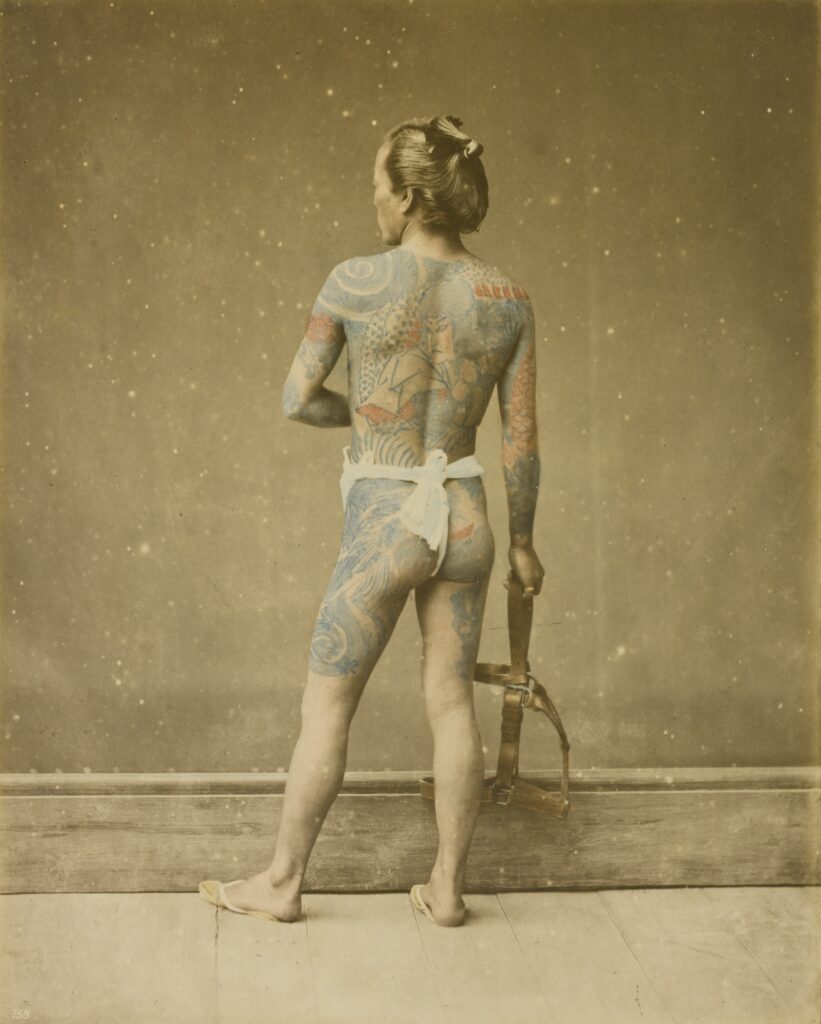
The nineteenth century also brought the ban that shaped the tradition. When Japan opened to the world in the Meiji era, the government banned tattooing as part of a drive to appear modern to Western eyes, and the art went underground for decades. Tattooing did not disappear; it retreated into the world of firefighters, labourers and the underworld, and it survived because its practitioners kept working in private. That underground history is why full bodysuits became associated with the yakuza: the Yakuza article notes the long association between organised crime in Japan and the full-body tattoo, an association that still colours public attitudes today, even though most people who wear irezumi now have no connection to crime at all. The ban was eventually lifted, but the stigma lingered, and it still explains why many Japanese baths and gyms ask tattooed visitors to cover up.
The revival of the art in the twentieth century owes a great deal to a handful of masters, above all Horiyoshi III. Horiyoshi III’s biography tells the story of an artist who took the traditional bodysuit to its highest level and, crucially, opened the doors of the tradition to the outside world, accepting foreign clients and teaching the discipline behind the work. Before him, a full bodysuit was something you earned through years of sitting; after him, it became something a dedicated client anywhere in the world could aspire to. His work set the standard that every serious wabori artist is still measured against, and his influence is visible in the Japanese sleeve tattoo designs and the Japanese tattoo designs for men that fill studios today.
Festivals still show the tradition at its most public. At the Sanja Matsuri festival in Tokyo, members of the public can see full bodysuits worn openly, carried through the streets on the shoulders of their owners. It is one of the few occasions when a tradition that is usually hidden is put on display, and it is a reminder that irezumi was always meant to be seen — by the wearer, by their peers, and by the community that understands what the images mean. The motifs themselves carry old meanings: the Koi article explains how the carp, swimming upstream, became a symbol of perseverance, while Japanese mythology supplies the dragons, demons and gods that populate the great back pieces. A wabori tattoo is never just decoration; it is a story told in pictures, and the story is older than the person wearing it.
Choosing Between Wabori and Tebori
Start with the design, not the tool. What do you want, and where do you want it? A full back piece, a sleeve, a chest panel — the great traditional compositions work in either method, and the choice of tool will not change the design. What it changes is the experience and the schedule. If you want the work done as quickly as possible, the machine is faster. If you want the experience of the traditional method — the quiet room, the rhythmic pushing, the sense of taking part in a centuries-old practice — tebori is the only way to get it. If you want a small, finely detailed piece, such as a geisha tattoo design with delicate facial features, a machine may serve the detail better; if you want a large, soft-shaded bodysuit, tebori’s wash shading may be exactly the look you are after. Our guides to snake tattoo meanings, koi fish tattoo designs and dragon tattoo designs can help you settle the imagery before you settle the method.
Then consider the practical questions: time, money and access. A tebori bodysuit takes longer, and because most artists charge by the hour or by the session, it usually costs more. A full bodysuit by either method is a major commitment — months or years of sessions, and a price that runs into thousands — so the difference between the methods is real but small compared with the total. Access matters more: there are far fewer skilled tebori artists than machine artists, and the best of them have waiting lists measured in months or years. If you live far from a tebori master, you will be travelling for every session, and that travel becomes part of the cost. A local machine artist whose healed wabori work you love is a better choice than a distant tebori master you can only see twice a year.
Finally, think about the relationship. A large tattoo is a collaboration, and you will spend many hours with this person, in a vulnerable position, over a long period. Meet the artist first. Look at healed work, not just fresh photographs. Ask how they work, how they learned, and how they handle aftercare and touch-ups. A good artist will answer plainly and will turn away work they cannot do well. If you are planning a large piece, our guides to full back tattoo designs and back tattoos for men show how the great compositions use the body’s shape — and a good consultation will do the same for your body, your design and your budget.
Safety and Aftercare: What to Check Before You Commit
The tool does not make a tattoo safe; the studio does. Every tattoo breaks the skin, and every broken skin carries the same risks: infection, allergic reaction, and, where equipment is shared or reused, blood-borne disease. Mayo Clinic’s tattoo safety guidance advises checking that the studio is licensed, that it uses sterile, single-use needles and fresh ink for each client, and that the artist wears gloves and works on clean, disinfected surfaces — and it warns that tattoos can cause allergic reactions, skin infections and complications with MRI scans. Those checks apply equally to a tebori studio and a machine studio. A hand-poked tattoo made with reused needles is far more dangerous than a machine tattoo made with sterile equipment, and the reverse is equally true.
Ask the questions before you book, not after. Is the studio licensed? Are needles single-use and opened in front of you? Is the ink from sealed, reputable bottles? Does the artist explain aftercare in writing? A good studio will welcome these questions; a bad one will rush you past them. Tell the artist about any skin condition, allergy or medication you take, and mention it again on the day — some conditions and medicines change how skin heals. If you have ever reacted to a tattoo, a piercing or a metal, say so. And if anything about the studio feels wrong — dirty surfaces, reused gloves, vague answers — walk away. There will always be another artist, and a tattoo is permanent.
Aftercare is the same for both methods and it is not optional. Keep the tattoo clean and lightly moisturised, avoid sun, pools, baths and saunas until the surface has healed, and do not pick at peeling skin. Expect soreness, redness and itching for a few days, and peeling for a week or two. See a doctor promptly if you notice spreading redness, swelling, heat, pus or a fever — those are signs of infection, and early treatment matters. A good artist will give you written aftercare instructions and will answer questions during healing; if yours does not, that is itself a warning sign. The tattoo you take home is only half the work — the other half is how you look after it.
Our View: The wabori-versus-tebori debate is mostly a misunderstanding, and it distracts people from the decision that actually matters. Wabori is a style with a history worth respecting; tebori is a beautiful, demanding way of making it, and the machine is a legitimate, modern way of making it too. We would rather see a client choose a great machine artist they can visit regularly than chase a tebori master they can barely afford to see — and we would rather see a client wait a year for the right tebori artist than settle for a poor imitation of the hand-poked look. The tool is the artist’s choice. Your choice is the artist, the design, and the commitment to see a large piece through to the end.
— The Tattoo Designs Pictures editorial team
Frequently Asked Questions
Is tebori the same as wabori?
No. Wabori is the traditional Japanese tattoo style — the large, flowing compositions of warriors, koi, dragons and peonies. Tebori is the hand-poking technique used to make tattoos. A wabori tattoo can be made by tebori or by machine.
Does tebori hurt more than machine tattooing?
Most people say it hurts differently rather than more. Tebori is often described as a deep, rhythmic pressure, while a machine feels like a constant scratching burn. Pain depends far more on placement and session length than on the tool.
How long does a tebori bodysuit take?
A full bodysuit takes years by either method, with sessions spread over months. Tebori is slower per session, so the same design usually needs more appointments — and more patience — than the machine equivalent.
Is tebori safer than machine tattooing?
No. Both methods carry the same risks of infection and allergic reaction. Safety depends on sterile, single-use equipment, a licensed studio and proper aftercare, not on the tool.
Can any design be done by tebori?
Almost any design can be hand-poked, but very fine detail and tiny lettering are harder by hand than by machine. Large, bold, traditionally shaded designs are where tebori shines; delicate miniature work is usually better done by machine.
Questions or corrections? Have a question about wabori or tebori, or spotted something we should fix? Visit Tattoo Designs Pictures and leave a comment — we read every one, and corrections from readers help keep these guides accurate.
Sources
- Encyclopaedia Britannica, “Tattoo” — britannica.com/art/tattoo
- Mayo Clinic, “Tattoos: Understand risks and precautions” — mayoclinic.org
- Wikipedia, “Irezumi” — en.wikipedia.org/wiki/Irezumi
- Wikipedia, “Tebori” — en.wikipedia.org/wiki/Tebori
- Wikipedia, “Tattoo” — en.wikipedia.org/wiki/Tattoo
- Wikipedia, “Ukiyo-e” — en.wikipedia.org/wiki/Ukiyo-e
- Wikipedia, “Horiyoshi III” — en.wikipedia.org/wiki/Horiyoshi_III
- Wikipedia, “Yakuza” — en.wikipedia.org/wiki/Yakuza
- Wikipedia, “Koi” — en.wikipedia.org/wiki/Koi
- Wikipedia, “Japanese mythology” — en.wikipedia.org/wiki/Japanese_mythology
- Wikipedia, “Tattoo machine” — en.wikipedia.org/wiki/Tattoo_machine
- Wikipedia, “Body modification” — en.wikipedia.org/wiki/Body_modification