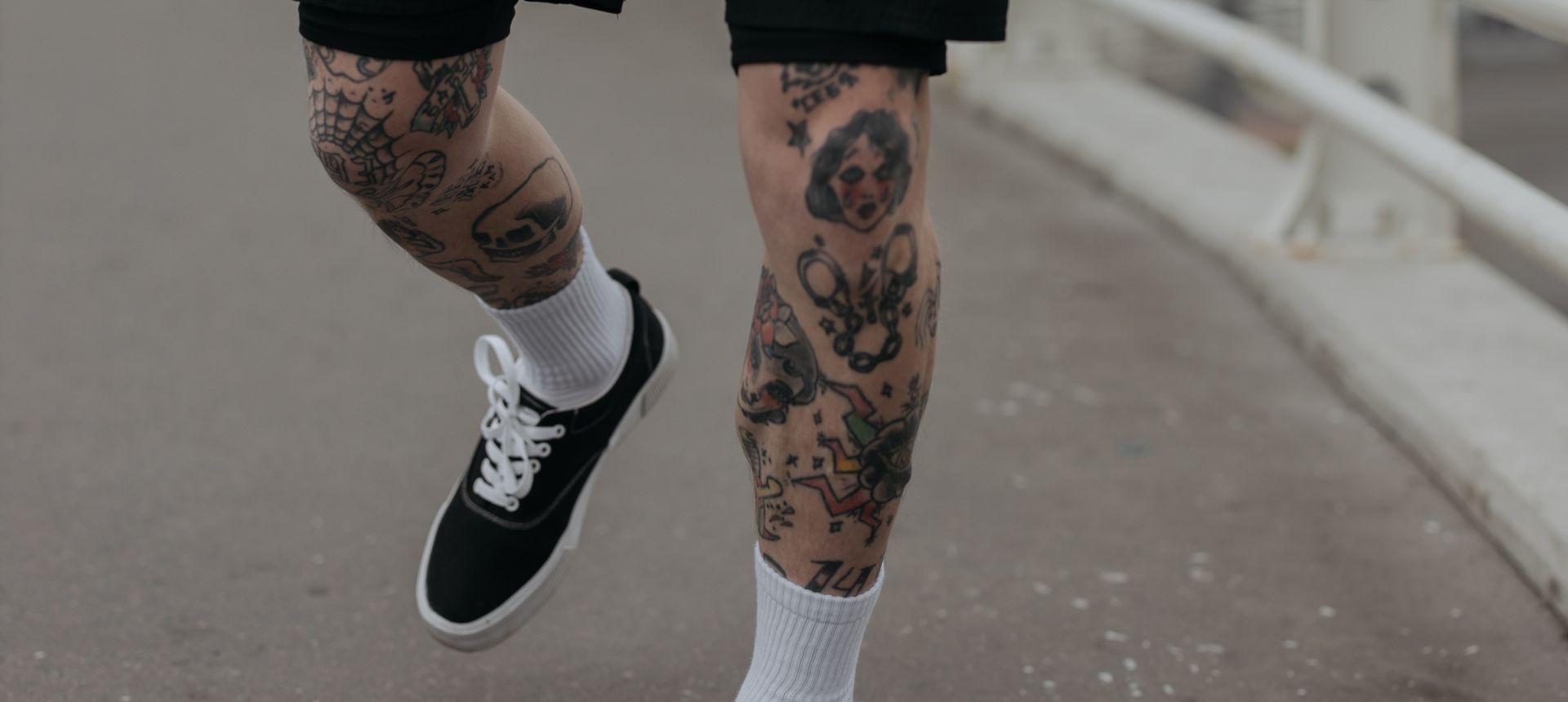
The knee is one of the most demanding places on the body to tattoo, and also one of the most rewarding. It is a working joint that bends hundreds of times a day, a patch of thin skin stretched over bone, and a spot that everyone sees when you wear shorts, sit down, or walk up a flight of stairs. A knee tattoo that is planned around the kneecap itself can look bold, balanced, and deliberate for decades. A knee tattoo that treats the joint like a flat piece of paper will warp, blur, and disappoint. This guide walks through the designs that actually work on a knee, the placements in front of, beside, above, and below the joint, how much it hurts, how healing really goes when the leg never stops moving, and how to live with the result at work, at the gym, and in everyday clothes.
Key Takeaways
- Design around the kneecap. Round, radial, and symmetrical designs suit the joint. Long straight lines and small text do not.
- Front of the knee is the boldest placement and the most painful. Above and below the knee are easier to heal and easier to hide.
- The design will change shape when the leg bends. A good artist stencils the knee bent, straight, and halfway between.
- Healing takes longer than a flat-area tattoo. Bending, sitting, stairs, and tight trousers all pull at the healing skin.
- Wear loose trousers for at least two weeks. Friction from denim and work trousers is the most common cause of a patchy knee heal.
- Choose an artist who has healed knee work to show you. Ask to see photos taken months later, not just fresh photos.
Table of Contents
- What the Knee Does to a Design
- The Best Knee Tattoo Designs by Style
- Front, Side, Above, and Below: Choosing Your Placement
- How Painful Is a Knee Tattoo
- Healing a Knee Tattoo When the Joint Never Stops Moving
- Work, Clothes, and Everyday Life With a Knee Tattoo
- Working With Your Artist and What a Knee Tattoo Costs
- Our View
- Frequently Asked Questions
- Sources
- Recommended
What the Knee Does to a Design
Start with the anatomy, because the anatomy explains almost every decision that follows. The knee is the joint that connects the thigh with the leg, and it is the largest joint in the human body. It is made up of two main joints, one between the femur and the tibia and one between the femur and the patella, and it works mainly as a hinge that bends and straightens the leg. That hinge action is the whole problem for a tattoo. A design that looks perfect while the leg is straight will stretch, fold, and pinch when the leg bends, and a design that is placed to look right while you sit may look off-centre while you stand. The patella, the kneecap, sits in the middle of it all as a small, flat, triangular bone, and it is the largest sesamoid bone in the body, which means it is a bone that forms inside a tendon. Skin over the patella is thin, tight, and almost without fat underneath, so the needle works close to bone and the ink sits in skin that is pulled in a different direction with every step.
The bones above and below the joint matter too. The femur is the thigh bone, the longest and strongest bone in the body, and the tibia is the larger of the two shin bones below it. The knee is classified as a synovial joint, a fluid-filled joint that allows a wide range of movement, and that movement is constant. You bend your knees to sit, to stand, to climb stairs, to drive, to kneel, and to pick things up. Even sleeping does not leave the knee still for long. Every one of those bends pulls the healing skin, and that is why a knee tattoo heals differently from a tattoo on the upper arm or the upper thigh, where the skin barely moves. The lesson is not to avoid the knee. It is to choose a design that expects movement and to place it where movement helps rather than hurts.
The comparison table below sums up the five placements most people consider, and how each one behaves once the leg starts moving. Use it as a shortlist, then read the placement section further down before you commit to any of them.
| Placement | Best suited to | How it changes when the leg bends | Pain and healing |
|---|---|---|---|
| Front of the kneecap | Mandalas, spiderwebs, moths, geometric stars | Stretches wide and flattens when bent; folds slightly when straight | High pain; slow heal; most friction |
| Above the knee | Floral pieces, script, small portraits, moths | Stays fairly flat; creases only at the top of the bend | Moderate pain; easier heal |
| Below the knee | Shin wraps, daggers, snakes, botanical stems | Moves with the shin; little distortion | Moderate pain; good heal if trousers are loose |
| Inner side of the knee | Small symbols, dots, fine line work | Folds and creases deeply when bent | Moderate to high pain; can blur if too detailed |
| Outer side of the knee | Floral, traditional, and geometric panels | Stretches gently; holds its shape well | Moderate pain; reliable heal |
One more anatomical point is worth knowing before you look at styles. The skin is the largest organ of the body, and a tattoo works by placing pigment into the dermis, the layer of skin beneath the surface. On the knee, that dermis is thin and tightly bound to the tissue underneath, so there is little room for error. An artist who goes too shallow loses ink as the surface heals. An artist who goes too deep risks blowout, where ink spreads under the skin and lines go soft. A good knee tattoo is a matter of depth control, and depth control is a matter of experience, which is why this placement rewards choosing the right artist more than almost any other.

The Best Knee Tattoo Designs by Style
With the anatomy understood, the style choices get easier. The designs that age best on a knee share three traits. They are built around a centre point, they use bold lines that survive stretching, and they do not depend on tiny detail that the joint will blur. The mandala is the classic example. A mandala is a radial pattern that grows outwards from a single centre, and the kneecap gives it that centre for free. Place the heart of the mandala on the patella and let the pattern spread across the front of the knee, and the design looks deliberate when the leg is straight and still reads clearly when the leg bends, because the pattern is symmetrical in every direction. Dotwork mandalas, blackwork mandalas, and mandalas with a small floral centre all work. Keep the finest lines in the outer rings, where the skin moves least, and keep the centre bold.
The spiderweb is the other knee classic, and it works for the same reason. A web is drawn from a centre point on the kneecap, with straight lines radiating out and curved lines joining them, and it was one of the first designs tattoo artists placed on elbows and knees because the shape of the joint does the work. A traditional black spiderweb suits a bold, old-school look. A finer web with a small spider, a fly, or a dewdrop detail suits someone who wants the same idea with a lighter touch. The web also connects well to other leg work. It can sit alone on the kneecap or join a larger leg piece, and it is one of the few knee designs that looks good even as it ages and softens, because a web is meant to look organic rather than precise. If you want a design that will still read as a web in twenty years, this is a strong candidate.
Moths and butterflies are the most popular figurative choice for the knee, and the reason is the wings. A moth with its wings spread fits the shape of the front of the knee almost exactly, with the body sitting over the kneecap and the wings spreading to either side. A death’s-head moth, a luna moth, or a simple black moth all work, and the antennae can run up the thigh or down the shin to tie the piece into the rest of the leg. The same idea works with a butterfly, and our guide to dragonfly tattoo meaning explains how another winged insect is read in Japanese tattooing, which is useful if you want your moth to carry a meaning rather than just a shape. Keep the body of the insect bold and the wing detail simple. Fine wing veins are the first thing a bending knee will blur.
Geometric designs are the fourth strong family. Triangles, stars, sacred geometry, and repeating line patterns all suit a joint because they are built from shapes that tolerate distortion. A geometric star centred on the kneecap, a triangle that points up the thigh, or a band of repeating pattern that wraps the knee like a bracelet all hold up well. Blackwork geometric pieces are particularly forgiving, because solid black shapes stay readable even as edges soften with age. The risk with geometry is precision. A geometric design that depends on perfectly straight lines and exact spacing will show every millimetre of movement, so ask your artist to build in slight curves and generous spacing rather than hairline precision. The best geometric knee tattoos look hand-drawn on purpose, not machine-perfect.
Floral designs can work beautifully on a knee, but they need to be chosen with care. A single large flower centred on the kneecap, a rose or a peony with open petals, can be striking, because the petals spread in the same radial pattern as a mandala. Our guide to peony tattoo meaning and our guide to chrysanthemum tattoo meaning both explain how those flowers are read in Japanese tattooing, and a large chrysanthemum is one of the best floral choices for a knee because its layered petals hide distortion well. Small, delicate flowers with thin stems are a poor choice for the front of the knee. They belong above the knee or on the outer side, where the skin moves less. The same rule applies to script. A word or a date wrapped around a knee will bend and fold with the joint, so keep lettering short, bold, and placed above or below the kneecap rather than across it.
Traditional American designs, with bold outlines and solid colour, are another reliable family. A traditional rose, a dagger, a snake, or a panther head can all sit on the front of the knee if they are drawn large and simple. The bold black outline is the key. It holds the shape together as the skin stretches, and the solid colour fills stay visible for years. Fine-line realism, small portraits, and detailed scenes are the designs to avoid on the front of the knee. They need a flat, stable surface, and the knee is neither. If you love a portrait or a detailed scene, place it on the thigh above the knee or on the shin below it, and let the knee itself carry a simpler design that frames it. That combination, a detailed piece above and a bold piece on the joint, is how many of the best leg sleeves are built.
Front, Side, Above, and Below: Choosing Your Placement
The front of the kneecap is the placement most people picture when they say knee tattoo, and it is the hardest one to get right. It is also the most visible and the most striking. A design on the front of the knee is on display every time you wear shorts, sit with your legs crossed, or walk past someone at eye level with a seated crowd. It is the placement for a statement piece, a mandala, a web, a moth, or a bold traditional design that you want people to notice. It is also the placement with the most pain, the slowest heal, and the most distortion. Go into it with your eyes open. The stencil session matters more here than anywhere else on the leg. Your artist should stencil the design with your leg straight, then ask you to bend the knee, sit down, and stand up again while they check how the lines move. If the design only looks right in one position, it is not finished yet. A good artist will adjust the stencil two or three times before the needle touches skin, and that is a sign of care, not indecision.
Above the knee is the most forgiving placement in this guide, and it is the best choice for a first knee-area tattoo. The skin above the patella is flatter, softer, and less tightly bound to bone, so fine detail survives better and healing is simpler. Floral pieces, small portraits, script, and moths all work well here, and the area connects naturally to a thigh piece above or a knee piece below. It is also the easiest placement to hide with shorts that are a little longer, and the easiest to protect from friction, because the top of the knee spends less time pressed against trouser fabric than the front of the joint. If you want a detailed design near the knee without taking on the full difficulty of the kneecap itself, start above it. You can always add the kneecap later, once you know how your skin heals on a joint.
Below the knee, the shin takes over, and the shin is a much kinder surface. A dagger, a snake, a botanical stem, or a wrap-around band can run from just below the kneecap down the shin, and the design will move with the leg rather than against it. Our guide to best calf tattoo designs covers the larger leg pieces that pair with a below-knee design, including snake wraps and daggers that use the length of the shin. Below-knee work also suits people who kneel at work, because the design sits clear of the point of contact when you kneel on a pad, although you should still avoid kneeling on a fresh tattoo for several weeks. The main risk below the knee is the same as anywhere on the shin. The skin is thin over bone, so the tattoo will hurt, and tight boots and long socks can rub the healing skin.
The sides of the knee are the quiet choices, and they suit people who want a knee tattoo that is visible from the side rather than head-on. The outer side holds its shape well because the skin there stretches gently when the leg bends, and it suits floral panels, traditional pieces, and geometric designs that follow the line of the leg. The inner side is trickier. The skin on the inside of the knee folds deeply when the leg bends, and any fine detail placed in the fold will blur or fade faster than the same detail anywhere else. If you love the inner knee, keep the design small, bold, and simple, with dots, small symbols, or a single thick line, and accept that it may need a touch-up sooner than a design on the outer side. For a sense of how other joints behave, compare the sides of the knee with the sides of the ankle in our guide to best ankle tattoo designs, where the same folding problem appears in miniature, and with the hip in our guide to best hip tattoo designs, where the skin is far more forgiving.
One placement decision is easy to overlook, and it is the relationship between the knee and the rest of the leg. A knee tattoo rarely lives alone. It sits between a thigh piece and a shin piece, or it anchors a full leg sleeve, and the design should respect that. Talk with your artist about the whole leg, even if you only plan to tattoo the knee this year. A mandala on the kneecap can become the centre of a leg sleeve later. A floral piece above the knee can grow into a thigh piece. A web on the knee can connect to a web on the elbow, which is why so many people who have one joint tattooed end up with the other, as our guide to best elbow tattoo designs explains. Planning the leg as a whole does not commit you to a sleeve. It simply stops a knee tattoo from blocking a design you might want later.
How Painful Is a Knee Tattoo
There is no way to soften this. A knee tattoo is one of the most painful tattoos you can get, and anyone who tells you otherwise has either never had one or has a very high pain tolerance. The reasons are straightforward. The skin over the kneecap is thin, the bone is directly underneath, and the area is rich in nerve endings. There is almost no fat to cushion the needle, and the vibration of the machine travels straight into the bone, which many people describe as a deep, rattling ache on top of the sharp pain of the needle itself. The inner side of the knee, where the skin is thinner still and the nerves run close to the surface, is often described as worse than the front. The areas above and below the knee hurt less, but they still hurt more than the fleshy parts of the thigh or calf.
Pain is personal, and it helps to know what actually changes it. A large, solid piece hurts more than a small, light one, simply because the needle is in the skin for longer. A long session on the knee is harder than two shorter sessions, because the skin becomes more sensitive as the session goes on and the joint stiffens from holding one position. Your state on the day matters too. Being well rested, well fed, and hydrated helps, while being tired, hungover, or stressed makes the same tattoo feel worse. The Mayo Clinic guide to tattoo risks is worth reading before any tattoo, and it covers the safety questions to ask your artist, including how the studio handles hygiene and aftercare. Numbing cream is a question to raise with your artist in advance, not on the day. Some artists welcome it, some find it changes the skin and makes their work harder, and some will not work over numbed skin at all. If you want to use it, ask early and follow your artist’s advice.
What does the pain actually feel like, in practice? Most people describe the first few minutes as the worst, because the surprise of the needle on bone is sharper than the pain itself. After that, the body settles into a rhythm, and the pain becomes a steady, hot ache with sharper spikes when the needle crosses the centre of the kneecap or the inner edge. Breathing helps more than bracing. Slow, steady breathing keeps the leg still, and a still leg is a leg your artist can work on cleanly. Tensing the leg makes the skin tighter and the needle work harder, which hurts more and heals worse. If you need a break, ask for one. A five-minute break to stand, stretch, and bend the knee gently is better than sitting through pain so intense that you flinch, because a flinch can spoil a line. A good artist will offer breaks without being asked, and will check in when the work crosses the most sensitive spots.
It is worth comparing the knee with other painful placements so you can judge your own tolerance honestly. The elbow is the closest comparison, and our elbow guide describes the same bone-on-bone vibration and the same need for breaks. The foot is another useful comparison, because the skin is similarly thin over bone, and our guide to best foot tattoo designs covers the same trade-off between a striking placement and a hard heal. The shoulder blade and the collarbone are gentler by comparison, and our guides to best shoulder blade tattoo designs and best collarbone tattoo designs are useful if you want a visible tattoo with less pain while you build up to the knee. If you have never been tattooed before, do not make the knee your first tattoo. Get a smaller piece on a flatter, fleshier area first, learn how your body reacts to being tattooed, and then come back to the knee with realistic expectations.
Healing a Knee Tattoo When the Joint Never Stops Moving
Healing is where knee tattoos are won or lost, and it is the part most people underestimate. A tattoo is a wound, and wound healing follows a predictable sequence of inflammation, new tissue growth, and remodelling, but on the knee that sequence is constantly interrupted by movement. Every time you bend the joint, the healing skin stretches. Every time you sit down, the skin folds. Every time you climb stairs, the skin pulls tight and then slackens again. The result is a heal that takes longer than a tattoo on a flat area, and that is more likely to scab heavily, lose small patches of ink, or need a touch-up. That is normal for this placement, not a sign that something has gone wrong, and a good artist will tell you so before you book, rather than after you panic about a scab.
The first three days are the most delicate. The tattoo will weep plasma, feel hot and tight, and look darker and sharper than it will when it settles. Keep the leg as straight as you comfortably can during this stage, and avoid sitting with the knee bent for long stretches. When you sit, put the leg up on a stool or a cushion with the knee slightly bent rather than folded at a right angle. Sleep with a pillow under the leg to keep the knee from bending too far overnight. Wash the tattoo gently with lukewarm water and a mild, fragrance-free soap, pat it dry with a clean towel or paper towel, and apply only the thin layer of aftercare your artist recommends. Thick layers of ointment trap moisture against the wound and soften the scabs, which can pull ink out with them. Less is more, and your artist’s instructions matter more than any general advice, including this guide.
From day four to about day fourteen, the tattoo will start to scab and flake. On a knee, the scabs are often thicker and slower to fall off than elsewhere, because the skin keeps cracking as it moves. Do not pick at them, and do not pull at loose edges, even when a scab catches on your trousers. Let every scab fall off on its own. Picking is the fastest way to lose ink and to leave a pale patch that needs a touch-up, and it is also the fastest way to introduce infection into a healing wound. If a scab does catch and tear, wash the area gently, keep it clean, and tell your artist. They have seen it before, and they would rather know early than discover it at your touch-up appointment. Scar tissue is another risk to keep in mind. A knee tattoo that is overworked, picked at, or infected can heal with raised or textured skin, and that texture will show in the finished tattoo.

The full surface heal usually takes two to three weeks, and the deeper healing underneath takes four to six weeks or longer. Do not judge the finished tattoo until at least a month has passed. During the first weeks it will look cloudy, dull, or milky as new skin grows over the ink, and that is normal. The colour sharpens as the skin settles. Avoid baths, swimming pools, hot tubs, and the sea until the tattoo is fully healed, and keep it out of direct sun. Sunlight fades new ink fast, and a sunburn on a healing knee tattoo can damage it badly. Once it is healed, sunscreen is a lifelong habit for any tattoo, and it matters more on the knee than on a covered area because the knee is exposed whenever you wear shorts. Book your touch-up check for six to eight weeks after the session, once the skin has fully settled, and budget for it as part of the cost of the tattoo rather than as an optional extra.
Work, Clothes, and Everyday Life With a Knee Tattoo
Clothes are the practical problem nobody warns you about. Trousers are the enemy of a healing knee tattoo, and work trousers are the worst of all. Denim is stiff and rough, suit trousers are tight across the knee when you sit, and uniform trousers often have a seam that runs exactly across the kneecap. That seam rubs the healing skin with every step and every bend, and it is the most common reason a knee tattoo heals patchily. The fix is simple but needs planning. Wear the loosest trousers you own for at least two weeks, and choose soft fabrics such as cotton jersey, linen, or soft sweatpants. Shorts are better than trousers while the tattoo heals, if the weather and your workplace allow them, because they remove friction entirely. If you must wear trousers for work, choose a pair a size larger than usual, or a pair with a relaxed fit through the knee, and change into shorts as soon as you get home.
Work itself needs a plan, especially if your job involves kneeling, squatting, climbing, or long periods of sitting. Kneeling on a fresh knee tattoo is out of the question for at least three weeks, and kneeling on a hard surface should be avoided for longer. If you kneel at work, as a plumber, a gardener, a cleaner, or a parent of small children, talk to your artist about timing the tattoo for a holiday or a quieter period at work, and talk to your employer if you need light duties for a week or two. Sitting all day is not much better, because a bent knee under a desk creases the healing skin for hours. Get up and straighten the leg every half hour, and use a footrest or a stool to keep the knee from staying folded at a sharp angle. Driving is another small problem. The driving leg bends and straightens constantly, and a long drive in the first week will leave the knee stiff and sore. Keep drives short for a few days, and take a break to stretch on longer trips.
The gym needs a pause too. Sweat, stretching, and shared equipment are all bad for a healing tattoo, and knee exercises are the worst combination of all. Squats, lunges, leg presses, cycling, and running all bend the knee under load and stretch the healing skin, and they also produce sweat that can irritate the wound. Most artists recommend at least two weeks away from the gym, and longer before heavy leg work. Walking is fine and even helpful, because gentle movement keeps the joint from stiffening, but keep the pace easy and the distance short for the first week. Swimming is off limits until the tattoo is fully healed, and so are saunas and hot tubs. The rule is simple. If an activity bends the knee hard, soaks it, or rubs it, wait until the skin has settled.
Long term, a knee tattoo is easy to live with. It is covered by trousers when you want it covered and visible in shorts when you do not, which makes it one of the more workplace-friendly visible tattoos. It will fade faster than a tattoo on a protected area, because the knee gets sun whenever you wear shorts and because the skin there is constantly moving, so expect a touch-up every few years if you want the lines to stay crisp. Colour tattoos fade faster than blackwork on the knee, and fine detail fades fastest of all, which is another reason to choose bold designs. Keep sunscreen on the knee in summer, moisturise the skin regularly, and the tattoo will age as well as any joint tattoo can.
Working With Your Artist and What a Knee Tattoo Costs
Choosing the right artist matters more for a knee than for almost any other placement, and the consultation is where you find out whether you have the right one. Bring reference images of the designs you like, and be honest about what you want, including the size, the style, and whether you want colour or blackwork. A good artist will tell you what will and will not work on your knee, and will suggest changes to the design that make it sit better on the joint. If an artist agrees to tattoo a fine-line portrait across your kneecap without a word of caution, that is a warning sign, not a green light. Ask to see healed knee work, not just fresh photos. Fresh tattoos always look sharp. Healed photos taken months later show how the artist’s lines survive bending, stretching, and sun. Ask how many knee tattoos the artist has done, how they stencil a joint, and how many sessions they expect. The history of tattooing is full of designs that were shaped by the body part they sat on, and a knee tattoo belongs in that tradition. The best artists think about the joint first and the image second.
Cost depends on size, style, artist, and location, and a knee tattoo is usually priced as a single session or as an hourly rate, depending on the studio. A small, simple design on the kneecap may take one to two hours. A large mandala or a detailed moth may take three to five hours, or two sessions if the artist prefers to work in stages. Expect to pay more for an artist with proven joint experience, and treat that as money well spent. A cheap knee tattoo that needs laser removal or a cover-up later is the most expensive option of all. Ask what the price includes. Most studios include a touch-up within a set period, usually six to twelve months, and that touch-up is part of the real cost of a knee tattoo, because most knee tattoos need one. Bring cash or card as the studio prefers, tip if that is the custom in your area, and do not haggle. You are paying for years of skill and for a result you will carry every day.
On the day itself, wear shorts or loose trousers that can be rolled up easily, and bring a snack and water. Eat a proper meal beforehand, and avoid alcohol the night before and painkillers that thin the blood unless your doctor advises otherwise. Tell your artist about any medication, skin condition, or allergy that could affect the tattoo, and be honest about your pain tolerance. If you need to stop, say so. The artist would rather pause than work on a leg that is shaking. After the session, follow the aftercare sheet your artist gives you, not advice from friends or from the internet. Every artist has a routine that works with their technique, and mixing routines is a common cause of a poor heal. Keep the appointment for your touch-up check before you leave the studio, so it does not slip your mind.
Our View
The knee is a hard placement that rewards honest planning. Choose a bold, radial design, place it with the joint in mind, pick an artist with healed knee work to show you, and give the heal the loose trousers and the patience it needs. Do that, and a knee tattoo is one of the most striking pieces you can own. Skip any of those steps, and the joint will expose the shortcut.
Frequently Asked Questions
How painful is a knee tattoo compared with other tattoos?
A knee tattoo is among the most painful placements, because the skin is thin, the bone is directly underneath, and the area is rich in nerve endings. Most people find it noticeably more painful than a tattoo on the thigh, calf, or upper arm, and similar in intensity to an elbow tattoo. The centre of the kneecap and the inner side of the knee are usually the most sensitive spots.
What is the best design for a knee tattoo?
Mandalas, spiderwebs, moths, geometric stars, and bold traditional designs work best, because they are built around a centre point and use bold lines that survive stretching. Fine-line realism, small portraits, and tiny text are poor choices for the front of the knee, because the joint bends and blurs fine detail.
How long does a knee tattoo take to heal?
The surface usually heals in two to three weeks, and the deeper healing takes four to six weeks or longer. Expect heavy scabbing, and do not judge the finished result until at least a month has passed. Most knee tattoos need a touch-up, which your artist will usually check six to eight weeks after the session.
Can I wear trousers while my knee tattoo heals?
Yes, but wear the loosest, softest trousers you own, and avoid denim and tight work trousers for at least two weeks. A trouser seam rubbing across the kneecap is the most common cause of a patchy heal. Shorts are better while the tattoo heals, if the weather and your workplace allow them.
Will a knee tattoo fade faster than other tattoos?
Yes, it usually fades faster, because the knee is exposed to sun whenever you wear shorts and because the skin there is constantly moving. Bold blackwork holds up best, colour fades faster, and fine detail fades fastest. Sunscreen on the knee in summer and a touch-up every few years will keep the lines crisp.
Should I get a knee tattoo as my first tattoo?
No. A knee tattoo is a poor first tattoo, because it is painful, slow to heal, and unforgiving of design mistakes. Get a smaller piece on a flatter, fleshier area first, learn how your body reacts to being tattooed, and come back to the knee once you know what to expect.
Questions About Your Design?
If you are still deciding between placements, or you want to compare the knee with another joint before you book, browse the rest of the site for ideas. You can start on the home page and work through the placement guides from there. Bring your favourite designs to your consultation, and let your artist adapt them to your knee.
Sources
- Knee — Wikipedia. Anatomy of the knee joint, the femur, the tibia, and the patella.
- Patella — Wikipedia. The kneecap, the largest sesamoid bone in the human body.
- Femur — Wikipedia. The thigh bone, the longest and strongest bone in the body.
- Tibia — Wikipedia. The larger of the two bones of the lower leg.
- Skin — Wikipedia. The largest organ of the human body, and how its layers are built.
- Dermis — Wikipedia. The layer of skin beneath the surface, where tattoo pigment sits.
- Tattoo — Wikipedia. How a tattoo is made, and how pigment is placed in the skin.
- Wound healing — Wikipedia. The stages of healing, from inflammation to remodelling.
- Scar — Wikipedia. How scar tissue forms, and what affects it.
- History of tattooing — Wikipedia. How tattoo designs have been shaped by the body parts they sit on.
- Synovial joint — Wikipedia. Fluid-filled joints, and how the knee moves.
- Tattoos: Understand risks and precautions — Mayo Clinic. Safety questions to ask before getting a tattoo.