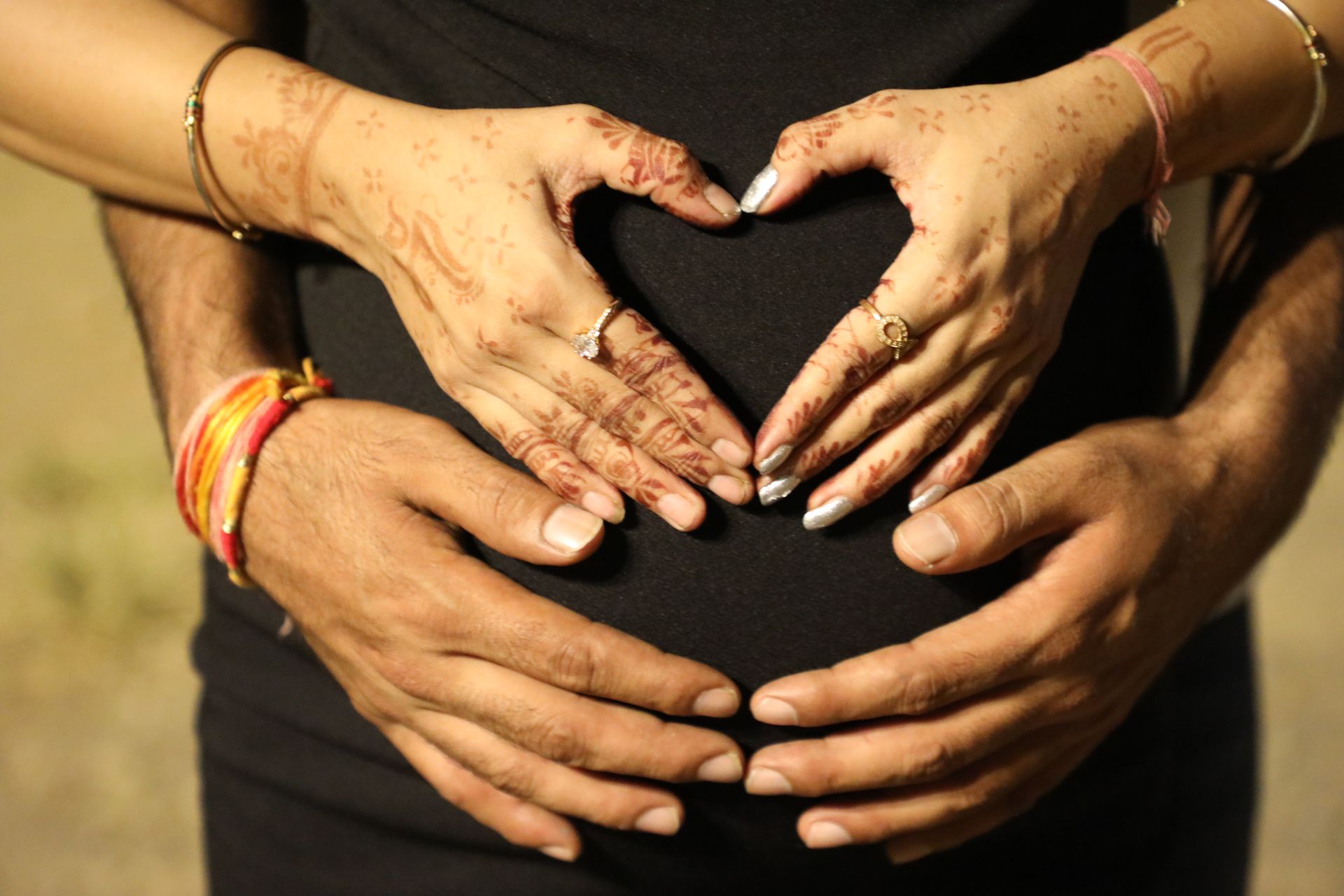
A pregnant belly is a canvas like no other: curved, warm, alive, and changing every week. Henna on that canvas is an old idea, and a beautiful one. In many cultures, henna has been used for centuries to mark celebrations, to bless a mother, and to bring good fortune to a child, and a belly blessing, sometimes called a blessingway, is a modern gathering built around that old idea, where friends and family honour the mother-to-be and decorate her belly with henna. This guide explains how to do that safely, what designs suit a curved belly, and when to pause and ask a healthcare provider first, because safety is the first rule of henna in pregnancy, and it is the rule that makes the celebration possible.
The most important fact to understand is that natural henna and black henna are not the same thing. Natural henna is made from the leaves of the henna plant, Lawsonia inermis, and it stains the skin a reddish-brown colour. Black henna is not henna at all: it is a chemical dye, often containing paraphenylenediamine, or PPD, a substance that can cause severe allergic reactions, blistering, and permanent scarring, and that is never safe to use on skin, least of all on a pregnant person. The U.S. Food and Drug Administration page on henna and temporary tattoos warns that black henna can cause serious skin reactions, and the henna page on Wikipedia explains that natural henna has been used for thousands of years, while black henna is a modern, dangerous imitation. If a henna artist offers you black henna, or a paste that is jet black, smells strongly of chemicals, or stains very quickly, walk away. That is not a bargain, it is a risk.

Related guide: If you are new to henna, start with our black henna tattoo guide, which explains the PPD danger in detail, and why natural henna is the only safe choice.
Key Takeaways
- Use natural henna only, made from Lawsonia inermis, and never use black henna, which often contains PPD and can cause severe reactions.
- Check with your midwife or doctor before a henna session in pregnancy, especially if you have sensitive skin, allergies, or a high-risk pregnancy.
- Do a patch test at least 24 to 48 hours before the full design, on a small area of skin, to check for a reaction.
- The second and third trimesters are the usual time for a belly blessing, when the belly is round and the mother can sit comfortably.
- Designs for a curved belly should be bold, simple, and centred, with motifs that follow the curve rather than fighting it.
- Keep the session short, comfortable, and warm, with breaks, water, and a position that supports your back.
- Natural henna stains reddish-brown and fades in one to three weeks, and it is temporary, which is part of its charm.
Table of Contents
- What Is a Belly Blessing?
- Safety First: Natural Henna Only
- Patch Test, Timing, and Your Healthcare Provider
- Designs for a Curved Belly Canvas
- Motifs and Meanings for a Belly Blessing
- Session Comfort and Positioning
- Aftercare and Fading
- Our View
- Frequently Asked Questions
- Sources
- Recommended
What Is a Belly Blessing?
A belly blessing is a gathering where friends and family honour a pregnant person, often with henna on the belly, and it is sometimes called a blessingway. The idea comes from several traditions at once: the henna traditions of South Asia, North Africa, and the Middle East, where henna is used to mark weddings and celebrations, and the blessingway tradition, where a community gathers to support a mother before birth. In a modern belly blessing, the mother-to-be sits comfortably, often in a circle of friends, while a henna artist draws a design on her belly, and the group shares food, stories, and good wishes for the birth. It is a gentler, more personal alternative to a traditional baby shower, and it puts the mother, rather than the gifts, at the centre.
Henna itself has a long history. The UNESCO inscription on henna rituals describes henna as a shared practice across many countries, used for celebrations, for beauty, and for social bonding, and it was inscribed on the Representative List of the Intangible Cultural Heritage of Humanity. That recognition matters, because it reminds us that henna is not a fashion trend, but a living tradition, and that a belly blessing should respect that tradition, by using natural henna, by learning about the motifs, and by giving credit to the cultures that created them. A henna bridal design is the most famous example of henna as a celebration, and a belly blessing borrows from that tradition, with the belly as the canvas and the baby as the celebration.
A belly blessing is not a medical treatment, and it is not a substitute for prenatal care. It is a celebration, and it should be planned as one: in the second or third trimester, when the mother is comfortable and the belly is round, with a henna artist who uses natural henna, in a warm, comfortable place, with time for breaks. The pregnancy page on Wikipedia describes how the body changes during pregnancy, and those changes affect how a henna session should be planned, from the position the mother sits in to the length of the session. A belly blessing that is planned with care will be a happy memory. One that is rushed, or that uses unsafe henna, will not.
| Henna type | Colour | Main ingredient | Safe in pregnancy? | How long it lasts |
|---|---|---|---|---|
| Natural henna | Reddish-brown | Lawsonia inermis leaves | Yes, with patch test and provider check | 1 to 3 weeks |
| Black henna | Jet black | Often PPD chemical dye | No, never use it | 1 to 3 weeks, with risk of scarring |
| Jagua | Dark blue-black | Genipa fruit | Ask provider, patch test first | 1 to 2 weeks |
| Henna with essential oils | Reddish-brown | Henna plus oils | Check oils with provider | 1 to 3 weeks |
The table makes the central point of this guide clear: natural henna is the only henna that is generally considered safe in pregnancy, and even then it should be used with a patch test and a check with a healthcare provider. Black henna is never safe, and jagua, which is a different plant product, should be treated with the same caution, because it can also cause reactions. Our jagua versus henna guide explains the difference between the two, and it is worth reading if you are considering jagua as an alternative to henna for a belly design.
Safety First: Natural Henna Only
The safety rule for henna in pregnancy is simple: natural henna only, and never black henna. Natural henna is made from the dried leaves of the henna plant, Lawsonia inermis, mixed with water, lemon juice, and sometimes a safe essential oil, and it stains the skin reddish-brown over several hours. It has been used for centuries, and the UNESCO inscription on henna rituals describes it as a practice shared across many cultures, used for celebrations and for beauty. Black henna, by contrast, is a chemical product, often made by adding paraphenylenediamine, or PPD, to henna or to a black dye, and it stains the skin black in minutes. That speed is a warning sign, not a benefit: natural henna takes hours to develop, and a paste that stains black quickly is almost certainly not natural.
PPD is the chemical that makes black henna dangerous. The paraphenylenediamine page on Wikipedia explains that PPD is a chemical used in hair dye, and that it can cause allergic reactions, and the FDA page on henna and temporary tattoos warns that black henna tattoos can cause redness, blistering, raised scars, and permanent sensitivity, and that the reactions can appear days or even weeks after the tattoo. In pregnancy, that risk is even more serious, because a severe skin reaction can cause stress, infection, and a need for medical treatment, and because the skin is more sensitive during pregnancy. The black henna tattoo guide on this site explains the PPD danger in detail, including the stories of people who were scarred by black henna, and it is worth reading before you book any henna, in pregnancy or not.
How do you tell natural henna from black henna? Natural henna paste is greenish-brown, it smells earthy, like cut grass or tea, and it stains the skin orange at first, darkening to reddish-brown over a day or two. Black henna paste is jet black, it may smell chemical, and it stains the skin black within an hour. A henna artist who uses natural henna will be happy to show you the paste, to tell you what is in it, and to do a patch test. An artist who cannot tell you what is in the paste, or who offers a black stain, or who works from a pre-mixed cone with no label, is not an artist you should trust with your belly. Ask for the ingredients in writing if you can, and check them with your midwife or doctor, especially if the paste contains essential oils, because some oils are not recommended in pregnancy. The allergy page on Wikipedia is a useful reminder that even natural products can cause reactions, and that a patch test is the only way to know how your skin will respond.

Patch Test, Timing, and Your Healthcare Provider
Before any henna in pregnancy, do three things: check with your healthcare provider, do a patch test, and choose the right time. The provider check is the most important, because only your midwife or doctor knows your pregnancy, your skin, and your medical history. Tell them you are planning to use natural henna on your belly, show them the ingredients if you have them, and ask if there is any reason you should not. If you have a high-risk pregnancy, a skin condition, a history of allergies, or you are taking medication, the provider may advise you to wait, or to use a smaller design, or to avoid henna altogether. That advice is not a disappointment; it is a protection, and it is worth following. The midwife page on Wikipedia describes the role of a midwife in supporting a healthy pregnancy, and a midwife is often the best person to ask about a belly blessing, because they know both the mother and the birth plan.
A patch test is a small test on a small area of skin, usually the inner arm, where a little henna paste is applied and left to develop, and the skin is checked 24 to 48 hours later for redness, itching, blistering, or swelling. If there is any reaction, do not use the henna. If there is no reaction, the henna is likely safe for you, though a patch test cannot guarantee that a larger design will not react, because the belly is a larger area and the skin there is more sensitive. The contact dermatitis page on Wikipedia explains how skin can react to substances it touches, and why a patch test is used to check for that reaction. A patch test should be done with the exact paste that will be used for the belly design, not with a different paste, and it should be done at least two days before the belly blessing, so there is time to check the result.
Timing matters, too. The second trimester, from about 14 to 27 weeks, and the early third trimester, from about 28 to 34 weeks, are the usual times for a belly blessing, because the belly is round enough to be a good canvas, and the mother can still sit comfortably for an hour or two. In the first trimester, many people prefer to wait, because they are more likely to feel nauseous or tired, and because the belly is not yet round. In the last weeks of pregnancy, the mother may find it hard to sit still, and the belly may change shape quickly, so a design done then may not last until the birth. The pregnancy page on Wikipedia describes the trimesters and how the body changes in each, and it is a useful guide to choosing a time. A belly blessing planned for a weekend, in a warm room, with time for breaks, will be far more enjoyable than one squeezed into a busy weekday.
Designs for a Curved Belly Canvas
A pregnant belly is a curved, moving canvas, and the best henna designs for it are bold, simple, and centred. A design that is too detailed, with tiny lines and dense patterns, will be hard to see on a curved surface, and it will blur as the skin stretches. A design that is bold, with clear lines, open space, and a strong central motif, will look beautiful from a normal distance, and it will still look beautiful in photographs. The centre of the belly, around the navel, is the natural focal point, and most belly designs are built around it, with a mandala, a flower, or a heart at the centre, and the pattern spreading outward in a circle or an arc. That circular shape follows the curve of the belly, and it looks as if it was always meant to be there.
Symmetry is your friend on a belly. A symmetrical design, with the same pattern on the left and the right, will look balanced even when the belly is not perfectly symmetrical, and it will photograph well from the front. An asymmetrical design, on the other hand, can look lopsided on a curved surface, unless it is drawn by an artist who is experienced with belly henna and who can adjust for the curve. The Arabic henna designs guide on this site shows how flowing, open designs with large flowers and leaves can work on a curved surface, and the Moroccan henna designs guide shows how geometric patterns can be adapted to a round canvas. Both are good sources of inspiration for a belly design, though a belly design should be simpler than a bridal hand design, because the belly is larger and the skin is more stretched.
Size is also important. A belly design that is too small will look lost on a large belly, while a design that covers the whole belly can be overwhelming, and it will take a long time to apply, which is tiring for the mother. A good size for a first belly blessing is a design about 15 to 20 centimetres across, centred on the navel, with room to grow if the mother wants more. The artist should draw the design while the mother is sitting or reclining in the position she will be in for the session, because the belly changes shape when she stands, sits, or lies down, and a design drawn in one position may look different in another. The henna tattoo arm designs guide on this site makes a similar point about drawing a design on the body, not just on paper, and it applies even more to a belly, which is a living, moving canvas.
Motifs and Meanings for a Belly Blessing
The motifs for a belly blessing should be chosen for their meaning, not just for their look, because a belly blessing is a celebration of a mother and a child. Flowers are the most popular motif, and each flower has a meaning: a lotus for purity and new beginnings, a rose for love, a sunflower for warmth and joy, and a peony for good fortune. The peony tattoo meaning guide on this site explains how the peony is used as a symbol of wealth and good fortune, and a peony on a belly can be a beautiful wish for the child. The Japanese tattoo flowers guide shows how flowers are used in another tradition to mark the seasons, and a flower that is in season when the baby is due can be a lovely, personal choice.
Other motifs that suit a belly blessing include a mandala, which is a circular pattern that represents wholeness and the universe, and which is a natural shape for a round belly; a heart, which is a simple, clear symbol of love; a sun and moon, which can represent the mother and the child, or the day and the night; a tree, with roots below and branches above, which can represent growth and family; and a small animal, such as a bird, a butterfly, or a turtle, which can be a symbol of the child. A henna bridal design often includes paisley, which is a teardrop shape that represents fertility and good luck, and paisley can be a beautiful addition to a belly design, especially when it is drawn large and bold. Avoid motifs that are too detailed, too dark, or too aggressive for a celebration, and choose instead motifs that feel warm, gentle, and hopeful.
Names and dates can also be part of a belly design, though they should be used with care. A baby’s name, if it has been chosen, can be written in henna on the belly, in a clear, simple script, and it can be a lovely photograph. A due date, or a word that matters to the mother, such as strength, love, or peace, can also be included, though the word should be short, because henna text can be hard to read on a curved surface. The skin page on Wikipedia explains how the skin stretches during pregnancy, and that stretching is why a belly design should be bold and simple: a design that is too fine will stretch and blur, while a design that is bold will stretch and still be readable.
Session Comfort and Positioning
A henna session in pregnancy should be comfortable, or it should not happen at all. The mother-to-be should sit or recline in a position that supports her back, with pillows behind her, her feet up if she likes, and room to move. A reclining chair, a sofa with cushions, or a bed with pillows are all good choices, and a hard, upright chair is not. The artist should work in front of her, at a comfortable height, so she does not have to twist or reach. The room should be warm, because henna develops best in warmth, and because a cold room will make the mother uncomfortable. Water, snacks, and a bathroom nearby are not luxuries; they are part of the plan.
Keep the session short. A belly design that takes two hours to apply is too long for most pregnant people, and a design that takes 45 minutes to an hour is a better target. If the design is large, split it into two sessions, or simplify it. The mother should be able to take breaks, to stand up, to walk around, and to use the bathroom whenever she needs to. The artist should be patient, and should not rush. The Cleveland Clinic tattoo aftercare guide is written for permanent tattoos, but its advice about keeping skin clean and avoiding irritation applies to henna too, and the Mayo Clinic guide to tattoos is a useful reminder that any product put on the skin in pregnancy should be checked with a provider first.
Positioning also affects the design. A belly that is drawn while the mother is reclining will look different when she stands, and a design that is centred when she is lying down may be off-centre when she sits up. The artist should draw the design while the mother is in the position she will be photographed in, usually sitting or reclining, and should check it from the front, not just from above. The mother should also be able to see the design in a mirror, so she can approve it before the henna is left to dry. Henna takes time to dry, and the mother will need to sit still while it dries, which is another reason to keep the design simple and the session short.

Aftercare and Fading
Natural henna is temporary, and it will fade in one to three weeks, which is part of its charm. The stain develops over 24 to 48 hours, darkening from orange to reddish-brown, and then it fades gradually as the skin renews itself. To get the darkest stain, keep the henna paste on the skin for as long as possible, ideally four to six hours, or overnight if you can, and keep it warm. Once the paste is removed, avoid water for the first few hours, and moisturise the skin with a natural oil, such as coconut oil, to help the stain last. Avoid soap, scrubbing, and swimming, all of which will fade the stain faster. The skin page on Wikipedia explains how the outer layer of skin renews itself, and that renewal is why henna fades: the stained skin is gradually replaced by new skin.
If the skin reacts at any point, with redness, itching, blistering, or swelling, wash the henna off at once with lukewarm water, do not scrub, and contact your midwife, doctor, or a pharmacist for advice. A reaction to natural henna is rare, but it can happen, and a reaction to black henna is common and can be serious. The contact dermatitis page on Wikipedia describes the signs of a skin reaction, and the black henna tattoo guide on this site explains what to do if you have been exposed to black henna. Keep a photograph of the reaction, and note what was in the paste, so you can tell a healthcare provider. Do not apply any cream or ointment without checking with a provider first, especially in pregnancy.
Finally, enjoy the fading. A henna belly design is not meant to last forever, and it is not a tattoo. It is a celebration for a moment in time, and it will fade as the pregnancy progresses, which is as it should be. Take photographs while it is at its darkest, usually a day or two after the session, and keep them as a memory of the belly blessing. The Arabic henna designs guide and the Moroccan henna designs guide on this site show how henna is used for other celebrations, and a belly blessing is one more celebration in that long tradition, a tradition that honours the mother, the child, and the community that supports them.
Our View
“A belly blessing is a beautiful idea, but only if it is done safely. Natural henna, a patch test, and a check with your midwife or doctor are not optional extras; they are the whole point. Black henna has no place in pregnancy, or anywhere else on skin. Choose a bold, simple, centred design, keep the session short and comfortable, and enjoy a celebration that honours the mother as much as the baby. That is what a belly blessing should be.” — Tattoo Designs Pictures
Frequently Asked Questions
Is henna safe during pregnancy?
Natural henna, made from Lawsonia inermis, is generally considered safe in pregnancy when used with a patch test and a check with a midwife or doctor. Black henna, which often contains PPD, is never safe. Always check with your healthcare provider before a henna session in pregnancy.
When is the best time for a belly blessing?
The second trimester and the early third trimester, from about 14 to 34 weeks, are the usual times, when the belly is round and the mother can sit comfortably. Avoid the first trimester, when nausea is common, and the last weeks, when sitting still is hard.
How long does belly henna last?
Natural henna on the belly usually lasts one to three weeks, darkening over the first day or two and then fading gradually as the skin renews itself. Moisturising with oil and avoiding soap and swimming can help it last longer.
What is the difference between natural henna and black henna?
Natural henna is made from the henna plant and stains reddish-brown over hours. Black henna is a chemical dye, often containing PPD, that stains black quickly and can cause severe allergic reactions, blistering, and scarring. Never use black henna, especially in pregnancy.
Do I need a patch test before belly henna?
Yes. Apply a little of the exact paste that will be used to a small area, usually the inner arm, and check it 24 to 48 hours later for redness, itching, or swelling. If there is any reaction, do not use the henna.
Can I have henna on my hands as well as my belly?
Yes, many belly blessings include henna on the hands as well, as the photographs in this guide show. Use the same natural henna, do a patch test, and keep the designs simple and comfortable.
Questions about this guide? Visit the Tattoo Designs Pictures home page to browse more tattoo designs, placements, and meanings.
Sources
- Henna – Wikipedia, on henna, its history, and its use.
- Pregnancy – Wikipedia, on pregnancy, its trimesters, and how the body changes.
- Skin – Wikipedia, on the structure of the skin and how it renews itself.
- Allergy – Wikipedia, on allergic reactions and how they happen.
- Contact dermatitis – Wikipedia, on skin reactions to substances that touch the skin.
- Midwife – Wikipedia, on the role of a midwife in pregnancy and birth.
- Lawsonia inermis – Wikipedia, on the henna plant.
- Paraphenylenediamine – Wikipedia, on PPD, the chemical in black henna.
- Henna: rituals, aesthetic and social practices – UNESCO, on henna as intangible cultural heritage.
- Temporary Tattoos and Henna – U.S. Food and Drug Administration, on black henna risks.
- Tattoos: Understand risks and precautions – Mayo Clinic, on tattoo risks and precautions.
- Tattoo Aftercare: Instructions and Healing Tips – Cleveland Clinic, on how to care for skin after tattooing.