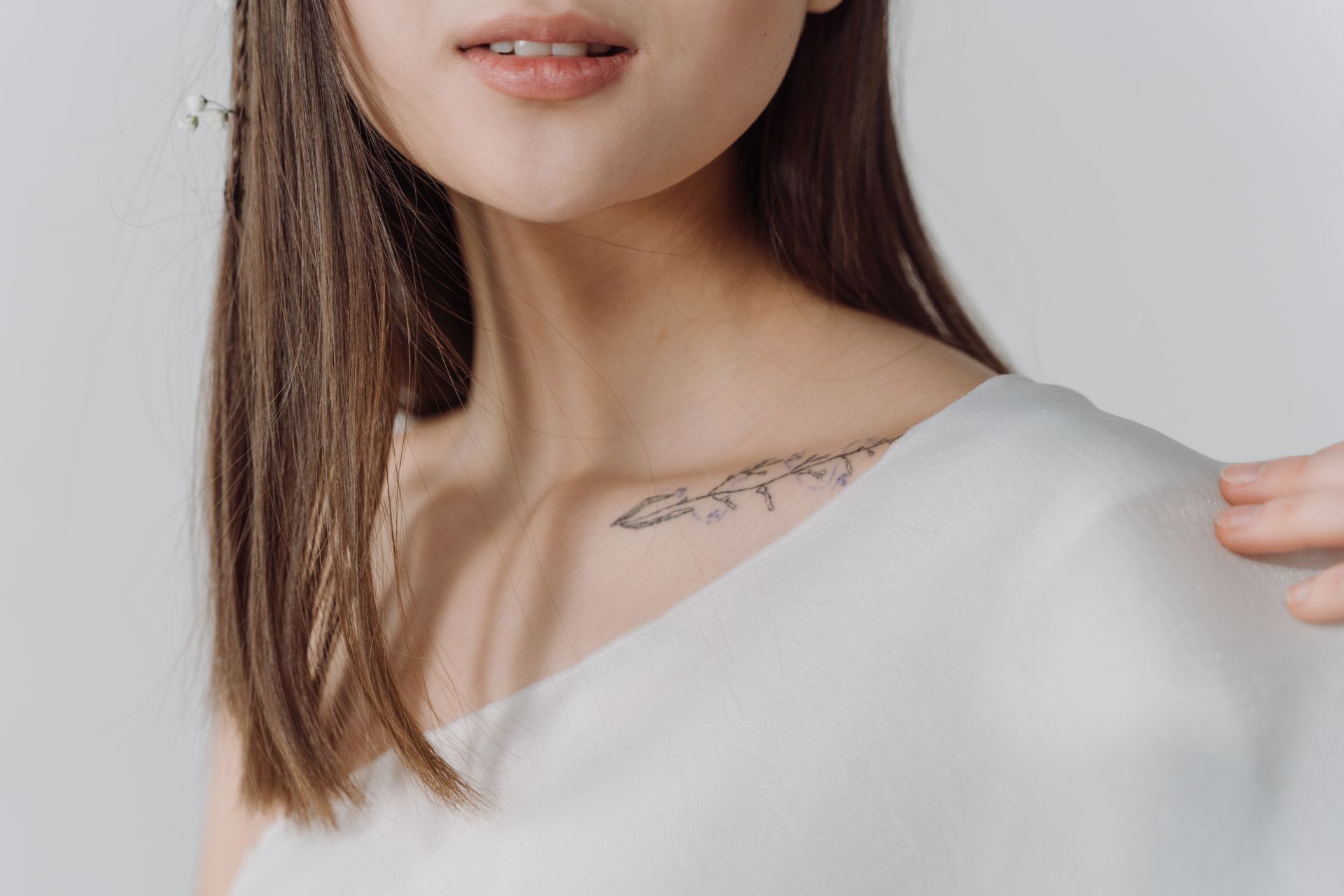
A collarbone tattoo sits where the body already draws a line. The clavicle runs in a shallow S-curve from the centre of the chest to the shoulder, and a good design follows that curve instead of fighting it. That is why the placement looks elegant on so many people, and why it also punishes a design that is too large, too heavy, or placed a centimetre too high. This guide covers the designs that work best on the bone, the anatomy and pain behind the placement, healing and aftercare, and the mistakes that make a collarbone piece blur, fade, or sit awkwardly under clothing.
In This Guide
- What Makes a Collarbone Tattoo Different
- The Anatomy of the Placement
- Best Collarbone Tattoo Designs
- Pain, Healing and Aftercare
- How to Choose Size, Placement and Symmetry
- What to Ask Your Artist
- Mistakes to Avoid
- How Collarbone Tattoos Age
- Frequently Asked Questions
Key Takeaways
- A collarbone tattoo works best when the design follows the curve of the clavicle, with fine lines, open space, and a clear focal point.
- The skin over the bone is thin and the bone is close to the surface, so expect a sharp, bony sensation and a slower, more careful heal than a fleshy arm piece.
- Fine-line floral sprigs, script, small symbols, and symmetrical ornamental pieces are the most reliable choices; large solid blackwork and dense colour are the hardest to age well here.
- One collarbone, both collarbones, or a piece that drops from the bone toward the chest are three different designs, not three versions of the same design.
- Clothing, sun, and movement matter as much as the artwork: necklines, straps, and collars rub a fresh collarbone tattoo every day.
- Try the idea as a temporary design first if you are unsure about size or symmetry, and book a consultation before you commit to a permanent piece.
Table of Contents
- What Makes a Collarbone Tattoo Different
- The Anatomy of the Placement
- Best Collarbone Tattoo Designs
- Pain, Healing and Aftercare
- How to Choose Size, Placement and Symmetry
- What to Ask Your Artist
- Mistakes to Avoid
- How Collarbone Tattoos Age
- Our View
- Frequently Asked Questions
- Sources
- Recommended
What Makes a Collarbone Tattoo Different
A collarbone tattoo is a placement tattoo before it is a subject tattoo. The subject can be a flower, a word, a bird, or a geometric pattern, but the first thing anyone sees is where it sits: a horizontal line across the upper chest, just below the neck, framed by the shoulders. That framing is the appeal. A design that respects the line looks deliberate even when it is small, while a design that ignores the line looks as if it landed there by accident. The clavicle itself is a long, slender bone that connects the arm to the body, and its visible curve gives the artist a natural guide for the composition.
Compare the placement with its neighbours and the trade-offs become clear. A sternum piece runs vertically down the centre of the chest, so it suits long, centred designs and is hidden by most tops. A collarbone piece runs horizontally, so it suits wide, low designs and is visible in a boat neck, a V-neck, or an off-the-shoulder top. The best sternum tattoo designs therefore solve a different problem from the best collarbone designs, even when both use the same floral or ornamental vocabulary. One is a vertical centre line; the other is a horizontal shelf. The best shoulder blade tattoo designs sit on a broader, flatter, more forgiving surface at the back, where larger work and heavier shading are easier to place. The best rib cage tattoo designs use a long vertical panel on the side of the body, which suits tall compositions and is easy to hide completely. A collarbone piece, by contrast, is small, visible, and unforgiving about proportion.
That visibility is part of the point for most people who choose it. A collarbone tattoo can be shown with a wide neckline and covered with a crew neck, a scarf, or a collared shirt, which gives it a flexibility that a hand or neck tattoo does not have. It is also a placement that photographs well, because the bone creates a natural shadow and the skin there is usually smooth. But visibility also means there is nowhere to hide a wobble. A line that is meant to be straight will look crooked if it crosses the bone at the wrong angle, and a symmetrical pair will look wrong if one side sits a few millimetres higher than the other. Good collarbone work is therefore as much about measurement and stencil placement as it is about drawing.
Movement is the other difference that people underestimate. The shoulders move every time you reach, lift, or turn your head, and the skin over the collarbone stretches and relaxes with that movement. A design that looks perfect when you are standing still with your arms at your sides can distort when you raise an arm or shrug. Experienced artists stencil with the client standing naturally, then check the design with the shoulders in different positions before they start. If your artist only checks the stencil while you are lying flat, ask them to check it while you are sitting up as well. The shoulder and the chest meet at this point, so the design has to work in both directions.
| Placement | Best shape | Visibility | Pain level | Healing |
|---|---|---|---|---|
| Collarbone | Wide and low, following the bone | Visible in wide necklines, hidden by crew necks | High, sharp and bony | Careful, rubs on straps and collars |
| Sternum | Long and vertical, centred | Hidden by most tops | High, sharp over bone | Careful, rubs on bras and waistbands |
| Shoulder blade | Medium to large, flat | Hidden, shown with open backs | Moderate | Straightforward, less friction |
| Rib cage | Tall and vertical | Hidden, shown with side cuts | High, sensitive and ticklish | Careful, moves with breathing |
| Forearm | Any shape, easy to wrap | Almost always visible | Low to moderate | Straightforward |
The table above is a guide, not a rule. Pain is personal, and a small collarbone piece can feel very different from a large one that crosses the bone for an hour. What the table does show is why the collarbone rewards restraint. It is a high-visibility, high-sensation, small-canvas placement, and the designs that last best there are the ones that accept those limits instead of trying to overpower them.

The photo above shows the classic collarbone formula at its best: a single fine-line sprig, placed just below the bone, following its curve, with plenty of bare skin around it. Nothing in the design fights the anatomy. The leaves are small, the stem is thin, and the whole piece reads clearly from a normal distance. That clarity matters, because collarbone tattoos are usually seen from a metre or two away, in conversation, not inspected at close range. A design that only works when you lean in close will look like a smudge in real life.
The Anatomy of the Placement
Understanding the anatomy helps you choose a design that will still look good in five years. The clavicle is one of the few bones that is visible under the skin in most people, and it sits just under a thin layer of skin and fat. There is very little padding between the needle and the bone, which is why the sensation is often described as vibrating or rattling rather than simply painful. The skin itself is also thinner here than on the arm or leg. Human skin varies in thickness across the body, and thin skin takes ink differently: fine lines can spread more easily, and heavy shading can look blotchy if the artist works the area too hard.
The area is also crossed by the edges of clothing in ways that other placements are not. Bra straps, bag straps, seat belts, shirt collars, and necklace chains all pass over or near the collarbone. During healing, that friction is a real problem, because a fresh tattoo is an open wound that needs to stay clean, dry, and undisturbed. The Mayo Clinic guide to tattoos explains the basic risks that apply to every tattoo, including infection, allergic reactions, and skin problems, and those risks are worth taking seriously on a placement that is rubbed all day. Choose a week when you can wear soft, loose, low-neck clothing and avoid heavy bags on that shoulder.
Sun exposure is another factor. The upper chest is exposed whenever you wear a wide neckline outdoors, and ultraviolet light is one of the main causes of tattoo fading. A collarbone tattoo that is shown off in summer needs sunscreen once it is fully healed, and it needs to be kept out of direct sun while it is healing. That is not a reason to avoid the placement, but it is a reason to plan the timing: a piece done in late autumn or winter heals before the strong sun returns, while a piece done at the start of a beach holiday is healing at exactly the wrong moment.
There is also a simple structural point. The collarbone is not a flat surface. It curves, it has a bump at the inner end near the sternum, and it dips where it meets the shoulder. A design that is drawn on flat paper will need to be adapted to that three-dimensional curve. A straight line of script, for example, may need a very slight arc to look straight on the body. A symmetrical pair of designs may need to be placed at slightly different heights on paper to look level on the body, because most people are not perfectly symmetrical. That is why a good artist will spend time on the stencil and will photograph it, step back, and adjust it, rather than rushing to start.
The diagram above shows the three main zones. Along the bone is the classic choice, and it suits script, sprigs, and small symbols that can follow the curve. A centre drop sits below the notch between the two collarbones and suits a small pendant, a single flower, or a short vertical design. A piece set just under the bone, on the upper chest, gives the artist a slightly flatter surface and suits a wider design that needs more room. Many of the best collarbone tattoos combine two zones: a sprig along the bone with a small flower dropping below it, for example. The key is that the design should have one clear anchor point, and the rest should support it.
Finally, consider how the placement relates to other tattoos you already have or plan to have. A collarbone piece can be a standalone statement, or it can be the top edge of a larger chest piece, or the end point of a shoulder piece. If you plan a larger chest or shoulder tattoo later, tell your artist now, so the collarbone design does not block the composition you want later. The history of tattooing is full of designs that were placed without a plan and then had to be worked around, and a little planning at the start saves a lot of cover-up work later. The Japanese tattoo history guide on this site shows how traditional Japanese work plans the whole body as one composition, and that habit of planning the full picture is useful even for a small modern piece.
Best Collarbone Tattoo Designs
The best collarbone designs share a simple quality: they look as if they belong on the bone. They are not shrunk versions of a back piece, and they are not a random collection of small images crowded together. Each one has a clear direction, a clear focal point, and enough empty skin to let the lines stay readable as they age. The tattoo itself is ink placed in the dermis, and on thin skin that ink needs room, so designs with open space age better than designs that fill every millimetre.
Fine-line floral sprigs
A fine-line sprig is the most popular collarbone design for a reason. A single stem with a few leaves or small flowers follows the bone naturally, it can be as short as five centimetres or as long as the full bone, and it works in black ink or in soft colour. A flower in this style should be drawn with a light hand: a rose, a lavender sprig, a cherry blossom branch, or a wildflower stem all work, provided the petals are not packed too tightly. The photo at the start of this guide shows a leafy sprig that does exactly this, and it is a good reference to show your artist. Avoid a dense bouquet that tries to fit ten flowers into a space meant for three, because the petals will merge as the ink settles.
Script and words
Script is the second classic collarbone choice, and it is also the one most likely to go wrong. A short word, a name, a date, or a line of text in a clean, legible font can look beautiful along the bone, especially in a language or script that means something to you. The photo of the Devanagari script tattoo in this guide shows how a single line of text can sit on the bone without any other decoration. Keep the text short, keep the letters large enough to stay legible, and check the spelling and the translation with a native speaker before you book. A long sentence in a tiny font will blur into a grey line within a few years, and a misspelled word on a visible placement is a permanent reminder of a rushed decision.

Symmetrical ornamental pieces
Symmetrical designs that mirror across the centre of the chest are striking on the collarbones, because the body itself is roughly symmetrical there. A mandala fragment, a pair of matching sprigs, or an ornamental pattern that meets in the middle can frame the neckline like jewellery. Symmetry is hard to execute well, so choose an artist who is comfortable with geometric and ornamental work, and expect the stencil to take time. The two sides will never be identical to the millimetre, and that is normal, but they should look balanced at a normal viewing distance. If you want a symmetrical piece, book a longer session and do not rush the stencil.
Small symbols and animals
Small symbols work well when they are given space. A bird in flight, a butterfly, a star, a moon, or a small animal can sit just below the bone and read clearly, provided it is not crowded by other elements. A Japanese koi tattoo is usually a large, flowing design, but a single small koi or a small wave element can be adapted to the collarbone if the artist simplifies it. The same is true of traditional Japanese work in general: the wabori tattoo tradition uses large, bold compositions, so a collarbone piece inspired by it should borrow one motif, such as a wave or a flower, rather than trying to fit a whole sleeve onto the bone. Japanese tattoo background designs, with their waves, clouds, and wind bars, can also provide a simple background for a collarbone piece, as long as the background does not overwhelm the main motif.
Minimal and single-needle designs
Minimal designs, including single-needle work, are popular on the collarbone because they suit the delicate nature of the placement. A tiny heart, a constellation, a small cross, or a single line drawing can look intentional and elegant. The risk with very fine work is that it fades faster than bolder work, especially on thin skin that is exposed to sun. If you choose a minimal design, accept that it may need a touch-up sooner than a bolder piece, and choose an artist who specialises in fine-line work rather than one who usually does heavy traditional work. Ask to see healed photos of their fine-line work, not just fresh photos, because fresh fine lines always look crisp.

Pain, Healing and Aftercare
Collarbone tattoos hurt more than most people expect, and it is better to know that before you sit in the chair. The needle passes over bone with very little padding, and the vibration can be felt in the chest and the teeth. Most people describe it as sharp and rattling rather than deep and aching, and the inner end near the sternum is usually the most sensitive part. A small piece may take thirty minutes and be entirely manageable, while a larger piece that crosses the bone for an hour or more can become draining. Eat before your appointment, stay hydrated, and do not arrive hungover or sleep-deprived, because all of those things make pain feel worse.
Healing takes the usual two to four weeks for the surface, with the deeper healing continuing for longer. The health effects of tattoos include infection and allergic reaction, and the collarbone is vulnerable to both because it is rubbed by clothing and exposed to sweat. Keep the tattoo clean with gentle washing, pat it dry, and apply a thin layer of the aftercare product your artist recommends. Do not over-moisturise, do not pick at scabs, and do not wear a tight bra strap, a heavy bag, or a stiff collar over the fresh tattoo if you can avoid it. The Cleveland Clinic tattoo aftercare guide gives clear, practical instructions on washing, moisturising, and what to avoid while a tattoo heals, and it is worth reading before your appointment, not after.
Aftercare for a permanent tattoo and aftercare for henna share some principles, even though henna is temporary. The henna tattoo aftercare guide on this site covers keeping a design dry and undisturbed while it develops, and the same patience applies to a fresh collarbone tattoo: leave it alone, let it heal, and do not rush back into the sun, the gym, or a swimming pool. If you want to test a collarbone design before committing, a temporary design can help you live with the size and placement for a week or two. The henna tattoo arm designs guide shows how henna can be used to try out a motif, and a black henna tattoo should be avoided, because the chemical that makes it black can cause severe allergic reactions.
How to Choose Size, Placement and Symmetry
Size is the decision that most affects how a collarbone tattoo ages. A design that is too small will lose detail as the ink spreads, while a design that is too large will crowd the neckline and look heavy. As a starting point, a single sprig or a short line of script of about eight to twelve centimetres works well on one collarbone, and a symmetrical pair can run across both bones with a gap in the centre. Bring reference photos in the size you want, and ask your artist to print the stencil at that size and place it on you before you agree to anything. If the stencil looks too small on your body, it will look even smaller once it is tattooed.
Placement is a choice between one side, both sides, or the centre. One side is the most versatile and the easiest to heal, because you can carry a bag on the other shoulder and sleep on the other side. Both sides is the most dramatic, but it doubles the healing work and the cost, and it requires a symmetrical design that works as a pair. A centre piece, below the notch, is the most discreet and suits a small pendant or a single symbol. There is no right answer, but there is a wrong way to decide: choosing both sides because a photo of a model looks good, without considering your own shoulders, neckline, and daily clothing. Try the stencil, wear your usual tops, and look at it in a mirror from a normal distance, not just from close up.
Symmetry deserves its own check. Stand naturally, relax your shoulders, and let the artist place the stencil. Then raise your arms, turn your head, and look again. A design that is level when you are standing still may look tilted when you move, and that is normal, but the artist should be aiming for a placement that looks balanced in your most common posture. If you have a noticeable difference in shoulder height, tell the artist, so they can adjust the design rather than forcing perfect symmetry onto an asymmetrical body.
What to Ask Your Artist
A consultation is not a formality. It is your chance to find out whether the artist is the right person for this placement, and whether your design will work at the size you want. Ask to see healed photos of collarbone work they have done, not just fresh photos. Ask how they handle symmetry, and whether they stencil with you standing up. Ask what size they recommend for your design, and why. Ask about their aftercare instructions, and what they charge for a touch-up if a fine line needs refreshing. If an artist is vague about any of those questions, or if they say yes to every idea without discussion, consider that a warning sign.
Also ask about the practical details. How long will the session take, and will you need a second session for a larger piece? What should you wear, and what should you avoid wearing during healing? When can you go back to the gym, to swimming, or to wearing a bag on that shoulder? A good artist will answer all of those questions clearly, and will tell you if your idea needs to change. A design that is too detailed for the space, a font that is too small to stay legible, or a colour that will not hold on your skin tone are all things a good artist will raise before they start, not after.
Mistakes to Avoid
The most common mistake is choosing a design that is too detailed for the space. A collarbone is a narrow, curved canvas, and a design with a lot of small elements will blur as it ages. The second mistake is choosing a design that is too large, so that it runs onto the neck, the shoulder, or the chest in a way that looks accidental. The third mistake is ignoring clothing: a design that sits exactly where a bra strap or a bag strap rubs will heal badly and fade unevenly. The fourth mistake is getting a collarbone tattoo just before a holiday, a wedding, or a period of heavy sun exposure, when healing will be difficult. The fifth mistake is choosing an artist based on price alone, for a placement where precision matters more than anywhere else.
Another mistake is to copy a photo without adapting it to your body. A design that looks perfect on a model with long collarbones and a different shoulder shape may not work on you, and a good artist will adapt it rather than copying it exactly. Finally, do not ignore aftercare. A collarbone tattoo that is picked at, over-moisturised, or exposed to sun while healing will look worse than a simpler design that was healed carefully. The artwork is only half the result; the healing is the other half.
How Collarbone Tattoos Age
All tattoos age, and collarbone tattoos age in a particular way. Fine lines spread slightly, black ink softens, and colour fades with sun exposure. A design with open space and clear lines will age gracefully, because there is room for the ink to spread without the elements merging. A design that is packed with detail will lose that detail first, and a design with very thin lines may need a touch-up after a few years. That is not a failure; it is a normal part of having a fine-line tattoo on thin, sun-exposed skin.
You can slow the ageing by protecting the tattoo from sun once it is healed, by keeping the skin moisturised, and by avoiding unnecessary friction on the area. You cannot stop it entirely, and you should not expect a collarbone tattoo to look exactly the same at forty as it did at twenty-five. Choose a design that you will still like when the lines have softened a little, and that does not depend on a single tiny detail for its meaning. A sprig, a word, or a simple symbol will still read clearly when it has softened; a miniature portrait or a tiny, detailed scene will not.
Our View
A collarbone tattoo is at its best when it is quiet. One fine line, one clear idea, and a design that follows the bone will outlast a crowded piece every time. Choose the artist first, the size second, and the subject third, and let the bone do the work.
Frequently Asked Questions
Do collarbone tattoos hurt a lot?
Yes, for most people they hurt more than a forearm or upper arm tattoo, because the bone is close to the surface and there is little padding. The sensation is often sharp and vibrating. A small piece is usually manageable, and the pain stops as soon as the session ends.
How long does a collarbone tattoo take to heal?
The surface usually heals in two to four weeks, with deeper healing taking longer. Keep it clean, avoid friction from straps and collars, and keep it out of sun and water while it heals. Follow your artist’s aftercare instructions.
Can I wear a bra after a collarbone tattoo?
You can, but a bra strap may rub the fresh tattoo. Choose a soft, loose bra or a strapless option for the first week if you can, and keep the strap off the tattooed area as much as possible.
Are collarbone tattoos easy to hide?
Yes, compared with a hand or neck tattoo. A crew neck, a collared shirt, or a scarf will cover most collarbone designs, while a wide neckline or an off-the-shoulder top will show them. That flexibility is one of the main reasons people choose the placement.
What is the best size for a collarbone tattoo?
For a single design, eight to twelve centimetres along the bone is a good starting point. Smaller designs can work if they are simple, but very small text and very fine detail are likely to blur. Ask your artist to stencil the design at the size you want before you agree.
Do collarbone tattoos fade faster?
They can fade faster than tattoos on covered skin, because the upper chest is exposed to sun and rubbed by clothing. Sunscreen once healed, careful aftercare, and a design with open space will help it last longer.
Questions about this guide? Visit the Tattoo Designs Pictures home page to browse more tattoo designs, placements, and meanings.
Sources
- Clavicle – Wikipedia, on the anatomy and function of the collarbone.
- Sternum – Wikipedia, on the breastbone and the vertical centre-line placement.
- Tattoo – Wikipedia, on how tattoos are made and how ink sits in the skin.
- History of tattooing – Wikipedia, on the long history of tattooing across cultures.
- Human skin – Wikipedia, on skin structure and thickness across the body.
- Health effects of tattoos – Wikipedia, on infection, allergy, and other risks.
- Tattoos: Understand risks and precautions – Mayo Clinic, on tattoo risks and precautions.
- Tattoo Aftercare: Instructions and Healing Tips – Cleveland Clinic, on how to care for a healing tattoo.
- Shoulder – Wikipedia, on the anatomy of the shoulder.
- Chest – Wikipedia, on the anatomy of the chest.
- Flower – Wikipedia, on flowers and floral structure.
- Mandala – Wikipedia, on mandala patterns and their meaning.