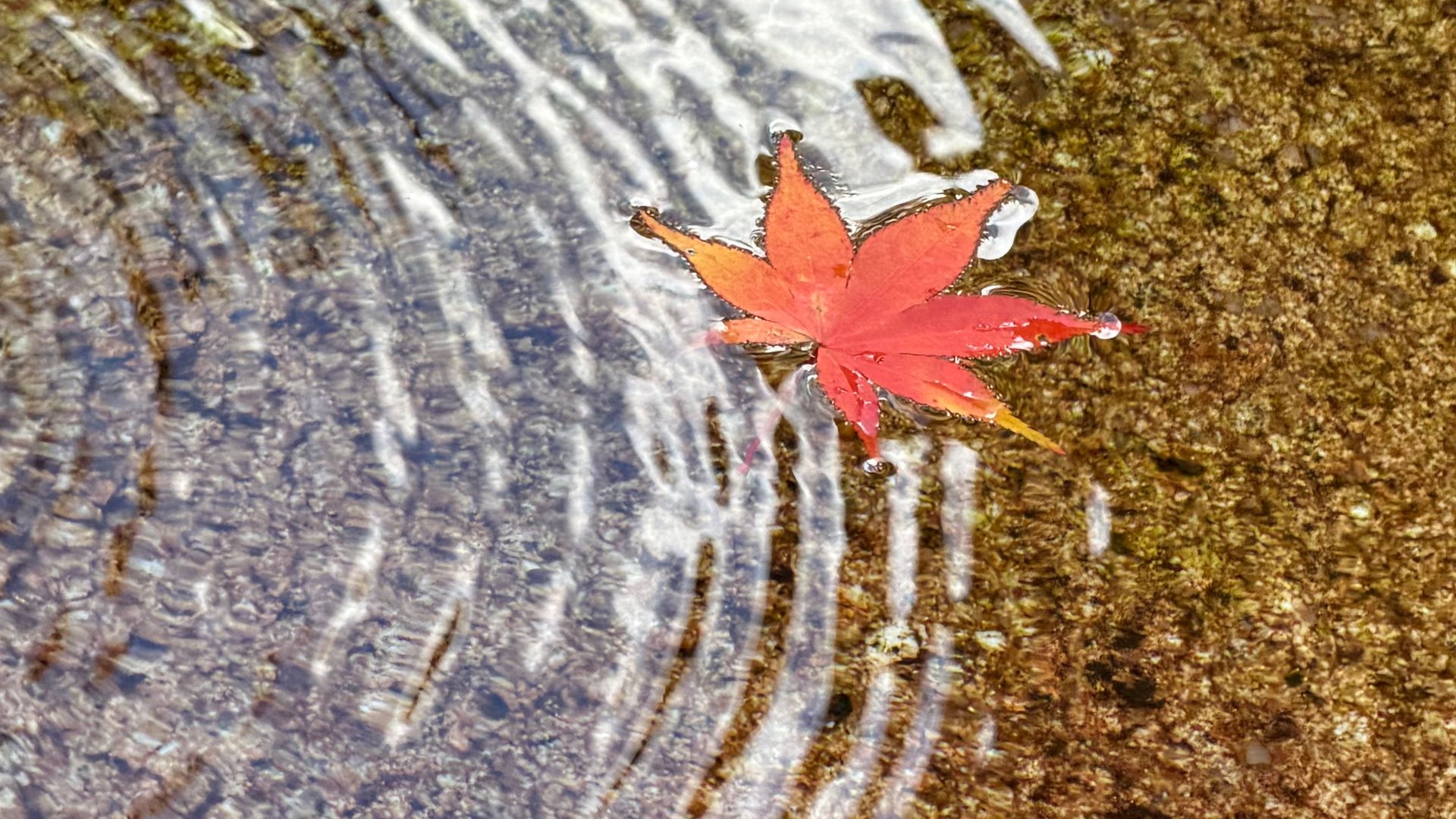
The maple leaf is the quiet counterpart to the cherry blossom in Japanese tattooing. Where sakura speaks of spring, of beauty that arrives suddenly and falls quickly, the maple leaf, momiji, speaks of autumn, of change that arrives slowly and turns the whole landscape red. It is the leaf that falls into the river and drifts past the koi swimming upstream, and that image, a fish fighting the current while red leaves fall around it, is one of the most loved compositions in the whole tradition. This guide explains what the maple leaf means in Japanese tattooing, how it differs from cherry blossom, how it is paired with koi, and how to design a maple leaf tattoo that carries its meaning clearly.
In This Guide
We start with the leaf at a glance, then trace its meaning through autumn, through the koi pairing, and through design choices. If you know cherry blossom first, read our cherry blossom tattoo meaning guide alongside this one, because the two flowers are a pair, spring and autumn, and each makes the other clearer. For the wider flower tradition, see our Japanese tattoo flowers guide, which surveys peony, cherry blossom, chrysanthemum and lotus.
Key Takeaways
- Momiji means autumn and change. The maple leaf stands for the turn of the season, for beauty that changes, and for accepting that change.
- It is the autumn answer to cherry blossom. Sakura is spring and sudden falling, momiji is autumn and slow turning, and the two are often paired as a set.
- The classic pairing is koi and maple leaves. A koi swimming upstream through falling maple leaves stands for perseverance through change.
- Colour carries the meaning. Green maple is youth and summer, red maple is maturity and the peak of autumn, and the turn between them is the story.
- Shape matters more than size. The five pointed lobes of the Japanese maple leaf must be drawn clearly, or the leaf reads as a generic leaf.
- Placement should follow the flow. Maple leaves work best as a falling trail, a scattered background, or a single focal leaf, not as a rigid block.
Table of Contents
- Momiji at a Glance
- The Tree Behind the Leaf
- Autumn, Change and Mono no Aware
- The Koi and the Fallen Leaves
- Maple vs Cherry Blossom
- Designing a Maple Leaf Tattoo
- Colour, Style and Placement
- Choosing Your Maple
Momiji at a Glance
Momiji is a season in a single leaf. The word momiji refers to the Japanese maple and to its red leaves in autumn, and it carries the whole season with it: the cooling air, the turning trees, the leaves falling on water, and the quiet that follows summer. Maples are a large group of trees and shrubs, and the Japanese maple is one of the most loved, because its leaves are finely shaped and its autumn colour is among the brightest of any tree. In a tattoo, a single red maple leaf can stand for all of that, which is why the motif is so often drawn alone, with no other flower to compete with it.
It is a meaning, not just a picture. In Japanese tattooing, a motif is chosen for what it says, not only for how it looks. The maple leaf says that change is beautiful, that the end of a season is not a loss but a turn, and that a person can change and still be themselves. That meaning is personal: it can stand for a move, a recovery, a new chapter, or simply for a love of autumn. A good maple leaf tattoo should make that meaning clear to the wearer, even if no one else knows it.
Compare the four great flowers. The table below sets the maple leaf against the other flowers of the Japanese tradition, so you can see where it sits. Each flower has its own season and its own meaning, and the maple is the only one that stands for autumn, which gives it a place no other flower can fill.
| Motif | Season | Core meaning | Classic pairing |
|---|---|---|---|
| Maple leaf, momiji | Autumn | Change, the turn of the season | Koi swimming upstream |
| Cherry blossom, sakura | Spring | Impermanence, beauty that falls quickly | Samurai, falling petals |
| Peony, botan | Late spring | Wealth, honour, full flowering | Lion, tiger, samurai |
| Chrysanthemum, kiku | Autumn | Longevity, rejuvenation, nobility | Imperial symbols, water |
The maple is the most personal of the four. Peony and chrysanthemum are grand, formal flowers, and cherry blossom is the most famous flower in Japan. The maple leaf is smaller, quieter and more personal, which is why it suits a tattoo that is meant for the wearer rather than for display. It is a leaf you choose because it means something to you, not because it is the most impressive flower in the garden.
The Tree Behind the Leaf
Know the tree before you draw the leaf. The Japanese maple is a small tree with finely divided leaves, each leaf with five to seven pointed lobes that spread like a hand. The leaves are green in spring and summer, then turn yellow, orange and red in autumn, often with several colours on the same tree at once. That colour change is the heart of the motif: a maple leaf tattoo that is all one flat red misses the story, while a tattoo that shows the turn from green to red tells it.
Shape is the test of a good drawing. A Japanese maple leaf has a distinctive silhouette: a short stem, five pointed lobes with toothed edges, and veins that radiate from the centre. If the lobes are too rounded, the leaf looks like a generic leaf, and if they are too sharp, it looks like a star. The artist should study a real leaf, or a good photograph, before drawing the tattoo, and the stencil should be checked at full size. The photo in this guide shows a single leaf held by its stem, and its five lobes are clearly visible, which is the shape your artist should aim for.
The leaf falls, it does not sit still. In Japanese art, maple leaves are almost always shown falling, floating on water, or scattered on the ground, rather than sitting neatly on a branch. That movement is part of the meaning: the leaf is beautiful because it is falling, and the tattoo should show that fall. A maple leaf drawn flat and still looks like a botanical illustration, while a leaf drawn at an angle, with a slight curl, looks alive. Ask your artist to draw the leaf as if it is in the air, not as if it is pressed in a book.
Autumn, Change and Mono no Aware
Autumn is the season of turning. Autumn is the season when the year turns from growth to rest, when the leaves change colour and fall, and when the light changes. In Japan, autumn is celebrated as a season in its own right, with leaf viewing, momijigari, as the autumn counterpart to hanami, the spring viewing of cherry blossom. People travel to temples and gardens to see the maple leaves at their peak, and that journey, to see a colour that will only last a week, is part of the meaning.

Mono no aware is the feeling behind the leaf. The Japanese concept of mono no aware is often translated as the pathos of things, or a gentle sadness at the passing of beautiful things. It is the feeling you have when you watch a maple leaf fall, knowing it will not return, and finding that knowledge beautiful rather than sad. Cherry blossom is the classic example of mono no aware in spring, and the maple leaf is its autumn counterpart. A maple leaf tattoo carries that feeling: it does not deny change, it honours it.
Change is the message, not the problem. Many people choose a maple leaf tattoo at a moment of change: after a move, after a loss, after a recovery, or at the start of a new chapter. The leaf says that change is natural, that it can be beautiful, and that the person who wears it has accepted it. That is a different message from a tattoo that says permanence or defiance, and it is why the maple leaf suits people who want a quiet, reflective tattoo rather than a bold statement.
The Koi and the Fallen Leaves
The pairing tells a story. The most famous maple leaf composition in Japanese tattooing is the koi swimming upstream through falling maple leaves. The koi is a fish that swims against the current, and in the Dragon Gate legend it swims up a waterfall to become a dragon. Koi are ornamental carp bred for their colour, and in tattooing their colour, their direction and their companions all carry meaning. When a koi swims upstream through falling leaves, the leaves show the season and the current, and the fish shows the will to keep going through them.

Direction decides the meaning. A koi swimming upstream, against the current and upward in the composition, stands for perseverance, ambition and a struggle that is still in progress. A koi swimming downstream stands for a struggle that is over, or for a person who has accepted the flow. Our Japanese koi tattoo guide explains colour, direction and Dragon Gate symbolism in full, and it is worth reading before you choose a koi and maple design, because the direction of the fish changes the whole message. If your maple leaves are falling, your koi should usually be swimming up, so the two movements balance each other.
Water ties the composition together. In a koi and maple design, water is the element that connects the fish and the leaves. The koi swims in the water, the leaves float on it, and the waves show the current the fish is fighting. Without water, the fish and the leaves can look like two separate tattoos placed side by side. With water, they become a single scene. Ask your artist to draw the water first, as the background of the scene, and then place the koi and the leaves inside it.
Scale the leaves to the fish. The maple leaves in a koi composition should be smaller than the koi, so the fish remains the hero of the piece. If the leaves are too large, they compete with the fish and the composition feels crowded. If they are too small, they disappear and the season is lost. A good rule is that the largest leaf should be about the size of the koi’s head, and the leaves should be scattered, not evenly spaced, so they look as if they are falling naturally.
Maple vs Cherry Blossom
Spring and autumn are a pair. Cherry blossom is the flower of spring, and its beauty is sudden and brief: the trees flower for a week or two, the petals fall, and the season is over. The maple leaf is the flower of autumn, and its beauty is slow: the leaves turn over weeks, the colour deepens day by day, and the fall is gradual. Cherry blossom says that beauty is fleeting, maple says that beauty changes. Both are true, and both are part of mono no aware, but they say it in different ways.
Choose by the season that speaks to you. If you love spring, if you are drawn to sudden beauty and to the samurai acceptance of a short life, cherry blossom is the right flower. If you love autumn, if you are drawn to slow change and to the quiet of the year turning, maple is the right leaf. Some people choose both, with cherry blossom on one arm and maple on the other, or with cherry blossom at the top of a sleeve and maple at the bottom, so the whole year is represented on the body. That pairing is a beautiful idea, but it needs a skilled artist to balance the two seasons.
Do not mix the two carelessly. A design that puts cherry blossom and maple leaves side by side without thinking about their seasons can look confused, because the two flowers never bloom at the same time. If you want both, give each its own space, or use them to show a journey through the year, with spring at one end and autumn at the other. Our Japanese tattoo meanings guide explains how symbols work together in a composition, and it is a useful check before you combine two strong motifs.
Designing a Maple Leaf Tattoo
Start with the leaf, not the scene. Before you plan a large koi and maple sleeve, practise with a single leaf. A single maple leaf, drawn well and placed well, is a complete tattoo, and it will teach you and your artist how the shape, the colour and the placement work on your body. A single leaf on the wrist, the ankle, the shoulder or the back of the hand is a quiet, elegant piece, and it carries the full meaning of momiji without needing a whole scene around it.
Draw the lobes clearly. The diagram above shows the parts your artist should get right: five pointed lobes, veins radiating from the centre, and a short stem. The lobes should be clearly separated, with deep notches between them, and the edges should be toothed, not smooth. If the lobes are not clear, the leaf will read as a generic maple, or as a star, and the Japanese meaning will be lost. Show your artist a photograph of a real Japanese maple leaf, and ask them to draw from that, not from memory.
Use falling leaves as a background. In a larger piece, maple leaves work best as a falling background, scattered through the composition with space between them, rather than as a dense block. A few leaves near the top, a few near the bottom, and one or two larger leaves as focal points will give the design movement and depth. The leaves should be drawn at different angles, some face on, some turned, some half hidden by water or by the koi, so they look natural rather than stamped.
Keep the outline bold. A maple leaf tattoo needs a strong outline to hold its shape, because the lobes are thin and can blur if the lines are too fine. Blackwork maple leaves, with a bold outline and solid shading, age well and read clearly from a distance. Colour maple leaves need a dark outline too, with the red shading inside it, so the leaf does not dissolve into a red blur as it ages. Ask your artist to show you a healed maple leaf they have done, so you can see how the outline holds up.
Colour, Style and Placement
Red is the classic colour, but it is not the only one. A red maple leaf is the most recognisable version, and it carries the meaning of autumn at its peak. But a green leaf stands for youth and summer, a yellow leaf stands for the first turn of autumn, and a leaf that shows green, yellow and red together stands for the change itself. The colour you choose should match the meaning you want: red for maturity and the peak, green for youth, and a turning leaf for a person in the middle of a change.
Style should match the meaning. Traditional Japanese style, irezumi, suits a large maple and koi composition, with bold outlines, strong colour and a background of water and wind. Blackwork suits a single leaf, with a strong outline and solid shading, and it ages well. Watercolour style can suit a maple leaf, because the soft edges echo the way a leaf changes colour, but it needs a strong outline to hold its shape as it ages. Ask your artist which style they are strongest in, and choose a style that suits their hand as well as your idea.
Placement should follow the fall. Maple leaves suit a placement where they can fall: down the arm, down the back, down the side of the body, or across the shoulder. A single leaf suits a smaller, flatter placement, such as the wrist, the ankle or the back of the hand. A large koi and maple piece needs a large, flat canvas, and our best rib cage tattoo designs and our best upper thigh tattoo designs guides explain how large, flowing designs work on those placements. The Japanese art tradition of woodblock prints, with their falling leaves and flowing water, is a good reference for how a maple composition should flow across the body.
Healing and aftercare are the same as for any tattoo. A tattoo is ink placed in the dermis, and healing in stages is how the skin repairs itself, first closing the surface and then rebuilding underneath. Keep the tattoo clean, keep it out of the sun, and follow your artist’s aftercare instructions. The risks and precautions set out by Mayo Clinic are worth reading before your appointment, because they explain how to choose a safe studio and what to expect while the tattoo heals.
Choosing Your Maple
Ask what the leaf means to you. Before you choose a maple leaf tattoo, spend a little time with the question of what it means to you. Is it autumn itself, or a change you have been through, or a person you associate with autumn, or simply the beauty of the leaf? The answer will decide the colour, the size, the placement and the companions you choose. A leaf that means change should show the turn, with green and red together. A leaf that means autumn at its peak should be a single, deep red leaf. A leaf that means perseverance should be paired with a koi.

Learn the tradition before you wear it. Japanese tattooing is a deep tradition, with its own history, its own rules and its own meanings, and a maple leaf tattoo is part of that tradition. Our Japanese tattoo history guide explains how the tradition grew from the Edo period to the present day, and our wabori tattoo guide explains the hand poked technique behind traditional work. Reading those guides will help you choose a design that respects the tradition, and an artist who understands it.
Choose an artist who knows the motif. Not every artist is comfortable with Japanese motifs, and a maple leaf drawn by an artist who does not know the tradition can look like a generic leaf. Ask to see healed photos of Japanese work they have done, ask how they draw the lobes and the veins, and ask how they would pair the leaf with koi or with water. A good artist will be happy to explain their approach, and they will draw the leaf from a real reference, not from memory.
Our View
The maple leaf is the most honest flower in Japanese tattooing, because it does not pretend that beauty lasts forever. It says that change is beautiful, that the turn of the season is worth celebrating, and that a person can change and still be themselves. Choose a leaf with clear lobes, choose a colour that matches your season, and if you add a koi, let it swim upstream while the leaves fall. Do that, and your maple leaf tattoo will carry its meaning for as long as you wear it.
Cherry blossom falls in spring. Maple falls in autumn. Both teach the same lesson, that beauty and change are the same thing.
— The Editors, Tattoo Designs Pictures
Frequently Asked Questions
What does a maple leaf tattoo mean in Japanese tattooing?
A maple leaf, momiji, stands for autumn and for change. It represents the turn of the season, the beauty of a leaf changing colour and falling, and the acceptance of change as a natural part of life. It is often paired with koi, where it stands for the season and the current the fish is swimming against.
How is a maple leaf different from a cherry blossom tattoo?
Cherry blossom is the flower of spring, and it stands for impermanence and beauty that falls quickly. The maple leaf is the leaf of autumn, and it stands for change that arrives slowly and for the turn of the season. Cherry blossom is sudden, maple is gradual, and the two are often seen as a pair, spring and autumn.
What does a koi with maple leaves mean?
A koi swimming upstream through falling maple leaves stands for perseverance through change. The koi is fighting the current, the leaves are falling around it, and the fish keeps going. It is a symbol of ambition, of a struggle in progress, and of a person who does not give up when the season turns.
What colour should a maple leaf tattoo be?
Red is the classic colour, and it stands for autumn at its peak and for maturity. Green stands for youth and summer, yellow stands for the first turn of autumn, and a leaf that shows several colours together stands for the change itself. Choose the colour that matches the meaning you want, not just the colour you like best.
Where is the best placement for a maple leaf tattoo?
A single leaf suits a small, flat placement, such as the wrist, the ankle or the shoulder. A larger koi and maple composition needs a large canvas, such as the back, the thigh or the rib cage, where the fish and the leaves can flow. Maple leaves work best where they can fall, down the arm, down the back or down the side of the body.
Is a maple leaf tattoo only for autumn?
No. The maple leaf is associated with autumn, but it can be worn at any time of year, and it can stand for change, for a new chapter, or for a love of the season, rather than for autumn itself. The meaning is in what the leaf stands for to you, not in the calendar.
Questions About Your Design?
If you are choosing between a maple leaf and a cherry blossom, or if you are planning a koi and maple composition, start by browsing the guides on the Tattoo Designs Pictures home page, where you will find meaning guides, placement guides and aftercare advice for every motif in the Japanese tradition. Bring the ideas you like to your artist, and ask them to adapt the design to your body, your season and your story.
Sources
- Maple — Wikipedia
- Acer Palmatum — Wikipedia
- Koi — Wikipedia
- Irezumi — Wikipedia
- Cherry Blossom — Wikipedia
- Mono no Aware — Wikipedia
- Autumn — Wikipedia
- Hanami — Wikipedia
- Tattoo — Wikipedia
- Wound Healing — Wikipedia
- Japanese Art — Wikipedia
- Tattoos: Understand Risks and Precautions — Mayo Clinic