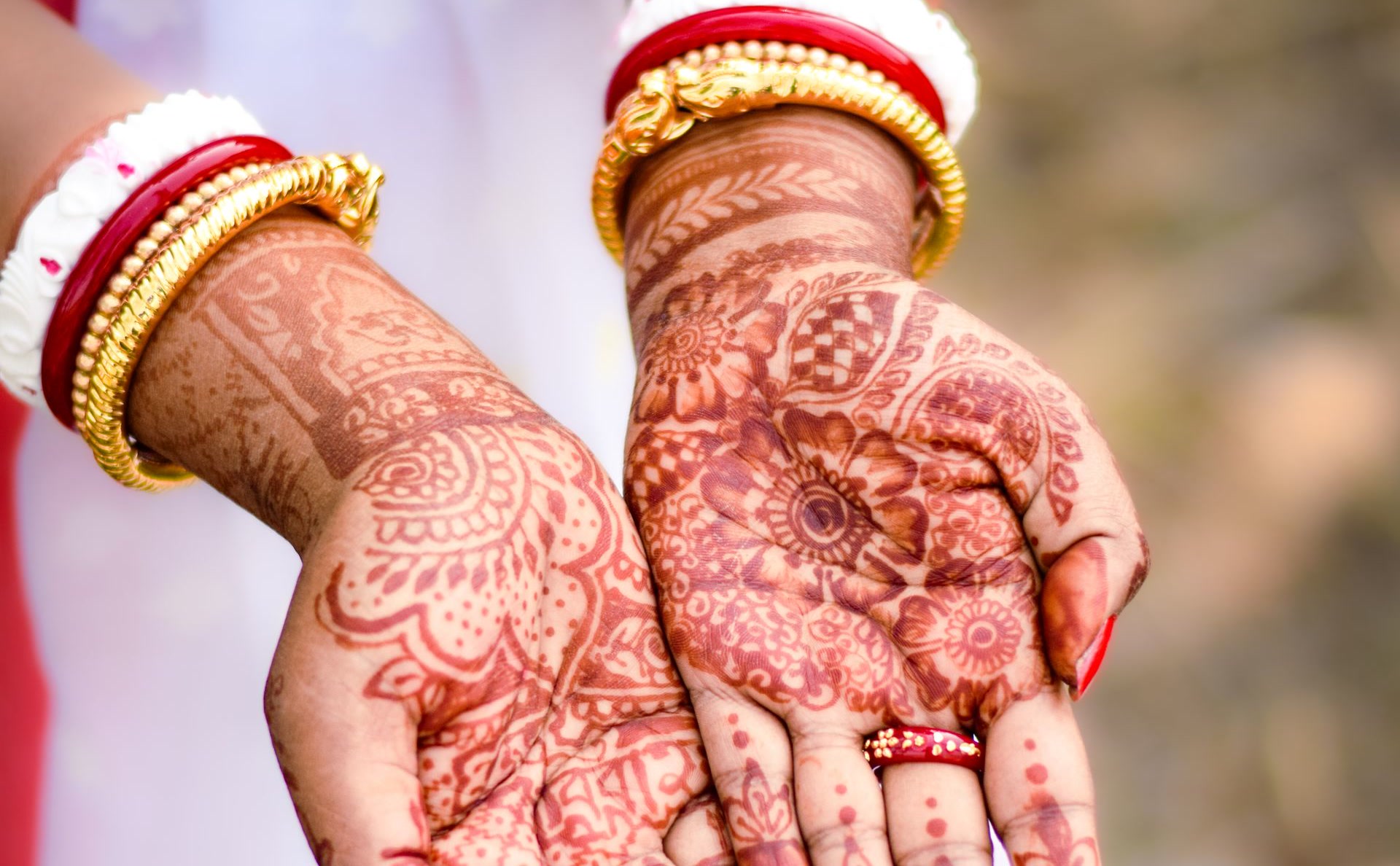
On the night before an Indian, Pakistani, Bangladeshi or Middle Eastern wedding, the bride sits still for hours while an artist draws a whole garden across her hands. Paisleys curl up her fingers, a peacock fans across one palm, the groom’s initials hide somewhere in the lace of lines, and by morning the pale orange paste has flaked away to leave a deep, warm brown stain. That is bridal henna, or wedding mehndi: part decoration, part blessing, part family ritual, and — for the bride — one of the most photographed moments of the wedding itself. The problem is that most brides plan it last. They book the artist late, choose a design from a single screenshot, and discover too late that a pattern which looked delicate on a phone takes five hours to draw, stains unevenly, or fades before the reception. This guide fixes that. It explains what each classic bridal motif means, how the main regional styles differ, how to plan the timing so the colour peaks on the wedding day, and how to spot the one danger — so-called black henna — that can turn a celebration into a skin injury.
In This Guide
Start with what bridal henna is and why it matters, then compare the regional styles, learn the meaning of each motif, and finish with timing, aftercare and safety. If you are still choosing between henna and a permanent tattoo, read our guide to henna tattoo meaning, and for the everyday patterns brides adapt for the wedding, see henna tattoo hand designs and Indian henna tattoo designs.
Key Takeaways
- Bridal henna is a ritual, not just a pattern. In South Asian and Middle Eastern weddings it marks the bride, blesses the marriage and gathers the women of the family — the design is the visible part of a much older ceremony.
- The stain develops over two to three days. Fresh henna looks pale orange, then darkens to a rich reddish-brown as the dye oxidises, so the application must happen two days before the wedding, not the night before.
- Regional styles are genuinely different. Indian bridal work is dense and figurative, Arabic work is bold and open, Moroccan work is geometric, and Pakistani work mixes the two — choose the style before you choose the artist.
- Every motif means something. Paisleys stand for fertility and good fortune, peacocks for beauty and grace, lotus flowers for purity, and the hidden groom’s name is a game the couple play on the wedding night.
- Black henna is not henna. Real henna is never black; black henna contains paraphenylenediamine (PPD), a chemical that can cause severe allergic reactions, blistering and permanent scarring.
- Full bridal henna takes three to six hours. Both hands to the elbows plus both feet can take a whole afternoon, so book the artist first, not last, and clear your schedule.
Table of Contents
- What Bridal Henna Is — and Why It Matters
- Indian, Arabic, Moroccan and Pakistani Styles Compared
- What Each Bridal Motif Means
- Hands, Arms and Feet: Where the Design Goes
- Timing the Stain So It Peaks on the Wedding Day
- Choosing an Artist and Planning the Mehndi Ceremony
- Aftercare: Keeping the Colour Deep and Even
- Black Henna and Other Safety Warnings
- Modern Twists: Minimal Bridal Henna and Mixed Traditions
- Frequently Asked Questions
What Bridal Henna Is — and Why It Matters
Henna is a dye, not an ink. It comes from the dried leaves of the henna plant, Lawsonia inermis, a small shrub that grows across North Africa, the Middle East and South Asia. The leaves are ground into a fine powder, mixed with water and a little lemon juice or tea, and the paste is applied to the skin, where a molecule called lawsone binds to the keratin in the outer layer and leaves a stain. As the history of henna records, people have used it for thousands of years: traces have been found on Egyptian mummies, and it has coloured hair, nails and skin across the ancient world long before it became a wedding tradition. The stain is temporary — it sits in the top layer of skin and fades as that skin sheds, usually within one to three weeks — which is precisely why it suits a wedding: it is beautiful, it is meaningful, and it does not last forever.
Mehndi is the ceremony as much as the design. The word mehndi covers both the henna itself and the celebration built around it. In the days before the wedding, the bride’s female relatives and friends gather, sing, and have their own hands decorated while the bride’s full design is drawn. According to the account of mehndi traditions, the practice is shared across Hindu, Muslim, Sikh and Jewish communities in South Asia and the Middle East, with local variations in pattern, song and ritual — and in December 2024 UNESCO added henna rituals to its Representative List of the Intangible Cultural Heritage of Humanity, recognising them as a shared cultural practice across sixteen countries. That recognition matters for brides choosing a design today: you are not picking a pretty pattern from a catalogue, you are joining a tradition that your grandmother, and her grandmother, would recognise.
The symbolism is practical as well as poetic. Bridal henna is traditionally said to bring good luck, fertility and protection to the new marriage, and the depth of the stain is read as a sign of the love between bride and groom — or, more playfully, of how much the mother-in-law will love the bride. Whether or not you believe the folklore, the symbolism shapes the design: the patterns are dense and generous because a bride’s henna is meant to be seen, admired and photographed, and because a sparse design on a bride looks unfinished. That is the first decision a bride has to make, and it is not about taste — it is about how much coverage she wants, how long she can sit, and how much she wants the henna to say about her family and her faith.
| Feature | Bridal Henna (Mehndi) | Permanent Tattoo |
|---|---|---|
| How it is made | Plant dye paste on the skin surface | Ink placed under the skin with needles |
| How long it lasts | 1–3 weeks, fading as skin sheds | Permanent, fading slowly over years |
| Pain | None — paste is painted on | Needles break the skin; painful |
| Colour | Orange to deep reddish-brown | Black, colour, or grey wash |
| Occasion | Weddings, festivals, celebrations | Any time; a lifelong commitment |
| Main risk | Allergy to added chemicals in black henna | Infection, allergy, scarring |

Indian, Arabic, Moroccan and Pakistani Styles Compared
Indian bridal henna is the most elaborate of all. It covers the hands to the elbows and the feet to the knees, fills every gap with fine lines, paisleys, peacocks, lotus flowers, bride-and-groom figures and tiny hidden details, and leaves almost no bare skin showing. The work is slow — a full Indian bridal set routinely takes four to six hours — and it is the style most brides picture when they think of wedding mehndi. Its density is its point: in the Indian tradition the henna is a display of the family’s joy and of the artist’s skill, and a bride whose hands are covered to the elbow is unmistakably a bride. If you love detail, if you want the classic photographs of two fully patterned palms held together, and if you can sit still for an afternoon, this is your style. Our guide to Indian henna tattoo designs shows the everyday versions of these same patterns, which is a good place to start narrowing down the motifs you like.
Arabic henna is bold, open and fast. Where Indian work fills the skin, Arabic work leaves it showing: thick, confident lines, large flowers and leaves, trailing vines and bold geometric shapes, with plenty of empty space between them. A full Arabic bridal set takes two to three hours rather than five, it photographs beautifully against skin, and it suits brides who want drama without density — or who are getting married in summer and do not want paste drying on their arms all afternoon. Arabic designs also translate well to the feet, where a single large flower on the top of the foot, with vines trailing between the toes, looks elegant with sandals. The trade-off is that Arabic henna fades faster in appearance, because there is less dye on the skin overall, so the timing matters even more.
Moroccan and Pakistani styles sit between the two. Moroccan henna is geometric and abstract: diamonds, triangles, lattice work and bold bands, drawn with a thick, confident line and almost no figurative imagery, reflecting the North African tradition in which the patterns are protective symbols as much as decoration. Pakistani bridal henna blends Indian density with Arabic boldness, often with a distinctive mandala or dome on the palm and fine, lace-like work on the fingers. Brides with roots in more than one tradition often mix them deliberately — Indian density on the palms, Arabic openness on the forearms, a Moroccan band at the wrist — and a good artist will help you combine styles without the result looking like three different designs stuck together. The rule is simple: one style should lead, and the others should echo it.
What Each Bridal Motif Means
The paisley is the queen of bridal henna. The teardrop-shaped motif, known as the mango or keri in India, is said to stand for fertility, good fortune and new beginnings, which is why it appears in almost every bridal design — sometimes as a single large paisley on each palm, sometimes repeated in a chain down the arm. The history of the paisley motif traces it from Persian and Indian textiles into shawls, carpets and body art, and that long journey is part of its appeal: a bride wearing paisleys is wearing a pattern that has meant good luck for centuries. Look closely at a good bridal design and you will see paisleys of many sizes nested inside each other, each one filled with a different pattern — dots, lines, tiny flowers — so that the design rewards a second look.
The peacock means beauty, grace and pride. In Indian tradition the peacock is the vehicle of the goddess Saraswati and a symbol of beauty that is not afraid to be seen, and a peacock fanning its tail across a bride’s palm is one of the most requested bridal images of all. It is also a practical choice: the fan of the tail fills a palm beautifully, the long neck curves naturally along a finger or wrist, and the eye-spots of the feathers give the artist a ready-made pattern of circles and dots. Peacocks pair naturally with lotus flowers, which stand for purity, rebirth and the unfolding of a new life — a meaning that suits a wedding exactly. The lotus is also one of the most common flowers in tattooing generally, which is why floral symbolism crosses so easily between henna and ink: our guide to Japanese tattoo flowers shows how the same flower carries a different, but equally serious, meaning in Japanese work.
The hidden name is the design’s secret. Tradition says the groom’s name — or his initials — should be hidden somewhere in the bride’s henna, and on the wedding night he must find it. It is a game, a test of attention, and a private joke between the couple, and it is also a useful check on the design: if you can find the name, the design is not so dense that it has lost all its structure. Some brides hide the name in a paisley, some in the lines of a peacock’s tail, some along the edge of a mandala on the palm. Tell your artist in advance that you want it, and agree where it will go, or it will be forgotten in the rush. Other motifs to ask about include the elephant, for strength and good luck; the sun, for a bright future; the bride and groom figures, for the couple themselves; and the mango, for fertility. None of these meanings is a rule — a bride from a different region may read the same motif differently — but knowing the traditional reading helps you choose a design that says something, rather than one that is merely pretty.

Hands, Arms and Feet: Where the Design Goes
The palms take the darkest stain, so they carry the most important work. Henna stains darkest where the skin is thickest — the palms and the soles of the feet — and palest where it is thin, which is why the same paste can look deep brown on a palm and light orange on the back of a hand. A good artist plans for this: the boldest motifs, the mandala on the palm, the peacock, the groom’s name, go where the stain will be deepest, while the backs of the hands get finer, more delicate work. The fingers are usually patterned individually, with a band at each joint and a filled fingertip, because fingertips stain very dark and frame the design. If you want proof of how much the hands matter, look at our guide to henna tattoo hand designs, where the same principle — palms dark, backs light — shapes every pattern.
The arms extend the design, and they need a plan. Full bridal henna runs from the fingertips to the elbows, and the forearm is where the artist can tell a story: a vine that climbs from the wrist, a chain of paisleys, a band of geometric work at the elbow. The danger is that the forearm design becomes an afterthought, a few trailing lines added when the hands are done and the artist is tired. Ask to see the whole design sketched or described before the paste comes out, and agree how far up the arm it will go — to the wrist, to the elbow, or beyond — because that decision changes the time by an hour or more. Brides who wear sleeveless or short-sleeved outfits should think about where the design ends: a hard stop at the elbow looks deliberate, a fade into nothing looks unfinished.
The feet are the second stage, and they are often rushed. Bridal henna traditionally covers the tops of the feet and runs up the ankles, and it is usually applied after the hands, when the bride is tired and the artist is under pressure. That is a mistake, because the feet are in almost every wedding photograph — walking down the aisle, standing beside the groom, dancing — and a rushed foot design shows. Budget at least an hour for the feet, keep them still while the paste dries, and wear loose sandals or go barefoot afterwards, because socks and tight shoes will smudge wet paste and rub off a fresh stain. For ideas on how the same area is treated in permanent tattooing, see our guide to henna tattoo designs for feet, which covers the patterns that work best on the top of the foot and around the ankle.
Timing the Stain So It Peaks on the Wedding Day
Henna colour is a slow chemical reaction, not an instant result. When the paste is first removed, the stain is a pale, almost disappointing orange. Over the next 24 to 48 hours it darkens as the lawsone oxidises in the air, reaching its deepest reddish-brown on the second or third day. That timetable is the single most important fact in bridal henna planning, and it is the one most brides get wrong. If the henna is applied the night before the wedding, the stain will still be orange in the photographs; if it is applied four days before, it will already be fading. The sweet spot is two days before the wedding for the main ceremony, with the mehndi party the evening before that. As the account of how henna stains develop explains, the colour keeps deepening for up to three days after the paste comes off, and the stain then lasts one to three weeks depending on the skin and the aftercare.
Warmth and time are what deepen the colour. The longer the paste stays on the skin, the darker the stain: six to eight hours is ideal for a bride, and many brides sleep with the paste on, wrapped in tissue or cling film, and scrape it off in the morning. Heat helps too — keeping the hands warm, avoiding water for the first day, and applying a little lemon-sugar sealant while the paste dries are the traditional tricks, and they work because they keep the paste moist and in contact with the skin for longer. What does not help is washing the paste off with water, which stops the reaction early, or scrubbing the skin, which removes the stained top layer. Scrape the dried paste off with a blunt edge or the back of a spoon, rub a little coconut or mustard oil over the stain, and leave water alone for as long as you can.
Choosing an Artist and Planning the Mehndi Ceremony
Book the artist before you book the photographer. Good bridal henna artists are booked months ahead in wedding season, and a rushed booking is how brides end up with an artist whose style they have never seen. Ask to see full photographs of finished, developed stains — not just fresh paste, which always looks darker and more dramatic than the stain underneath — and ask how long a full bridal set takes, what is included, and whether the artist brings an assistant for the feet. Agree the price in writing, including travel, the number of guests who will also be decorated, and what happens if the wedding runs late. A professional artist will also ask about allergies, skin conditions and any previous reaction to henna, and will offer a patch test: a small dot of paste on the inside of the arm, left for a day, to check for a reaction before the full design goes on.
Plan the ceremony around the bride’s comfort. The mehndi ceremony is a party, but the bride is working: she must sit still, keep her hands flat and her arms supported, and avoid eating, drinking or using her phone for hours. Set her up in a comfortable chair with cushions, a table at the right height, good light, and someone to hold a drink with a straw and feed her snacks. Schedule the guests’ henna after the bride’s is finished, or with a second artist, so the bride is not kept waiting while the artist decorates twenty cousins. And build in a buffer: if the artist says four hours, plan for five. A bride who is rushed, tired or in pain will fidget, and a fidgeting hand is how a perfect line becomes a smudge. The ceremony itself — the songs, the dancing, the yellow and green outfits, the relatives gathering — is part of the wedding, so treat it as an event in its own right, not as an appointment squeezed between the hair trial and the rehearsal dinner.
Aftercare: Keeping the Colour Deep and Even
The first 24 hours decide the final colour. Once the paste is off, the stain is still developing, and water is its enemy: avoid washing the hands, showering with the hands under the spray, swimming or washing dishes for at least 24 hours, and wear gloves for any chore you cannot avoid. Rub a natural oil — coconut, olive or mustard oil — over the stain several times a day; it protects the skin and is traditionally believed to deepen the colour. Avoid exfoliating soaps, scrubs and chlorine, all of which strip the stained skin faster, and keep the hands out of strong sun, which fades the stain. The stain will fade naturally over one to three weeks, fastest on the hands, which are washed most, and slowest on the palms and feet, where the skin is thickest.
Expect uneven fading, and do not panic. The stain fades first where the skin is thinnest and most washed — the backs of the hands and the fingers — and lasts longest on the palms. That is normal, and it is why the design should be planned with fading in mind: the boldest motifs belong where the stain lasts longest. If the stain comes out patchy, the usual cause is uneven paste thickness or uneven contact time, not a problem with your skin; a good artist will offer a touch-up, but a touch-up applied days later will never match the original stain exactly, because the skin underneath has already begun to shed. The honest advice is to accept that bridal henna is temporary, enjoy it at its peak, and let it fade gracefully — it is meant to be a memory of the wedding week, not a permanent mark.
Black Henna and Other Safety Warnings
Real henna is never black, and black henna is never safe. So-called black henna is henna paste mixed with paraphenylenediamine, or PPD, a chemical dye used in hair colour that is not meant for skin. It gives a fast, very dark stain — which is exactly why it is sold at festivals and tourist markets — but it can cause severe allergic reactions, blistering, swelling and permanent scarring, sometimes days after the design is applied. The US Food and Drug Administration warning on temporary tattoos and black henna states plainly that henna is not approved for direct application to the skin and that black henna can cause serious injuries, and the NHS guidance on black henna carries the same message: a black henna reaction can sensitise you to PPD for life, affecting future hair dye and even some medicines. If an artist offers you black henna, or a stain that looks jet black within minutes, walk away.
Natural henna has its own, much smaller risks. True henna is generally safe, but a small number of people are allergic to it, and a paste mixed with unlisted oils, citrus or essential oils can irritate sensitive skin. Ask the artist what is in the paste — it should be henna powder, water or lemon juice, and a little sugar or essential oil such as eucalyptus, nothing else — and insist on a patch test at least 48 hours before the wedding if you have sensitive skin, eczema or any history of allergy. Keep the paste away from broken skin, cuts and sunburn, and tell the artist about any medication that affects your skin. For a comparison with the risks of permanent tattooing, Mayo Clinic’s guide to tattoo risks and precautions explains the infections and allergic reactions that needles can cause — henna avoids most of those risks precisely because it never breaks the skin.
Modern Twists: Minimal Bridal Henna and Mixed Traditions
Not every bride wants full coverage, and that is fine. Minimal bridal henna — a single mandala on each palm, a fine vine up one finger, a small flower on the wrist — has become popular with brides who love the tradition but not the five-hour sitting, or who are marrying in a mixed-faith or intercultural ceremony and want henna as a gesture rather than the centrepiece. Minimal designs still follow the same rules: apply two days early, keep the paste on for hours, and put the darkest work on the palms. They also suit brides who work with their hands, or who simply do not want to be unable to use them for a whole day. The tradition is flexible — as the spread of mehndi across cultures shows, it has been adapted by Hindu, Muslim, Sikh and Jewish communities in different ways — and a design that fits your wedding is a better design than one that follows someone else’s rules.
Mixed traditions are the new normal. Brides today combine henna with white henna (a body paint, not a stain, that lasts a day), with glitter, with a permanent tattoo revealed beside the henna, or with a design that mixes Indian density with Arabic openness. Some brides ask the artist to include a small motif from the groom’s culture — a flower, a symbol, a date — hidden in the pattern alongside the groom’s name. Others choose henna for the wedding and a permanent tattoo later, using the wedding as the moment to decide what they want to carry for life. If you are considering a permanent design after the wedding, start with our guides to henna tattoo arm designs and henna tattoo meaning, which explain how the temporary patterns translate into permanent work — and how the meanings travel with them.

Our View
Bridal henna is at its best when the bride treats it as part of the wedding, not as an errand before it. Book the artist early, choose a style that fits your patience as well as your taste, apply the henna two days before the day, and keep the paste on as long as you can bear it. The stain will do the rest — and the photographs of two patterned palms held together will be the ones you keep. Above all, never accept black henna: no design is worth a scar. — The Tattoo Designs Pictures Team
Frequently Asked Questions
How long does bridal henna last?
Usually one to three weeks. The stain is darkest on the palms and fingertips, where the skin is thickest, and fades first on the backs of the hands, which are washed most often. Keeping the hands dry for the first day and oiling the stain daily helps it last.
When should bridal henna be applied?
Two days before the wedding. The stain is pale orange when the paste comes off and reaches its deepest reddish-brown after 24 to 48 hours, so applying it two days early means the colour peaks on the wedding day.
How long does full bridal henna take?
Three to six hours, depending on the style. Indian bridal work to the elbows takes four to six hours, Arabic work two to three, and the feet add at least an hour. Plan for longer than the artist estimates, and clear your whole afternoon.
Is bridal henna safe?
Natural henna is generally safe, but black henna is not: it contains PPD, which can cause severe allergic reactions, blistering and permanent scarring. Ask what is in the paste, get a patch test if you have sensitive skin, and refuse any paste that stains jet black within minutes.
Can the groom’s name really be hidden in the design?
Yes — it is a well-known tradition. The groom’s name or initials are hidden in the pattern, often inside a paisley or a peacock’s tail, and the groom must find it on the wedding night. Tell your artist in advance so the name is planned into the design.
Does henna stain darker on some parts of the hand?
Yes. Henna stains darkest where the skin is thickest — the palms, fingertips and soles — and lightest on the backs of the hands and the forearms. A good artist places the boldest motifs where the stain will be deepest.
Questions About Your Design?
If you are planning bridal henna, choosing a motif, or wondering how a henna pattern would look as a permanent tattoo, we are happy to help. Visit our home page to browse the full collection of tattoo and henna guides, or start with our guide to henna tattoo meaning.
Sources
- Henna — Wikipedia
- Mehndi — Wikipedia
- Lawsonia inermis — Wikipedia
- Henna, Rituals, Aesthetic and Social Practices — UNESCO
- Temporary Tattoos, Henna and Black Henna — US Food and Drug Administration
- Black Henna: PPD Dangers — NHS
- Hindu Wedding — Wikipedia
- The Henna Plant — Natural History Museum, London
- Paisley Design — Wikipedia
- Bangle — Wikipedia
- Tattoo — Wikipedia
- Tattoos: Understand Risks and Precautions — Mayo Clinic
Recommended Reading
- Henna Tattoo Meaning: History, Symbolism and What Your Design Says
- Henna Tattoo Hand Designs: Patterns, Meanings and Placement Ideas
- Indian Henna Tattoo Designs: Traditional Patterns and Their Meanings
Flower meanings travel across traditions: the cherry blossom in our guide to Cherry Blossom Tattoo Meaning and the bold floral work in Wabori Tattoo show how the same flowers are read differently in Japanese tattooing.