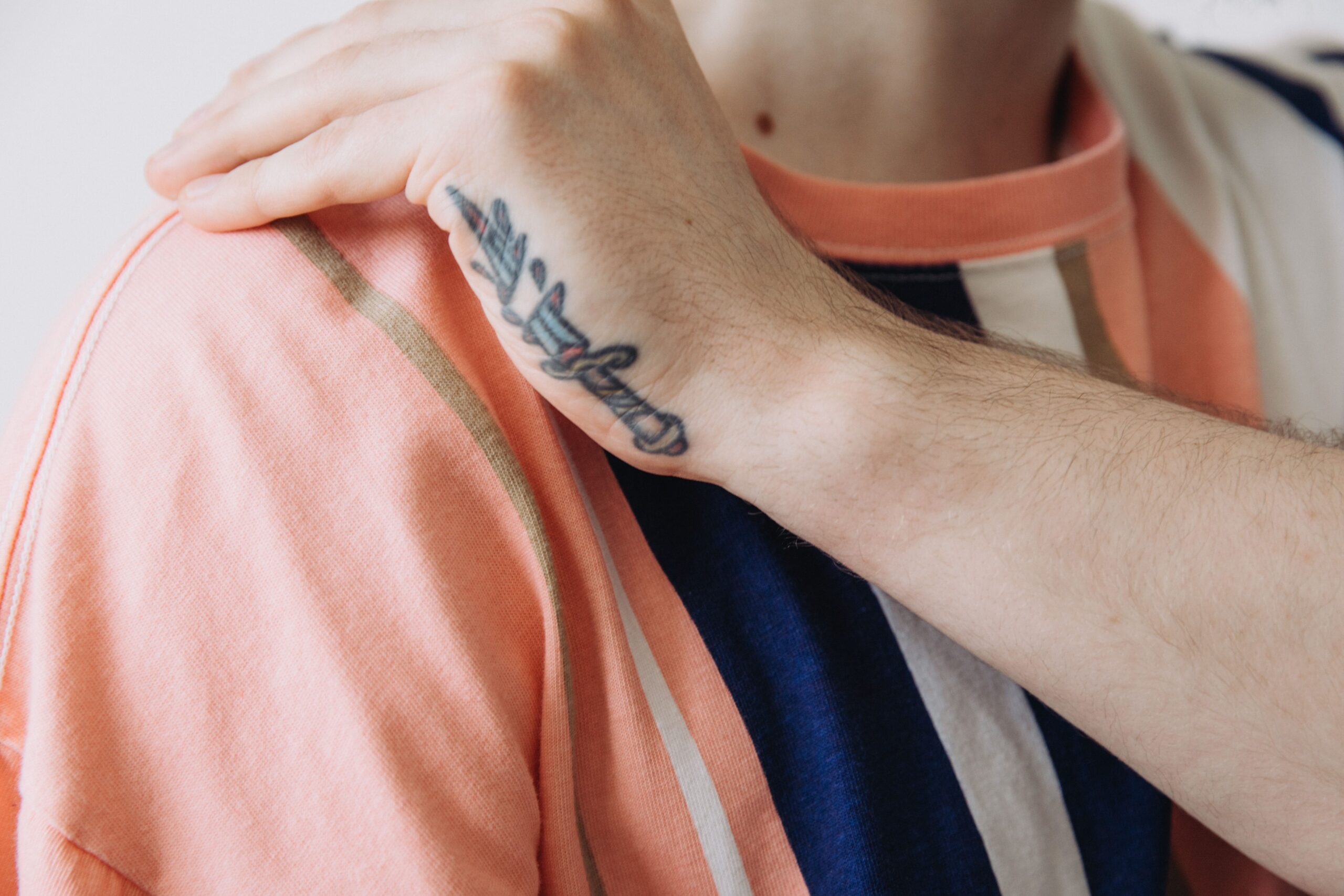
Of all the symbols in tattooing, the dagger is the one that refuses to mean only one thing. It is a weapon and a promise, a threat and a sacrifice, a piece of steel that can stand for loyalty, for loss, for courage, or for a wound that never quite healed. That is why it has lasted: sailors wore it, soldiers wore it, and lovers wore it, and each of them meant something different by it. A dagger tattoo is never just a picture of a knife. It is a statement about what its wearer is prepared to do, to endure, or to give up — and the meaning changes completely with what is drawn beside it. This guide explains what the dagger has meant across history and tattoo tradition, what its classic pairings add, and how to choose a design that says what you actually mean.
In This Guide
Start with the blade itself, then follow its meanings through history, its classic pairings, and the practical choices of style and placement. For the dagger’s most famous pairing, read Rose and Dagger Tattoo Meaning, and for the Japanese tradition where blades carry their own symbolism, see our guides to Wabori Hebi and Japanese tattoo history.
Key Takeaways
- A dagger is not a sword and not a knife. It is a short, double-edged thrusting blade, and that distinction — small, close, personal — is the root of everything it means in a tattoo.
- The pairing decides the meaning. A dagger alone means courage or danger; a dagger through a heart means love or betrayal; a dagger with a rose means love with thorns; a dagger with a snake means protection or betrayal survived.
- Loyalty and sacrifice are the two oldest readings. The dagger has marked soldiers, sailors and sworn companions for centuries, and those meanings still dominate the tattoo today.
- Old-school style is the dagger’s home. Bold lines, limited colour and simple shapes suit the dagger better than any other style, and they age better too.
- Placement changes the message. A dagger on the hand is a public statement; on the forearm it is a working tattoo; on the chest it is private; on the ribs it is a secret.
- Get the anatomy of the blade right. A dagger with a wrongly drawn guard, edge or fuller looks wrong to anyone who knows blades, so choose an artist who draws weapons carefully.
Table of Contents
- What a Dagger Is — and What It Is Not
- A Short History of the Dagger
- Loyalty, Sacrifice and the Old Symbols
- The Classic Pairings and What They Add
- Styles, Sizes and Placements That Work
- Choosing a Dagger Design That Says What You Mean
- Common Mistakes to Avoid
- Frequently Asked Questions
What a Dagger Is — and What It Is Not
Small, double-edged, and made for the thrust. A dagger is a short fighting blade, usually double-edged, designed for close combat and for thrusting rather than cutting. That definition matters, because it separates the dagger from its neighbours: a sword is longer and made for reach, a knife is a tool first and a weapon second, and a dirk is a long dagger with its own Scottish history. The dagger’s whole character comes from its size. It is a weapon you carry hidden, draw at arm’s length, and use up close. In a tattoo, that closeness is the point. A sword tattoo speaks of honour in battle; a dagger tattoo speaks of something personal — a promise kept, a betrayal answered, a danger faced at close quarters.
The blade has parts, and they all mean something. A traditional dagger has a pointed tip, two sharpened edges, a central ridge or fuller running down the blade, a crossguard that protects the hand, a grip, and a pommel at the end. Tattoo artists who draw daggers well respect those parts: the blade tapers to a real point, the guard is wide enough to matter, and the grip is long enough to hold. Artists who draw them badly produce something that looks like a kitchen knife with pretensions, and the tattoo loses its force. When you look at a dagger design, check the guard first. If the guard is missing or drawn as a thin line, the artist has not thought about the weapon; if it is drawn with weight and symmetry, the rest of the design will usually follow.
Why the dagger entered tattooing early. The history of tattooing is full of blades, because the people who got tattooed earliest — sailors, soldiers and travellers — lived with blades every day. A dagger was a tool, a sidearm and a status object all at once, and it was small enough to draw well on the skin. The sailor tattoo tradition adopted it whole: daggers through hearts, daggers with swallows, daggers with roses and banners. The American traditional style that grew out of that tradition — bold black outlines, a limited palette of red, green and yellow, and simple, readable shapes — remains the dagger’s natural home, and most of the best dagger tattoos ever made are old-school pieces that could have been drawn in 1940.
| Blade | Length | Edges | Made for | Tattoo meaning |
|---|---|---|---|---|
| Dagger | Short, under 50 cm | Double-edged | Thrusting at close quarters | Loyalty, sacrifice, courage, betrayal |
| Sword | Long, over 60 cm | Single or double-edged | Reach in open battle | Honour, justice, warrior spirit |
| Knife | Short | Usually single-edged | Cutting, everyday work | Self-reliance, craft, survival |
| Dirk | Long dagger | Single-edged | Thrusting, Scottish dress | Heritage, clan loyalty, ceremony |

A Short History of the Dagger
Humans have carried short blades since the Bronze Age. The earliest daggers were made of copper and bronze more than five thousand years ago, and the form has barely changed since: a short, pointed, double-edged blade with a grip. Every culture that worked metal made one — the Egyptian khanjar, the Roman pugio carried by legionaries, the medieval rondel dagger, the Scottish dirk, the Japanese tantō, the Malay kris. The dagger survived because it was useful in a way a sword was not: it could be worn every day, hidden under clothing, and drawn in a space too small for a sword. That everyday presence is why it became a symbol rather than just a weapon. A sword belongs to war; a dagger belongs to a person.
The dagger in the East carried its own code. In Japan, the tantō was a companion blade, worn with the katana and used for close work and, in the darkest part of the samurai code, for ritual suicide. The irezumi tradition that grew alongside it treated the body as a canvas for stories of loyalty and endurance, and blades appear throughout it — not as decoration, but as markers of the wearer’s place in a moral order. Our guide to Japanese tattoo history traces how those meanings developed, and the hand-poked tradition described in Wabori Tattoo shows how seriously Japanese artists still take the discipline behind every line. A dagger in a Japanese-style tattoo is never casual; it is placed with the same care as a koi or a cherry blossom, and it is chosen because the wearer understands what it costs.
The West made the dagger a sailor’s mark. In the age of sail, a dagger was part of a sailor’s kit — a tool for cutting rope, opening crates and, if it came to it, defending himself in a port brawl. Sailors tattooed what they lived with, and the dagger joined the swallow, the anchor and the rose as one of the defining marks of the trade. The sailor tattoo tradition is the direct ancestor of the American traditional style, and its rules still govern most dagger tattoos today: bold black outlines so the design reads at a distance, a small number of strong colours, and no detail so fine that it will blur into nothing within a decade. A dagger drawn in that style is a piece of history you can wear.
Loyalty, Sacrifice and the Old Symbols
Loyalty is the dagger’s first meaning. For most of its history, the dagger was the weapon of the companion — the soldier at your side, the sworn friend, the person who would stand with you when the fighting started. In tattooing, that has made it the mark of loyalty in its strongest form: not the easy loyalty of fair weather, but the loyalty that costs something. People get dagger tattoos for a fallen friend, a brother in arms, a family member they would defend, or a promise they intend to keep. The dagger points the way loyalty does — straight ahead, without hedging. If you are considering a dagger for loyalty, think about what the loyalty is to, because the tattoo will ask that question of you for the rest of your life, and a vague answer will not satisfy it.
Sacrifice is the dagger’s second meaning, and its hardest. A dagger is also the blade of sacrifice — the weapon of the ritual, the offering, the thing given up. In the old stories, the dagger is what Abraham raised, what Brutus held, and what the martyr accepted. As a tattoo, it marks a loss willingly borne: a sacrifice made for someone else, a part of yourself given up, a price paid. This is why the dagger through the heart is such a powerful image: it is not only a wound, it is a wound accepted, and it is often worn by people who have survived something — an illness, a loss, a betrayal — and come out the other side. The heart symbol itself carries that weight: for centuries the heart has stood for the seat of feeling, of courage and of love, and a dagger through it is the most direct statement in tattooing that love and pain are the same story.
The old symbols still do their work. The dagger’s meanings have not been invented by tattoo culture; they have been inherited from a much older symbolic language in which the blade stood for justice, for judgement, and for the cutting away of what is false. A dagger can mean cutting ties, cutting through lies, or cutting away a past self. That is why it appeals to people at turning points: after a divorce, after leaving a bad situation, after getting clean, after a death. The tattoo becomes a line drawn under a chapter. It is worth sitting with that before you book, because the meaning that feels urgent this year may not be the meaning you want to carry in twenty years — and the best dagger tattoos are the ones whose meaning deepens with time rather than fading with it.
The Classic Pairings and What They Add
The dagger through a heart is the most famous tattoo in the world. A red heart pierced by a dagger, often with a banner reading love, mother or a name, is the single most recognisable image in Western tattooing. Its meaning is double-edged, like the blade itself: it can mean a love so strong it hurts, a love lost or betrayed, or a heart that has been wounded and survived. The photograph below shows that image in its oldest form — not on skin, but printed on a ceramic vase decorated with old-school tattoo flash, where the heart, dagger, dice and anchor sit together exactly as they would in a sailor’s tattoo. It is a useful reminder that these images were a visual language before they were a fashion: every element was chosen, and every combination said something specific.

The rose changes everything. A rose with a dagger is the pairing most people ask for, and for good reason: the rose stands for love and beauty, the dagger for pain and protection, and together they say that love is worth defending and that beauty has thorns. Our full guide to rose and dagger tattoo meaning works through the variations — the rose in bloom, the rose with thorns, the dagger through the flower — and the differences matter. A dagger resting beside a rose is a gentler statement than a dagger through one. A rose with the dagger pointing down is defensive; a dagger pointing up is defiant. These are small choices, but a tattoo is made of small choices, and they are the ones people notice.
Snakes, skulls and swallows each add a chapter. A dagger with a snake is one of the oldest pairings of all: the snake stands for danger, for healing and for rebirth, and the dagger beside it can mean protection against betrayal, or a betrayal survived. The snake is a natural companion to the dagger because both are associated with the same virtues — watchfulness, patience, and a strike that comes only when it is needed. Our guide to Wabori Hebi shows how Japanese tradition treats the snake as a creature of water and transformation, which is a useful corrective to the Western habit of reading every snake as evil. A dagger with a skull speaks of death faced and mortality accepted; a dagger with a swallow — the sailor’s bird — speaks of a safe return. And a dagger alone, with no pairing at all, is the purest statement: courage without qualification, or a warning without explanation. Choose the pairing that matches your story, not the one that looks best on someone else.
Styles, Sizes and Placements That Work
Old-school first, everything else second. The American traditional style suits the dagger better than any other: bold outlines, solid black, a red handle or a red heart, and nothing fussy. It reads from across a room, it ages gracefully, and it carries the history of the symbol with it. Blackwork is the second choice — a dagger in solid black, with fine dotwork shading, looks severe and modern. Fine-line daggers are the riskiest: the blade’s edge is a single line, and if that line softens, the dagger becomes a smudge. If you want fine-line, keep the dagger large and the lines heavier than you think. Japanese-style daggers work when they are part of a larger piece — a tantō beside a koi or a snake — and they need an artist who understands that tradition, as described in our guide to the Japanese tattoo bodysuit, where every element is placed according to rules that go back centuries.

Placement is a message. The hand, as in the first photograph in this guide, is the boldest placement: a dagger on the hand is visible in every handshake and every photograph, and it says that the wearer does not hide what they stand for. The forearm is the classic working placement — visible when you choose, covered when you need it to be — and it suits a dagger of ten to fifteen centimetres, with room for a heart or a rose beside it. The upper arm and the shoulder suit larger pieces, and the shoulder blade takes a dagger well because the flat surface keeps the blade straight. The chest is the private placement: a dagger over the heart is a statement for the wearer alone, and it is the placement that makes the heart-and-dagger pairing most literal. The rib cage takes a vertical dagger beautifully, following the line of the ribs, while the upper back suits a larger dagger as the centrepiece of a symmetrical composition. Wherever you put it, keep the blade straight: a dagger that follows the body’s line looks deliberate, and a dagger that cuts across it looks accidental.
Choosing a Dagger Design That Says What You Mean
Start with the sentence, not the picture. Before you look at a single design, write down the sentence your tattoo has to say, in plain words: I kept my promise. I survived. I will protect my family. I cut ties and I do not regret it. If you cannot write the sentence, you are not ready to choose the design, because every design decision — the pairing, the direction, the size, the placement — follows from it. A dagger for loyalty should be paired with something that names the loyalty: a name, a date, a rose for a person, a swallow for a safe return. A dagger for sacrifice should be paired with something that names the cost: a heart, a skull, a broken chain. A dagger for a fresh start should stand alone, clean and unadorned, because it is a line under the past rather than a picture of it.
Direction is a decision. A dagger pointing up is defiant and ready; a dagger pointing down is protective and at rest; a dagger pointing at the heart is personal; a dagger held horizontally is a line drawn. In old-school flash, the dagger through the heart almost always points down, following the shape of the chest, and that is still the most natural orientation for a chest or forearm piece. On the hand or the fingers, a small dagger pointing outward reads as a warning; on the ribs, a vertical dagger reads as a secret. There is no single right answer, but there is a wrong one: a dagger whose direction was chosen by accident, because the artist placed the stencil without asking. Ask, and decide together.
Talk to your artist about the blade’s anatomy. A good tattoo artist will already know the parts of a dagger — tip, blade, fuller, guard, grip and pommel — but a great one will ask you how realistic you want it. A realistic dagger needs correct proportions: a blade about three times as long as the grip, a guard wider than the grip, and a point that is actually pointed. A stylised old-school dagger can break those rules, because the style itself is the point, and the bold black outline does the work that realism would do. What neither style can survive is a dagger drawn from a photograph the artist has not understood. Bring references, but let the artist redraw the design for your body and your story. And remember the practical side: the Mayo Clinic’s guidance on tattoos applies here as it does everywhere — choose a licensed studio, check that needles are single-use and inks are fresh, and follow the aftercare your artist gives you, because a well-drawn dagger in an infected arm is no one’s idea of a tribute.
Common Mistakes to Avoid
Choosing a dagger because it looks dangerous. A dagger tattoo worn as a threat — to look tough, to intimidate — is the most likely to be regretted, because the threat fades and the tattoo does not. The dagger’s real power is not in frightening other people; it is in reminding the wearer of a promise. If the promise is not there, the tattoo is a costume, and costumes wear thin.
Copying a famous design without understanding it. The heart-and-dagger is so famous that people copy it without knowing what the banner says or what the dice beside it mean. In the old flash, every element was a word in a sentence: the heart was love, the dagger was pain, the dice were chance, the anchor was hope. Copy the image without the sentence and you get a tattoo that says nothing. Learn the language first — this guide is a start — and then choose your words.
Going too small or too fine. A dagger is a shape that depends on its outline. Shrink it below about eight centimetres and the guard disappears, the fuller disappears, and the blade becomes a splinter. Draw it in hairline fine-line and the edge will soften within a few years. The health effects of tattoos are the same for small tattoos as for large ones, so the saving from a tiny piece is not a saving at all. Give the dagger room, give it bold lines, and it will still be a dagger in twenty years.
Our View
The dagger is the most honest symbol in tattooing, because it cannot be worn lightly. It is a weapon, and it asks its wearer to mean it. The best dagger tattoos we have seen are not the biggest or the most detailed; they are the ones where the pairing, the direction and the placement all point at the same sentence, and where the wearer can say that sentence out loud without hesitating. If you can do that, the dagger will serve you for life. If you cannot, wait until you can — the blade will still be there.
— Muse, Tattoo Designs Pictures
Frequently Asked Questions
What does a dagger tattoo mean?
Most often loyalty, sacrifice, courage or betrayal — and the exact meaning depends on what is drawn with it. A dagger through a heart means love or loss; a dagger with a rose means love with thorns; a dagger with a snake means protection or betrayal survived; a dagger alone means courage or a promise.
Is a dagger tattoo a bad sign?
No. The dagger has been a mark of loyalty and protection for centuries, worn by sailors, soldiers and sworn companions. Like any symbol, it can be worn badly — as a threat, or copied without understanding — but the symbol itself is about courage and commitment, not wrongdoing.
Where is the best place for a dagger tattoo?
The forearm is the classic choice, visible when you want it and easy to cover. The hand is the boldest, the chest the most private, and the ribs the most secret. Keep the blade straight and aligned with the body’s lines, whichever placement you choose.
How big should a dagger tattoo be?
At least eight to ten centimetres long, so the guard, the fuller and the point all stay readable as the tattoo ages. Smaller daggers lose their detail quickly, especially in fine-line work.
What goes well with a dagger tattoo?
A heart, a rose, a snake, a skull or a swallow are the classic pairings, and each changes the meaning. A banner with a name or a date makes a dagger tattoo personal, and old-school style — bold lines and limited colour — suits the dagger better than any other style.
Does a dagger tattoo hurt more than other tattoos?
The pain depends on the placement, not the design. A dagger on the hand or ribs hurts more than one on the forearm or upper arm, because the skin is thinner and the bone is closer. A small dagger takes one to two hours, and the pain ends when the session ends.
Questions About Your Tattoo?
Visit Tattoo Designs Pictures for more placement guides, design ideas and tattoo meanings, and bring your questions to your artist before you book.
Sources
- Dagger — Wikipedia
- Sword — Wikipedia
- Heart symbol — Wikipedia
- Rose — Wikipedia
- Sailor tattoos — Wikipedia
- American traditional — Wikipedia
- Tattoo — Wikipedia
- History of tattooing — Wikipedia
- Health effects of tattoos — Wikipedia
- Tattoos: risks and precautions — Mayo Clinic