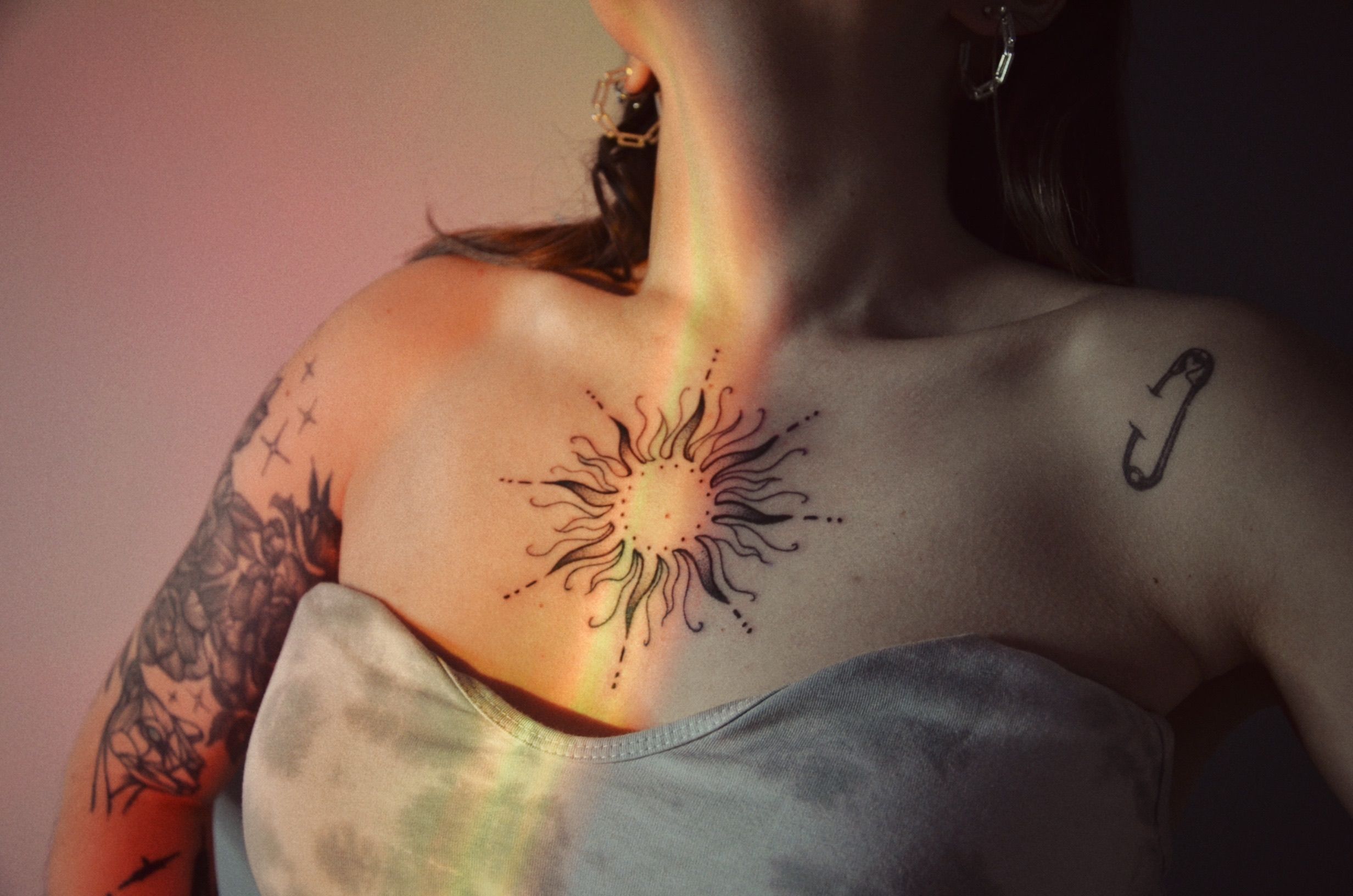
A sternum tattoo runs down the centre line of the chest, from the hollow at the base of the throat to the soft point where the ribs meet, and it is one of the most deliberate placements a woman can choose. Nothing about it is accidental: the design has to be symmetrical, the line has to be straight, and the skin it sits on is thin, mobile and close to bone. That is exactly why it works so well. A sternum piece frames the body the way a necklace does, drawing the eye down a single vertical axis, and when the design is chosen with the anatomy in mind it can look elegant at a glance and reward a closer look for years. This guide covers the designs that genuinely suit the sternum, the pain and healing honestly, and the mistakes that turn a beautiful idea into a blurry regret.
In This Guide
Start with the placement itself, then explore the designs, the pain and the aftercare. For neighbouring placements, see our guides to rib cage tattoo designs, upper back tattoo designs and shoulder blade tattoo designs, and for the symbolism behind one of the most popular sternum pairings, read Rose and Dagger Tattoo Meaning.
Key Takeaways
- The sternum is a vertical canvas. Designs that follow the centre line — ornamental drops, fine-line florals, moths, script and suns — age far better than wide designs forced into a narrow space.
- Pain is real and specific. The skin over the breastbone is thin and the bone is close, so most people rate sternum work as sharp and intense, especially near the top and bottom of the bone.
- Symmetry is everything. A millimetre off-centre shows at a glance, so a good artist stencils, photographs and re-stencils before a single line is tattooed.
- Healing needs stillness and soft clothing. Bras, tight tops and sleeping on your front all rub a fresh sternum tattoo, so plan your wardrobe and your sleep for the first two weeks.
- Small and fine ages differently from bold and black. Fine-line sternum tattoos look exquisite when fresh and need touch-ups sooner; bold ornamental work holds its shape longer.
- Choose the artist before the design. Look for healed sternum work in their portfolio, not just fresh photographs, and walk away from anyone who rushes the stencil.
Table of Contents
- What a Sternum Tattoo Is — and Why the Centre Line Matters
- The Anatomy Under the Design
- The Designs That Work Best Along the Sternum
- Pain, Healing and Aftercare — What to Expect
- Sizing, Symmetry and Working With Your Artist
- Sternum Tattoos and Ageing, Weight Change and Stretch Marks
- Common Mistakes to Avoid
- Frequently Asked Questions
What a Sternum Tattoo Is — and Why the Centre Line Matters
The centre line is the design. A sternum tattoo is any tattoo placed on or along the sternum, the long flat bone that joins the ribs at the front of the chest. In practice the word covers three related placements: the true sternum piece, which runs vertically down the breastbone itself; the underbust piece, which sits beneath the breasts and often connects to the sternum; and the chest panel, which spreads across the upper chest with the sternum as its axis. All three share the same discipline, which is that the body gives you a narrow, symmetrical corridor and punishes anything that ignores it. A design that respects the corridor looks inevitable, as though it grew there. A design that fights it looks crooked within a month, even if the lines were perfect on the day.
History is on the sternum’s side. Tattooing the chest is not a new fashion. The history of tattooing shows chest and torso work in many cultures, from the full-body Japanese tradition — where the chest is part of a larger composition with an open space left down the middle — to the chest panels of Western sailors. What is new is the sternum as a standalone, deliberately feminine placement: a single vertical motif, often ornamental or floral, worn with open necklines and chosen for its elegance rather than its coverage. Our guide to Japanese tattoo history explains how the chest became one of the most meaningful areas of the body to tattoo, and the irezumi tradition still shapes how serious artists think about the centre line today.
Visibility is the point — and the price. A sternum tattoo is easy to hide under a crew neck and impossible to hide under a scoop neck, a V-neck, a swimsuit or a low-cut dress. That middle ground is why so many women choose it: it is private at work and visible in the clothes they actually love. Before you book, try the honesty test. Put on the five outfits you wear most, stand in front of a mirror, and ask which of them would show the tattoo. If the answer is all of them, make sure you are comfortable with that. If the answer is none of them, ask whether you want a placement you will rarely see. The tattoo itself is permanent; the decision about who sees it is made fresh every morning.
| Placement | Best for | Pain level | Visibility | Healing |
|---|---|---|---|---|
| Sternum | Vertical ornamental, floral and fine-line designs | High — thin skin over bone | Hidden by crew necks, shown by scoop and V-necks | 2–3 weeks; avoid bra pressure |
| Underbust | Horizontal ornamental bands and mandalas | High — ribs and bone close by | Very private; rarely seen | 2–3 weeks; avoid underwire |
| Chest panel | Wider floral, animal and script designs | Medium to high | Shown by most open necklines | 2–3 weeks; keep clothing soft |
| Upper back | Large symmetrical pieces | Medium | Hidden by most clothing | 2–3 weeks; easy to protect |
The Anatomy Under the Design
Know the bone before you ink over it. The sternum is a flat bone in the centre of the chest, made of three parts: the manubrium at the top, the long body in the middle, and the small xiphoid process at the bottom. The rib cage joins it on both sides, which is why a sternum tattoo sits in a shallow valley between the pectoral muscles. The bone is close to the surface along its whole length, and the skin over it is thin, with little fat to cushion the needle. That combination is the whole story of sternum pain: it is not that the area is mysterious, it is that there is almost nothing between the needle and the bone.
Skin here behaves differently. Human skin varies in thickness across the body, and the chest is on the thinner end of the scale, as well as being skin that stretches every time you breathe, reach overhead or twist. A tattoo is made by placing pigment in the dermis, the layer beneath the surface, and when that layer is thin and mobile, two things follow. First, the artist must work with a lighter hand and shallower depth than they would on an arm or a thigh, or the ink will blow out into a soft halo around the lines. Second, the tattoo will move with you: it looks different standing, sitting and lying down, and a design that is symmetrical when you stand with your arms at your sides may not be symmetrical when you raise them. Good artists stencil with you standing in a neutral posture and check the design in a mirror before they begin, because that is the posture the tattoo will be judged in.
Breathing is part of the session. Because the chest rises and falls, many artists ask you to breathe slowly and steadily, and to tell them when you need a pause. The vibration of the machine travels into the bone, which some people find more unsettling than the pain itself — a buzzing, rattling sensation in the chest that is hard to describe until you feel it. It is normal, it is not dangerous, and it passes the moment the machine lifts. If you are anxious about it, say so before the session starts; an artist who knows will slow down, take breaks, and keep you talking, which is the oldest pain management there is.
The Designs That Work Best Along the Sternum
Ornamental work is the sternum’s natural language. If there is one style that was made for this placement, it is ornamental: symmetrical mandalas, dotwork drops, lace-like chains and geometric fans that widen at the top and taper to a point at the bottom. The mandala, with its radial symmetry, is the perfect sternum motif, because the placement itself is symmetrical and the design can mirror itself across the centre line without distortion. Ornamental pieces also age well here, since their bold lines and solid black areas hold up where fine lines fade. Look at our guide to rib cage tattoo designs for how ornamental work behaves on the neighbouring torso, and notice how the best pieces all share the same discipline: a strong central spine, balanced wings, and nothing that fights the body’s own lines.
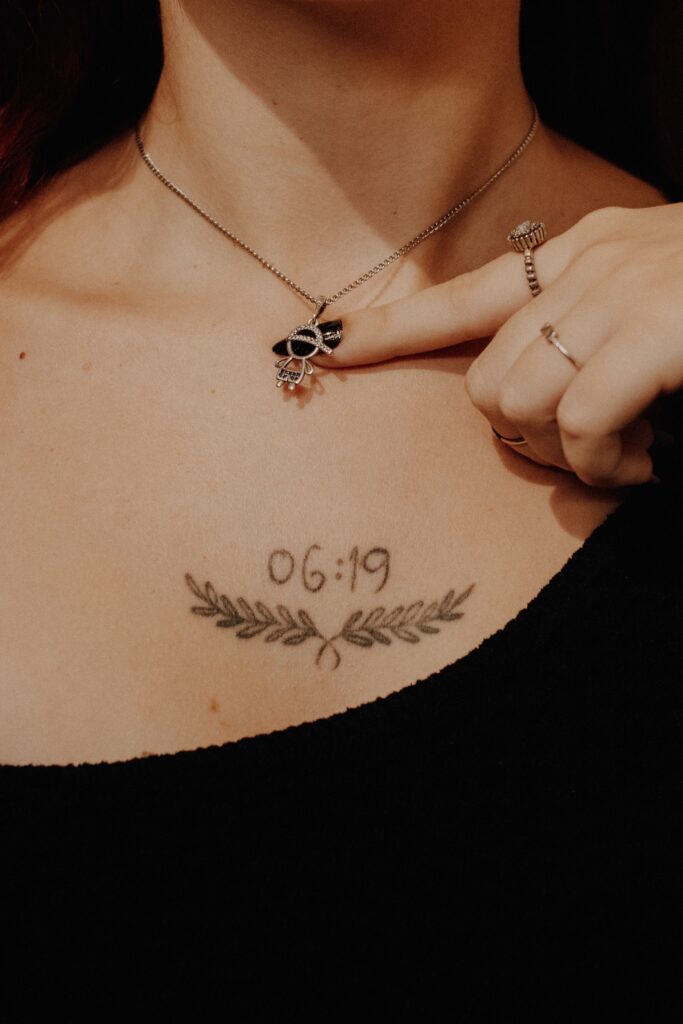
Fine-line florals are the romantic choice — with a trade-off. Delicate stems, small leaves and single flowers running down the centre line are the most requested sternum designs of the last few years, and they photograph beautifully. The trade-off is longevity. Fine lines spread slightly as skin ages, and on thin chest skin they can soften faster than on an arm. That does not make them a bad choice; it makes them a choice with maintenance. Budget for a touch-up in two to three years, keep the tattoo out of the sun, and choose an artist whose healed fine-line work you have actually seen. The photograph below shows how good small fine-line work can look on the upper chest: a tiny time and laurel sprig, placed where a necklace would sit, doing more with restraint than a large piece could.
Moths, butterflies and moons suit the vertical drop. A moth or a butterfly centred on the sternum, with its wings spread across the chest, is one of the most flattering compositions in tattooing, because the insect’s own symmetry matches the body’s. The same is true of crescent moons and stars arranged in a vertical fall: they give the eye a path to follow and they can be scaled from a single small moth to a full centrepiece with trailing elements toward the underbust. The photograph below shows a moth and crescent moon tattoo on the upper chest, worn with a white top — the kind of piece that is visible in summer and invisible in winter, which is exactly the flexibility many women want.

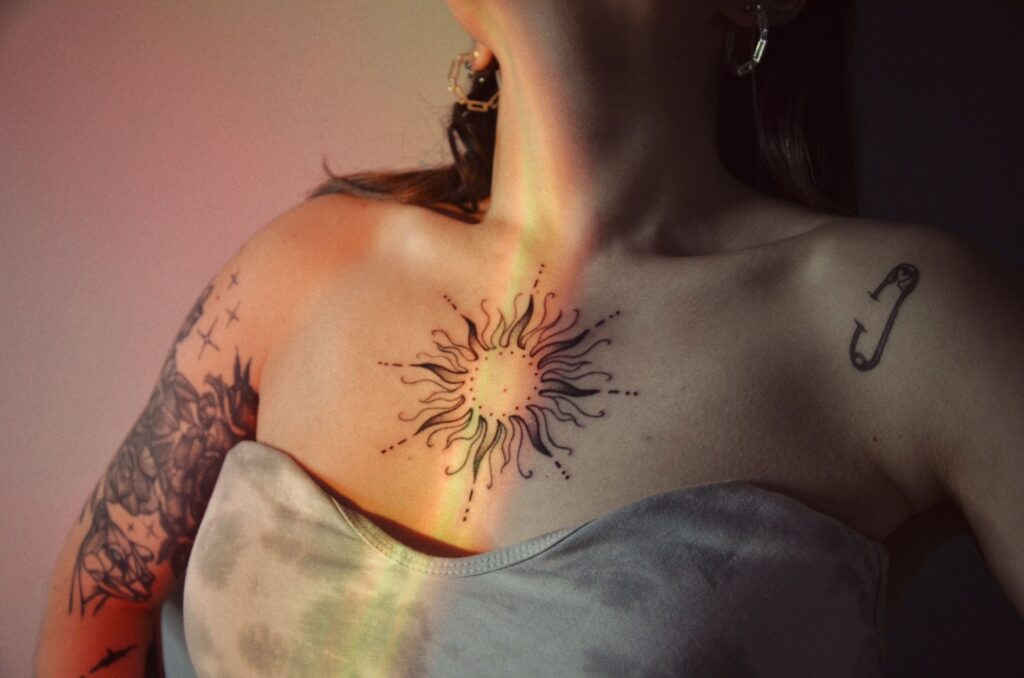
Script, suns and snakes all work — if they are drawn for the space. A single word or a short phrase running vertically down the sternum can be striking, but script must be sized generously: letters smaller than a grain of rice will blur into each other within a few years. A sun, like the one in the first photograph in this guide, works because its rays radiate symmetrically from a centre point on the bone. Snakes work when they coil down the centre line rather than across it; a snake that crosses the sternum diagonally will look crooked the moment you move. The same rule applies to daggers and roses: a dagger pointing down the centre line, paired with a rose at the top, is a classic for a reason, and our guide to rose and dagger tattoo meaning explains why that pairing has lasted a century. Whatever the subject, the test is the same: does the design have a spine, and does that spine sit on your spine? If the answer is yes, the design will hold.
Think in three zones. The most useful way to plan a sternum tattoo is to divide the bone into three zones and assign each a job. The top zone, from the throat hollow to the top of the breasts, is the showcase: it is the part people see first, so put your focal point there — the sun, the moth, the mandala’s centre. The middle zone, between the breasts, is the connector: it carries the design down and can be lighter, with dots, fine lines or a thin chain. The bottom zone, below the breasts to the xiphoid, is the finish: a taper, a drop or a small pendant shape that ends the piece cleanly instead of letting it peter out. Artists who plan in zones produce pieces that look finished; artists who do not produce pieces that look as though they ran out of ideas halfway down.
Pain, Healing and Aftercare — What to Expect
Expect it to hurt, and expect to cope. There is no honest version of this guide that calls a sternum tattoo painless. The Mayo Clinic’s guidance on tattoos is clear that pain, swelling and redness are normal parts of getting tattooed, and the sternum concentrates all three: thin skin, bone underneath, and a placement you cannot ignore because you feel it every time you breathe. Most people describe the sensation as sharp and scratchy at the top of the bone, vibrating and rattling in the middle, and tender and deep at the bottom near the xiphoid. It is worse than an upper arm and, for most people, worse than the shoulder blade, which has more muscle and fat to absorb the work. It is also finite: a small sternum piece takes one to two hours, a large ornamental piece two to four, and the pain ends when the session ends.
Healing is mostly about friction. The health effects of tattoos are well documented, and the practical lesson for the sternum is that a fresh tattoo is an open wound that needs to stay clean, dry and undisturbed while it closes. On the sternum, the main enemy is friction: bra bands, underwire, tight tops, seatbelts and sleeping on your front all rub the same square of skin. Plan around it. Wear a soft bralette or go without a bra for the first few days if you can; choose loose, breathable tops; sleep on your back for a week; and keep the tattoo out of the bath, the pool and the sea until it is fully healed. Wash it gently with warm water and fragrance-free soap, pat it dry, and apply the thin layer of aftercare your artist recommends — thin is the operative word, because a thick coat of ointment suffocates the skin and can pull ink out.
Watch for the signs that need a professional. Some redness, swelling and tenderness in the first few days are normal. Spreading redness, increasing pain after the third day, heat, pus, a fever, or red streaks running away from the tattoo are not, and they mean you should contact your artist and a clinician promptly. The same applies to an allergic reaction: itching and a raised rash beyond the tattooed area, or blistering, should be checked rather than waited out. Choose your studio with this in mind. A licensed studio that uses single-use needles, fresh ink caps and proper sterilisation makes complications unlikely; a cheap, unlicensed one makes them a gamble. The tattoo will be on your chest for the rest of your life; the saving from a cut-price studio is not worth it.
Sizing, Symmetry and Working With Your Artist
Size it to the bone, not to the photograph. The most common sizing mistake is choosing a design from a photograph of someone else’s chest and asking for it at the same size. Chests differ in width, in the distance between the breasts, and in the length of the sternum itself, and a design that is perfect on one body will be too wide or too long on another. A good artist will measure you, not the photograph. As a rough guide, a small sternum piece runs about 8 to 12 centimetres long, a medium piece 12 to 20, and a large ornamental piece can run the full length of the bone, 20 centimetres or more. Anything wider than about 10 centimetres at its widest point will start to spill off the bone and onto the softer tissue of the breasts, where it will distort with movement — which is why the best sternum designs are tall and narrow, not wide.
The stencil is the whole appointment. A sternum tattoo should never be started from a stencil that has not been checked three ways: standing straight with your arms at your sides, standing in front of a mirror, and photographed from the front. Ask your artist to place the stencil, then stand up, walk around, and look at it in a mirror before you agree to anything. Check that the centre of the design sits on the centre of your body, that the top is level, and that the design does not drift to one side when you breathe in. If anything is off by even a little, ask for a re-stencil. This is not fussiness; it is the difference between a tattoo that looks deliberate and one that looks like a printing error. The Japanese tradition understands this better than any other: the wabori masters who build full-body work around the centre line, and the comparison in Wabori vs Tebori, both show how much of the craft is planning before the needle ever touches skin, and our guide to Wabori Hebi shows the same discipline applied to a single motif.
Choose an artist with healed sternum work. Every artist has fresh photographs; far fewer have photographs of their sternum work a year later, when the fine lines have settled and the black has softened. Ask to see healed work, and ask specifically about sternum pieces. If the artist has none, they may still be excellent — but you are then paying them to learn on your chest, and you should know that before you pay. Also ask about their approach to depth: on thin chest skin, a heavy hand causes blowouts, the soft blue-grey halo that appears around lines that were pushed too deep. An artist who talks about depth, voltage and needle choice without being asked is an artist who has thought about it. The full-body Japanese tradition is the extreme case of this discipline — see our guide to the Japanese tattoo bodysuit — but the same care applies to a piece ten centimetres long.
Sternum Tattoos and Ageing, Weight Change and Stretch Marks
All tattoos age; sternum tattoos age in public. A tattoo is pigment held in the dermis, and over time the body’s immune system slowly carries some of that pigment away while the rest spreads very slightly. On the sternum, that means bold black lines stay readable for decades, fine lines soften within a few years, and colour — especially light colour — fades fastest of all. Sun is the biggest accelerator: the chest gets more sun than most people realise, in summer clothes and on holiday, and ultraviolet light breaks pigment down. If you want your sternum tattoo to look good in ten years, the single most effective thing you can do is put sunscreen on it every day you are outdoors, and keep it covered in strong sun. That is cheaper and more effective than any touch-up.
Weight change and pregnancy will move the design. The sternum itself does not change shape with weight, but the tissue around it does, and a design that extends onto the breasts or the underbust will stretch and shift as that tissue changes. This is the strongest argument for keeping a sternum design on the bone itself, where it is anchored, rather than letting it sprawl sideways. Pregnancy, breastfeeding and significant weight loss can all change the chest substantially, and while a well-placed sternum tattoo will survive those changes gracefully, a wide design that crosses onto soft tissue may not. If you are planning a pregnancy in the next year or two, consider waiting, or choose a design that stays strictly on the centre line. Stretch marks are a related question: a tattoo does not prevent them, and a stretch mark running through a tattoo will distort the lines it crosses. There is no way to predict exactly where stretch marks will appear, which is another reason to keep the design simple and central.
Common Mistakes to Avoid
Going too small is the most common regret. Tiny script and micro-designs look delicate on the day and are the first to blur, because letters and details below a certain size have nowhere to go as the ink settles. If you want script, make it large enough to read from arm’s length. If you want detail, give it room. A sternum piece that is too small also looks lost on the chest, like a single earring. Go bigger than you think, within the width of the bone, and you will thank yourself in five years.
Copying a design exactly is the second mistake. A design made for someone else’s body, skin tone and style will not translate perfectly to yours, and a copied design is also, frankly, someone else’s tattoo. Use other people’s sternum tattoos as a starting point, then let your artist redraw the idea for your body. The result will fit better and mean more.
Skipping the healing plan is the third. Booking a sternum tattoo the week before a beach holiday, a festival, a gym challenge or a wedding is asking for trouble. You need two weeks of gentle treatment: no swimming, no sunbathing, no tight clothing, no heavy chest workouts. Book the appointment when your calendar is quiet, and treat the healing period as part of the tattoo, not as an inconvenience after it. Compare the healing demands with a placement that is easier to protect, like the upper back, and be honest with yourself about which one fits your life right now.
Our View
The sternum is the most honest placement in tattooing: it rewards symmetry, patience and a good artist, and it punishes rushing, copying and wishful thinking. If you choose a design that follows the bone, an artist who has healed sternum work to show you, and a fortnight of your life to heal properly, you will end up with a tattoo that looks like it was always meant to be there. If you cut any of those corners, the centre line will tell on you. Choose well, and wear it with the confidence it deserves.
— Muse, Tattoo Designs Pictures
Frequently Asked Questions
How painful is a sternum tattoo?
Most people rate it as one of the more painful placements, because the skin is thin and the bone is close. Expect sharp pain at the top of the bone, a vibrating sensation in the middle, and tenderness at the bottom. It is very manageable for a one to three hour session, and the pain stops when the session stops.
How long does a sternum tattoo take to heal?
The surface heals in about two weeks and the deeper skin in about four. During the first two weeks, avoid bra pressure, tight tops, swimming, baths and sun, wash gently, and apply only a thin layer of aftercare.
Do sternum tattoos stretch or sag with age?
A design kept on the bone itself holds its shape well, because the sternum does not change shape. Designs that extend onto the breasts are more affected by weight change, pregnancy and ageing, so keep the work central if longevity matters to you.
Can I wear a bra after getting a sternum tattoo?
Not comfortably for the first few days. A soft bralette or no bra is best while the tattoo is fresh, because bands and underwire rub exactly where the tattoo sits. After the first week, a soft, clean bra is usually fine.
What is the best sternum tattoo design for a first tattoo?
A small to medium ornamental or fine-line design with a clear centre point — a sun, a moth, a small mandala or a short stem of flowers. It is forgiving to heal, easy to hide, and easy to extend later if you want a larger piece.
Will a sternum tattoo fade faster than other tattoos?
Fine-line and light-coloured sternum tattoos fade faster than bold black work, and sun exposure speeds fading on the chest. Daily sunscreen and a touch-up every few years will keep a sternum tattoo looking sharp.
Questions About Your Tattoo?
Visit Tattoo Designs Pictures for more placement guides, design ideas and tattoo meanings, and bring your questions to your artist before you book.
Sources
- Sternum — Wikipedia
- Human skin — Wikipedia
- Chest — Wikipedia
- Rib cage — Wikipedia
- Tattoo — Wikipedia
- History of tattooing — Wikipedia
- Health effects of tattoos — Wikipedia
- Irezumi — Wikipedia
- Mandala — Wikipedia
- Butterfly — Wikipedia
- Tattoos: risks and precautions — Mayo Clinic