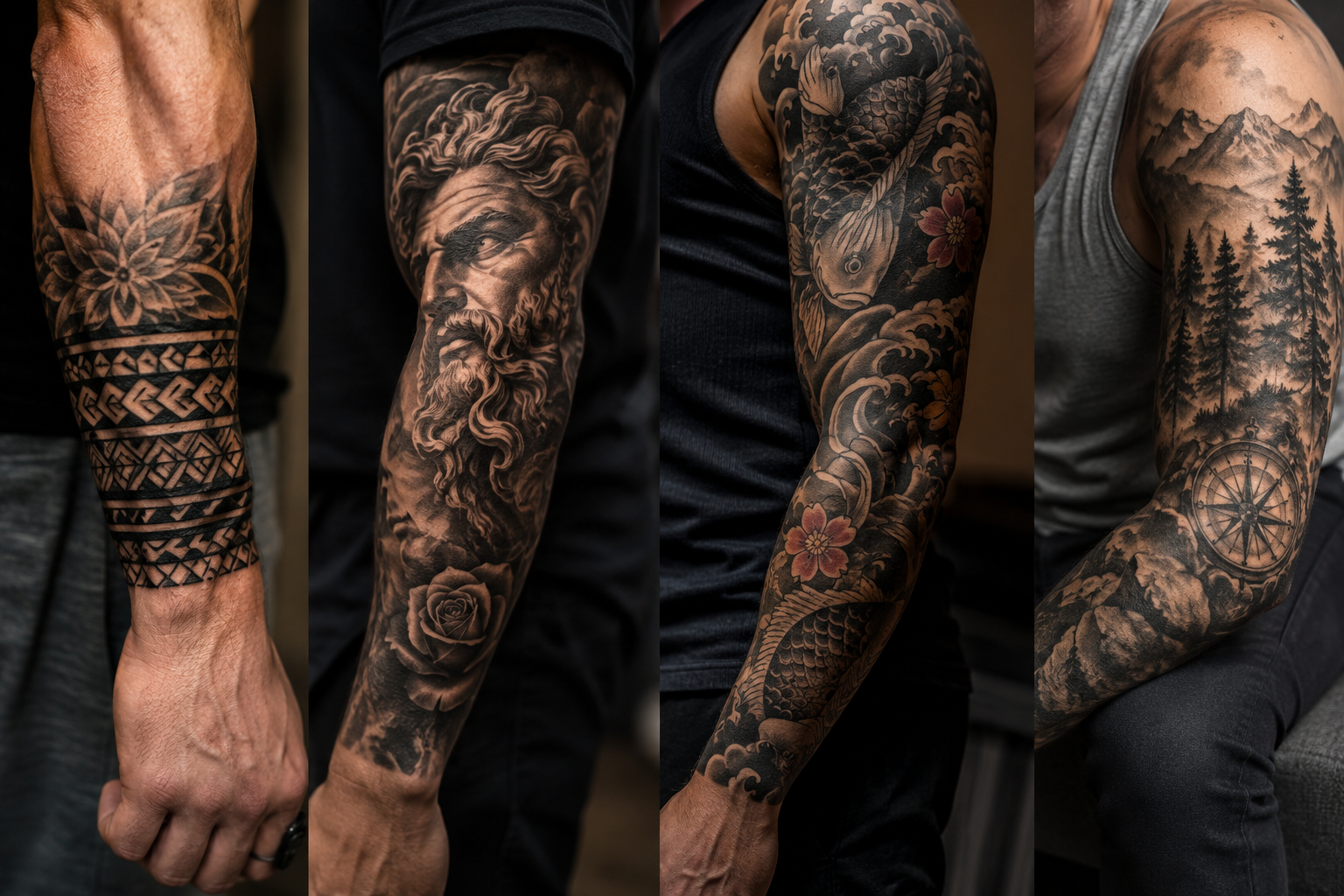
The arm is where serious tattoo collections begin and where they most completely develop — the surface that combines maximum everyday visibility with genuine canvas quality, professional manageability across most contexts, and the compositional versatility that suits the widest possible range of tattoo subjects and styles. More tattoos have been placed on arms than on any other part of the human body, and for reasons that are rooted in genuine functional logic rather than simply convention. The arm’s combination of consistent visibility, excellent skin quality across most of its surface, and the natural progression from wrist to shoulder that creates one of the most architecturally satisfying canvases available for ambitious body art makes it the placement where more meaningful, more technically accomplished, and more personally significant tattoo work is produced than anywhere else. Understanding the arm as a complete system of distinct placement zones — each with its own qualities, its own design logic, and its own relationship to the overall composition of an eventual sleeve — produces placement decisions that serve both the individual piece and the long-term development of the arm as a unified body of work.
Why the Arm Is the Primary Canvas for Men’s Tattoos
The arm’s specific qualities as a tattoo canvas create conditions that suit serious body art in several distinct and mutually reinforcing ways that explain its dominance across every era of tattoo culture.
The arm’s visibility profile is the most immediately practical of its advantages. A forearm tattoo is present in every short-sleeve social context, every professional environment that permits visible tattoos, and every physical situation where the arms are bare — creating a daily relationship between the wearer and their tattoo that more hidden placements cannot replicate. This visibility suits tattoos whose primary purpose is expressive — that say something specific about who the wearer is rather than existing purely as private personal marks. The arm’s visibility is not indiscriminate, however — long sleeves cover it completely in professional contexts that require concealment, making the arm one of the most practically manageable visible placements available to men navigating environments with mixed tattoo acceptance.
The arm’s skin quality across most of its surface supports detailed work in ways that more topographically complex or biologically challenging surfaces do not. The forearm and upper arm both have relatively consistent skin texture, good blood supply that supports clean healing, and moderate UV exposure that is manageable through consistent sunscreen application. These qualities make the arm one of the most technically forgiving placements available, producing results that hold their quality well over time with appropriate aftercare.
The Wrist and Lower Forearm: Where the Sleeve Begins
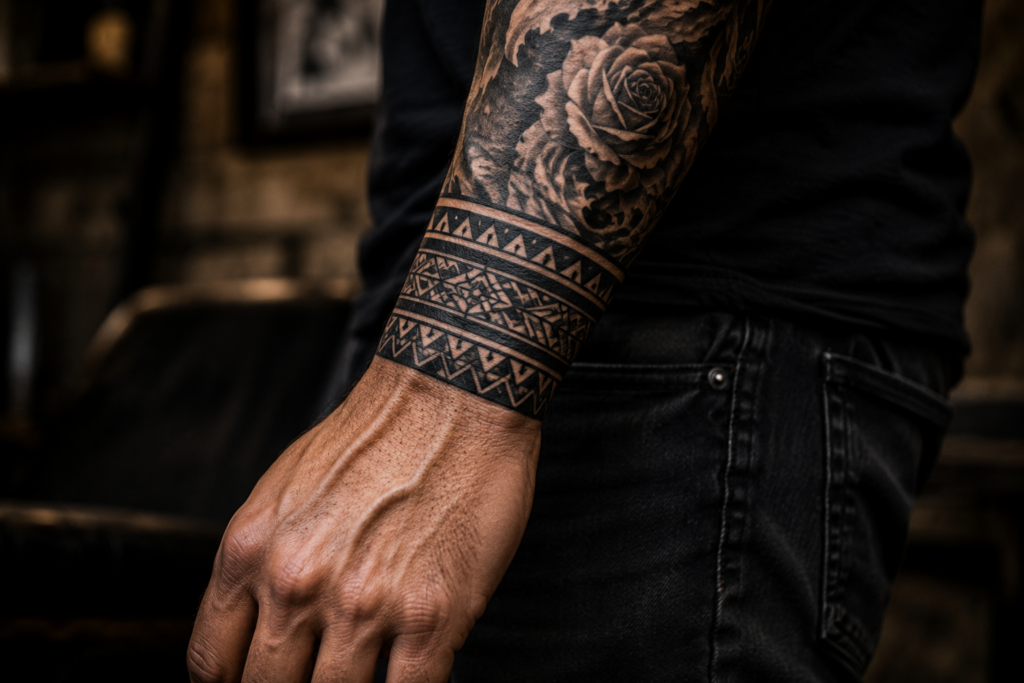
The wrist is the arm’s most intimate zone and the natural starting point for sleeve development that will eventually extend upward toward the shoulder. The thin skin, the visible pulse point, and the constant social visibility of the wrist give whatever design is placed there a specific charged quality — present in every handshake, every gesture, every moment of daily interaction in ways that more proximal arm placements are not.
Designs at the wrist work best when they are bold enough to hold their character through the mechanical demands of this active surface. The wrist is subject to more UV exposure, more water contact through handwashing, and more mechanical stress from daily activity than most other arm zones — all of which accelerate fading and cause fine lines to soften more quickly than in more protected placements. Bold traditional designs, geometric bands, and blackwork compositions hold their visual character through these conditions more reliably than fine detail approaches that depend on line quality that the wrist’s environment will progressively compromise.
The bracelet format — a continuous band design that wraps completely around the wrist — is one of the most naturally suited wrist tattoo approaches for men, the cylindrical form of the wrist creating a canvas that the wraparound design uses as a compositional strength rather than working against. Tribal-influenced bands, geometric pattern bands, and bold vine compositions that carry genuine visual weight rather than delicate prettiness suit masculine aesthetic preferences and age with the specific reliability that the wrist’s demanding environment requires.
The Forearm: The Primary Canvas for Men’s Arm Tattoos
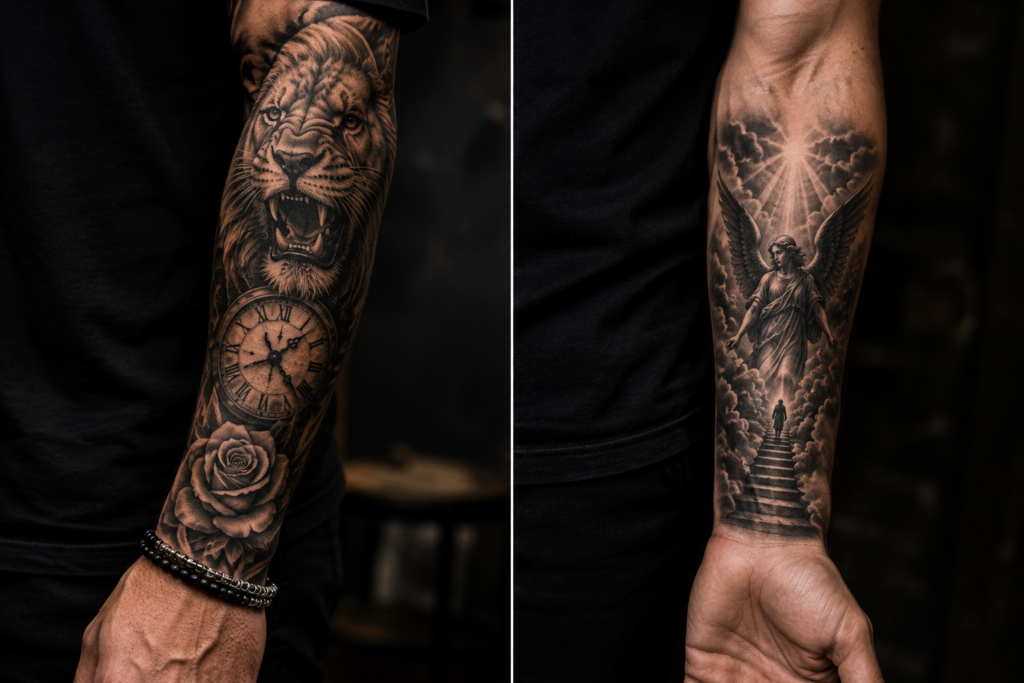
The forearm — from just above the wrist to just below the elbow — is the primary arm canvas for men’s tattoo work across every style and every level of ambition. Its combination of surface area, consistent everyday visibility, and excellent skin quality make it the placement where more meaningful, more technically accomplished, and more personally significant arm tattoo work is produced than any other single zone.
The distinction between inner and outer forearm creates two meaningfully different design opportunities that are worth understanding separately rather than treating as interchangeable surfaces.
The outer forearm — visible when the arm hangs naturally at the side — is the more publicly oriented surface, facing outward toward the world in normal everyday situations. Designs on the outer forearm make public statements, read clearly at conversational distance, and benefit from compositions that announce themselves with visual confidence rather than rewarding only close examination. Traditional American designs, blackwork compositions, and bold realist pieces work particularly well on the outer forearm for exactly this reason — their visual confidence suits the surface’s inherently public orientation.
The inner forearm — the softer surface that faces inward and upward when the arm is extended — is a more intimate canvas that the wearer sees consistently throughout their day but that is less immediately visible to others in normal arm-at-side position. The inner forearm’s lower sun exposure history typically gives it more consistent pigmentation and smoother surface texture than the outer, making it better suited for fine detail work and realistic rendering. Memorial pieces, deeply personal symbolic designs, and work whose primary audience is the wearer rather than the world suit the inner forearm’s intimate orientation.
Popular Forearm Tattoo Subjects for Men
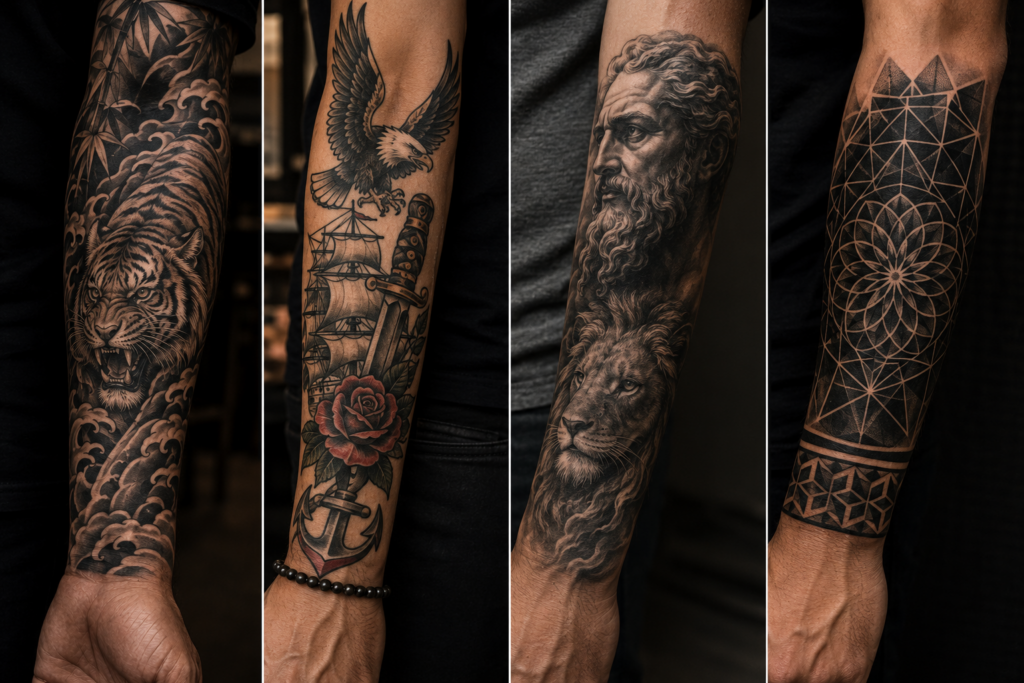
The range of subjects that work well on the forearm is as wide as the range of tattoo design generally, but certain categories appear most consistently because they suit the forearm’s specific qualities most naturally.
Japanese sleeve elements — tigers, dragons, koi fish, samurai, and the environmental vocabulary of waves, clouds, and wind bars — are among the most ambitious and most visually spectacular forearm tattoo subjects available, and the forearm’s length suits the vertical development of Japanese compositional logic particularly well. A tiger composition that begins at the wrist and develops upward toward the elbow, with bamboo and atmospheric elements filling the surrounding space, creates a piece of genuine visual grandeur that suits the forearm’s generous length as a compositional axis.
Traditional American subjects — eagles, anchors, daggers, roses, panthers — on the forearm represent some of the most historically grounded and most visually reliable forearm tattoo choices available. The traditional style’s bold outlines and solid fills hold up through the forearm’s mechanical demands more reliably than fine detail approaches, and the subjects themselves carry genuine symbolic depth that suits the forearm’s consistent visibility in everyday life.
Realist black and gray work — portraits, animal studies, detailed figurative compositions — achieves some of its most impressive results on the inner forearm, where the skin quality and the intimate orientation of the surface create ideal conditions for detailed rendering that rewards close examination.
Geometric and blackwork compositions create pieces of graphic authority that suit men who want maximum visual impact without the color complexity of traditional or realist approaches. The forearm’s relatively flat surfaces accommodate geometric precision particularly well — straight lines and precise angular forms reading more accurately on the forearm’s moderate curvature than on more dramatically curved surfaces.
The Elbow: The Compositional Bridge
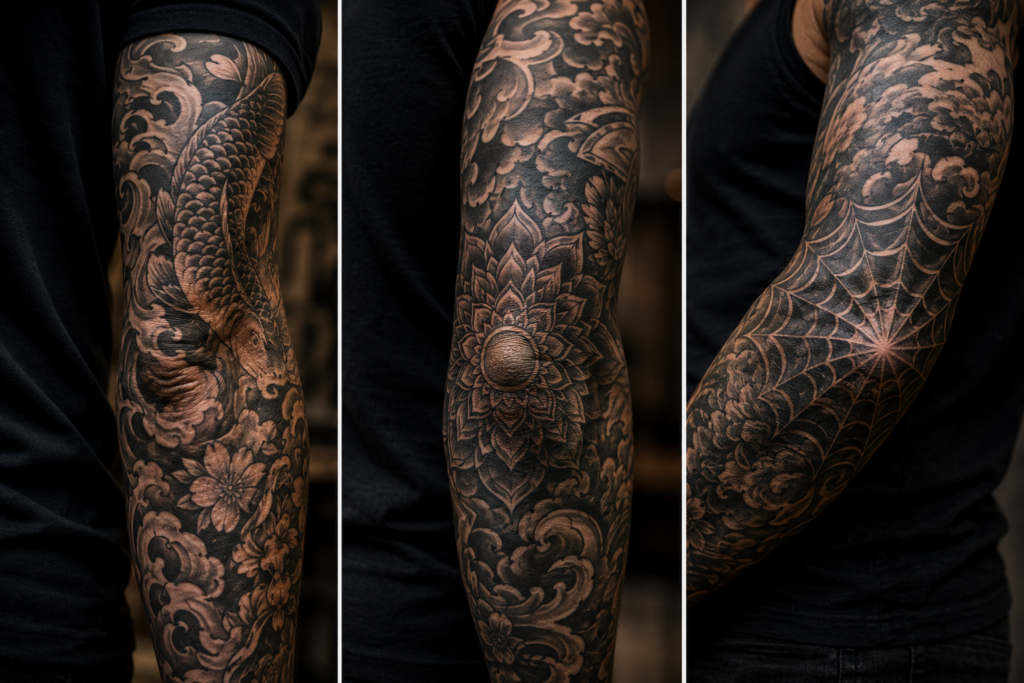
The inner elbow crease — called the ditch in tattoo culture — is simultaneously the arm’s most compositionally important transitional zone and one of its most challenging surfaces to tattoo. It is where the forearm composition must connect to the upper arm in a sleeve development, and how this transition is handled determines whether a developing sleeve feels like a unified composition or like separate pieces awkwardly assembled.
The ditch is consistently among the most painful tattoo locations on the entire body — thin skin directly over the joint, a concentration of nerve endings, and the constant movement of the elbow during healing create a tattooing experience that requires honest preparation. Designs that require significant time in this specific zone should be planned with clear awareness of what that involves.
The outer elbow — the pointed prominence of the olecranon — suits specific compositional approaches that work with the joint’s rounded form. Mandala designs centered on the elbow point, spider web compositions that use the point as a geometric center, and compositional elements that deliberately incorporate the elbow’s topography into the design rather than working around it produce the most successful results in this zone.
The Upper Arm: Ambitious Compositions and Sleeve Anchors
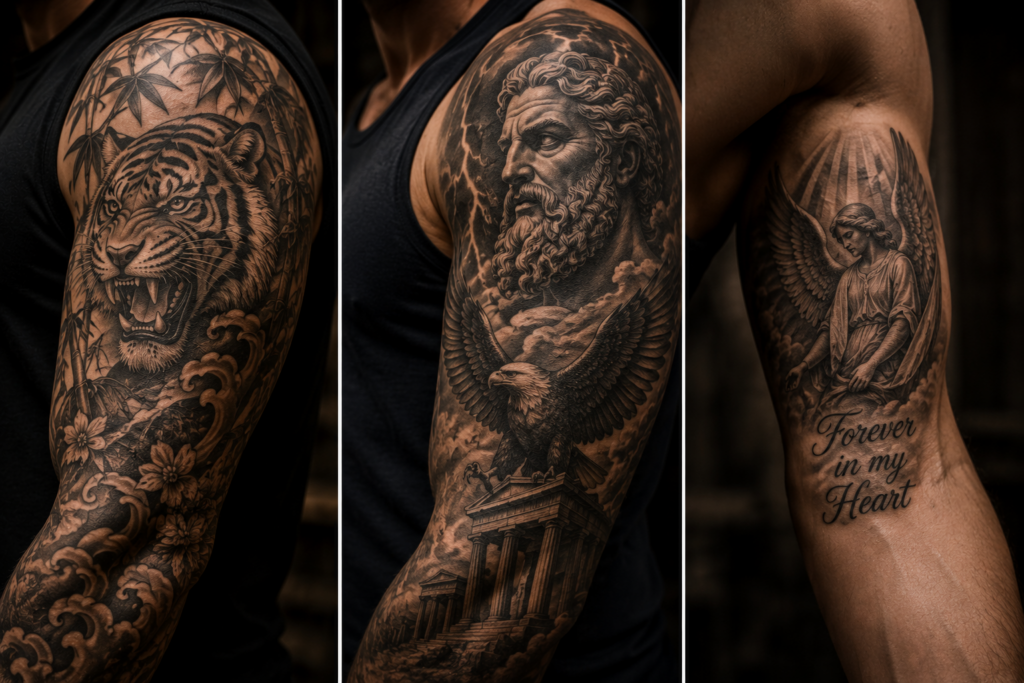
The upper arm — the bicep and tricep surfaces from above the elbow to below the shoulder — provides a larger and more structurally supported canvas than the forearm, with substantial muscle mass beneath the skin creating excellent conditions for detailed work at ambitious scales.
A large traditional or blackwork composition on the outer upper arm creates a classic sleeve anchor that has been the foundation of serious arm tattoo collections in every generation of tattoo culture. The upper arm’s generous canvas gives traditional subjects room to be rendered at a scale that fully expresses the style’s bold graphic character, and the good structural support of the bicep muscle means pieces hold their visual integrity exceptionally well over time.
The inner upper arm is a more intimate canvas whose designs are visible primarily in specific situations — raised arms, sleeveless clothing viewed from certain angles, or intimate contexts. Memorial pieces and deeply personal designs suit this zone’s private orientation particularly well.
The Shoulder Cap: The Crown of the Sleeve
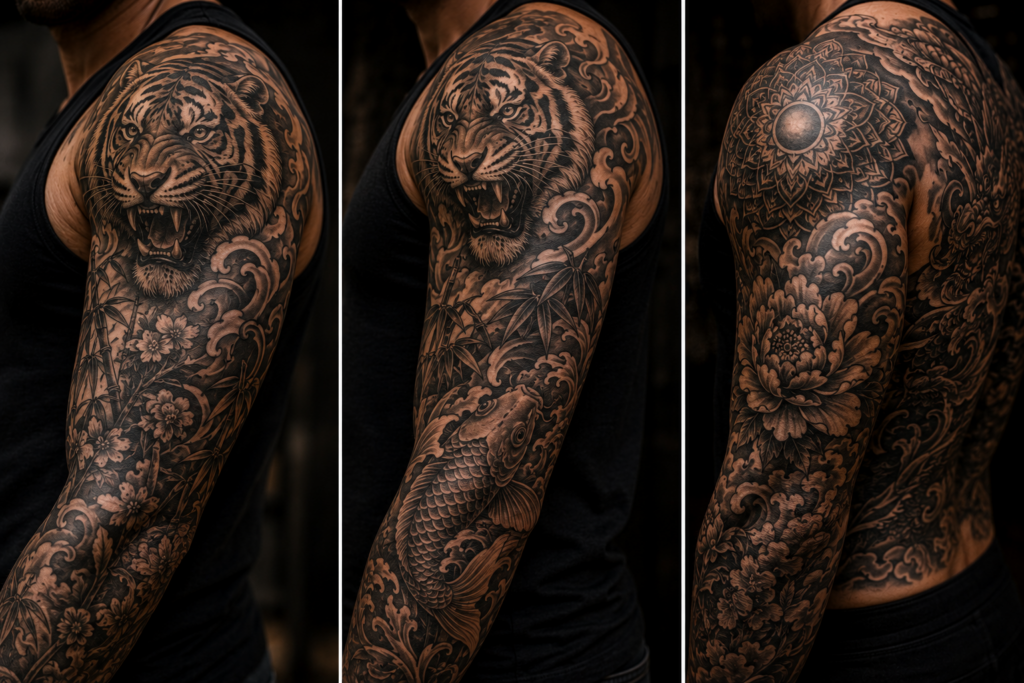
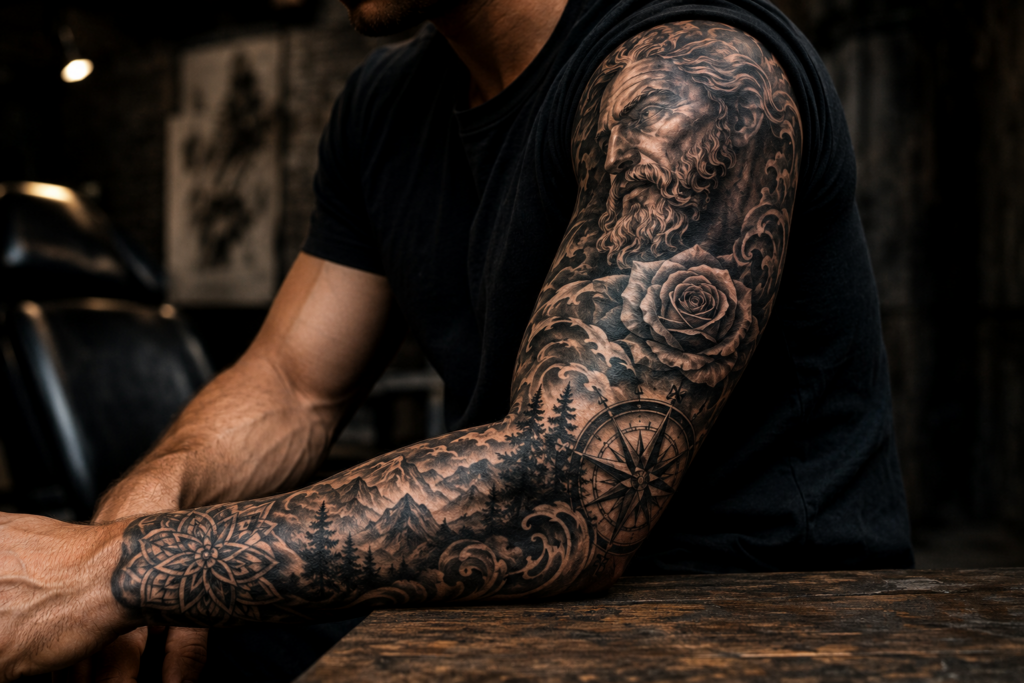
The shoulder cap — the rounded surface of the deltoid muscle — is the compositional crown of any arm sleeve, the zone where the sleeve’s visual energy culminates and where the most powerful primary subjects are typically positioned. A large tiger, eagle, or geometric mandala centered on the shoulder cap creates a piece whose prominence and structural support combine to produce maximum visual impact in the most architecturally commanding position on the entire arm.
The shoulder cap is also the natural connection point between the arm sleeve and the chest or back — the location where a developing sleeve most naturally extends onto the torso through hikae compositions that bring the sleeve’s visual world into the body’s central surfaces.
Building a Complete Arm Sleeve
The arm sleeve — a unified composition covering the complete arm from wrist to shoulder in a coherent visual environment — is the most ambitious arm tattoo project available and the format in which the arm’s potential as a tattoo canvas is most completely realized.
The most important principle of sleeve development is planning the complete composition from the beginning rather than assembling it section by section without reference to the whole. A sleeve whose overall compositional logic — the connecting elements, the color relationships, the balance of detail density and negative space — has been considered as a unified program from the first session produces dramatically more coherent results than one built through sequential individual decisions.
Japanese sleeves, traditional American sleeves, blackwork geometric sleeves, and realist nature sleeves are the most widely practiced formats, each with its own specific compositional logic that suits the arm’s complete surface as a unified environment. The choice of format should be made with genuine understanding of what each approach involves — not just aesthetically but in terms of the artist expertise required, the multiple session commitment, and the long-term maintenance that keeping a sleeve looking its best across decades of wear demands.
Practical Considerations for Men’s Arm Tattoos
Sun protection applied consistently to exposed arm tattoos is the single most impactful long-term maintenance practice available — the arm receives significant UV exposure in most men’s daily lives, and consistent SPF application dramatically slows the color shift and line softening that UV exposure accelerates across every arm zone.
Touch-up sessions — needed more frequently for arm work than for tattoos in more protected placements — should be budgeted as part of the total investment rather than treated as unexpected additional costs. Planning for ongoing maintenance from the beginning produces a healthier long-term relationship with the work than being surprised by the need for it years down the road.
The arm rewards intentional decision-making more directly than almost any other placement because its everyday visibility means the work is constantly present — constantly available to be seen, to start conversations, to reflect something about the person wearing it to everyone they interact with. Getting those decisions right produces tattoos that justify that constant presence completely and that continue to mean something deeper every time they are seen for the rest of the wearer’s life.