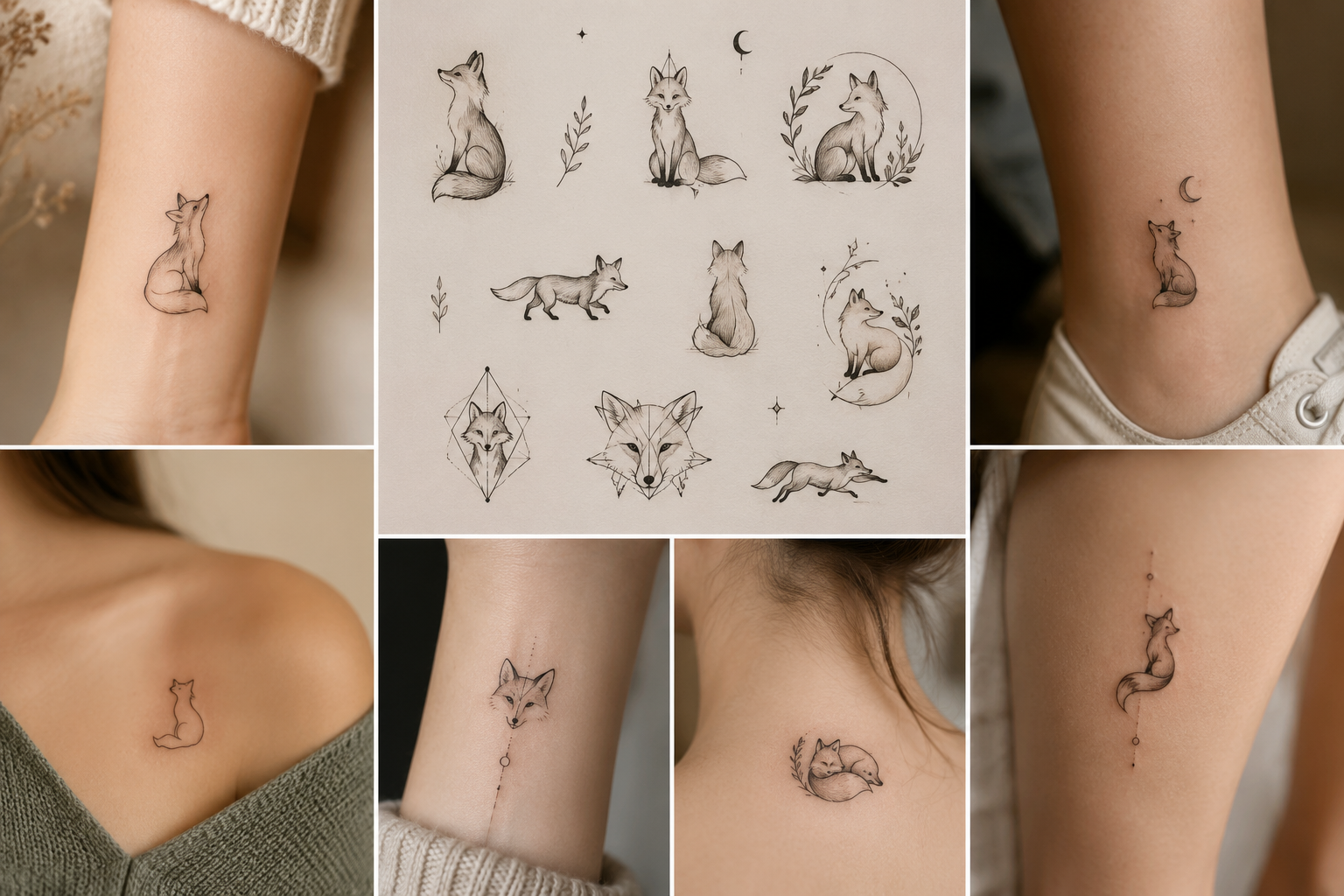
The small fox tattoo occupies a specific and genuinely distinct category from its larger counterparts — not simply a big fox made smaller but a design approach with its own compositional logic, its own placement opportunities, and its own relationship between the wearer and the image. The appeal of small fox tattoos is rooted in something real about what miniature scale does to the fox’s symbolic content — it makes it intimate rather than declarative, personal rather than public, a detail discovered rather than a statement announced. A small fox on the inner wrist or behind the ear or on the ankle creates a different kind of relationship between the tattoo and its wearer than a large fox on the forearm or the upper arm, and understanding what that difference is and why it matters will help you decide whether small scale is genuinely right for your specific fox or whether the design you have in mind requires more canvas to be fully itself.
What Small Scale Does to the Fox
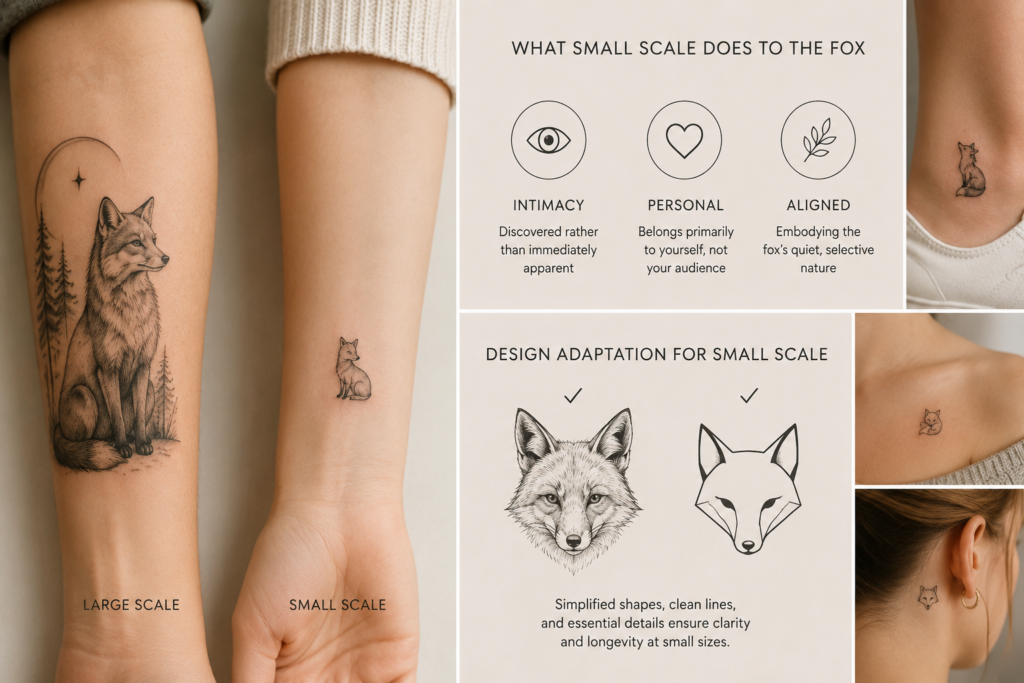
Reducing a fox to small scale changes its fundamental character in ways worth understanding before committing to a miniature approach. A small fox is inherently more intimate than a large one — where a forearm or upper arm fox announces itself at conversational distance and participates in the wearer’s public identity in every context where the placement is visible, a small fox reveals itself selectively. It is noticed by people who are physically close, discovered rather than immediately apparent, creating a relationship between the tattoo and its social context that suits people who want body art that belongs primarily to themselves rather than to their public presentation.
This intimacy aligns naturally with the fox’s own symbolic character. The fox is not an animal that announces itself — it operates quietly, reveals what it chooses to reveal, and keeps the full extent of its awareness private. A small fox tattoo worn in an intimate placement embodies this quality physically rather than simply depicting it — the tattoo itself behaving like the animal it represents, present without proclaiming itself, visible to those who are paying genuine attention.
Small scale also changes the technical parameters of fox design significantly. Elements that read beautifully at forearm scale — detailed fur texture, fine whisker lines, elaborate background environments — may become indistinguishable or muddy at the reduced scale of a wrist or finger fox. The small fox that works is not a compressed version of a large fox but a design specifically conceived for the scale it will be executed at, with every element chosen for its ability to read clearly and hold its character at the size available.
Which Fox Design Approaches Work Best at Small Scale
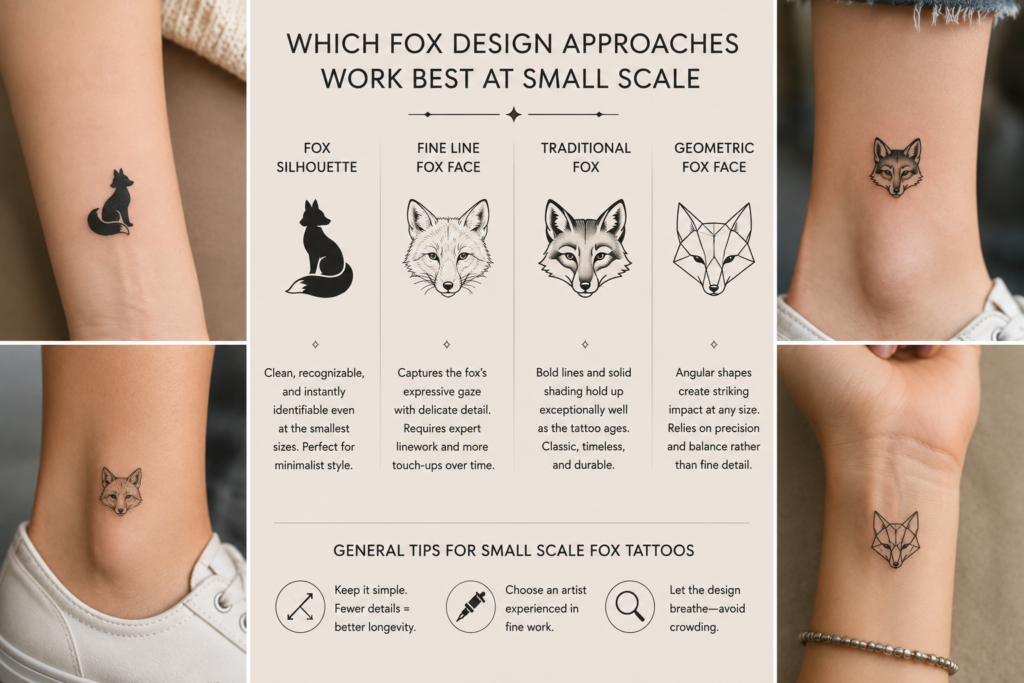
Not every fox design style translates equally well to small scale, and understanding which approaches are most reliable at miniature dimensions produces significantly better results than simply reducing a design intended for a larger canvas.
The fox silhouette is one of the most naturally suited approaches for very small scale work — the fox’s distinctive profile, with its pointed muzzle, large ears, and full flowing tail, is immediately recognizable even when reduced to a simple outline with minimal internal detail. A clean, confident fox silhouette at small scale carries the animal’s complete visual identity and symbolic content in the smallest possible visual footprint. These designs suit people drawn to the minimalist aesthetic and to the philosophical quality of saying something meaningful with the fewest possible marks.
Fine line fox faces — a front-facing fox rendered with single-needle precision that captures the alert ears, watchful eyes, and pointed muzzle — are among the most requested small fox designs and among the most technically demanding at reduced scale. When executed by an artist with genuine fine line expertise the result can be genuinely extraordinary — the miniature face carrying the full psychological presence of the fox’s gaze in a composition small enough to fit on the inner wrist. The practical consideration is longevity — fine lines at very small scales require more frequent touch-ups than bolder approaches to maintain their crispness as the tattoo ages.
Small traditional fox designs work particularly well because the bold outlines that define the traditional style maintain their clarity at reduced sizes more reliably than fine detail work. A small traditional fox head on the wrist or ankle — rendered with confident thick lines and solid fills rather than delicate fine line detail — holds its visual character through fading more reliably than the same design executed in the finest possible linework.
Geometric fox faces at small scale are among the most visually striking small fox options — the angular geometric forms translating naturally to small scale because their visual impact comes from the precision of the geometric relationships rather than from fine tonal detail that would be lost at reduced dimensions.
Placement Options for Small Fox Tattoos
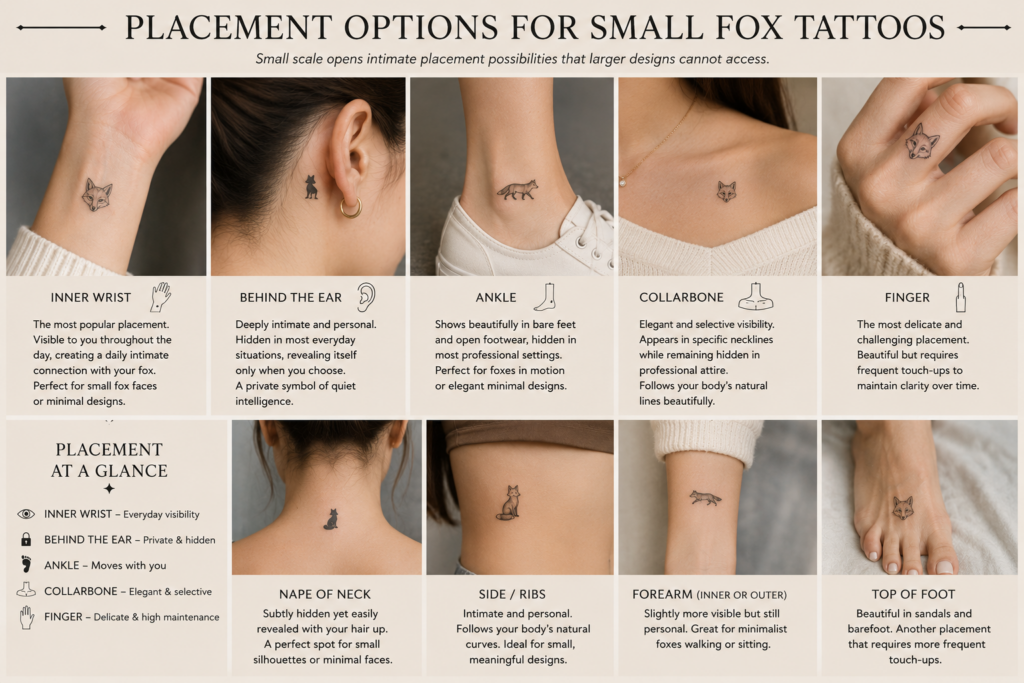
The small fox’s miniature scale opens placement options that larger compositions cannot access, creating opportunities for genuinely intimate and personally specific placement decisions.
The inner wrist is the most popular small fox placement and the one that most consistently suits the format’s intimate character. The wrist’s consistent visibility to the wearer throughout the day — the fox present in the wearer’s own field of vision during work, during moments of stillness, during every activity that involves looking at the hands — creates the specific daily relationship with the tattoo that inner wrist placement produces at its best. A small fox face centered on the inner wrist, the gaze directed upward toward the wearer when the palm is turned up, creates an intimate daily encounter with the animal’s symbolic intelligence.
Behind the ear is one of the most genuinely intimate small fox placements — completely invisible in most everyday contexts, revealing itself only when the hair is pulled back or pinned up. Small fox designs behind the ear have a quality of private personal significance that suits the fox’s own symbolic association with intelligence that operates quietly rather than announcing itself. A tiny fox silhouette or minimal fox face tucked behind the ear is a placement that exists primarily for the wearer rather than for the world.
The ankle suits small fox designs that show beautifully in bare feet and open footwear while remaining completely hidden in most professional contexts. A small fox in mid-stride on the ankle, moving forward with the contained energy of the animal in motion, creates one of the most naturally suited small fox compositions for this placement — the fox’s own forward movement aligned with the ankle’s association with the body’s motion through the world.
The collarbone suits small to medium fox compositions that show in specific necklines while remaining invisible in most professional clothing. A small fox centered on the collarbone, or a minimal fox silhouette that follows the bone’s horizontal line, creates a placement of genuine elegance that suits the fox’s selective visibility on its own terms.
The finger is the most technically challenging and most rapidly fading small fox placement — the mechanical demands of daily hand use and the thinness of finger skin meaning that even the most minimal fox designs require frequent touch-ups to maintain their legibility. A simple fox outline or a minimal fox face on the finger can be genuinely beautiful immediately after healing while requiring more ongoing maintenance than any other small fox placement.
Design Principles Specific to Small Fox Work
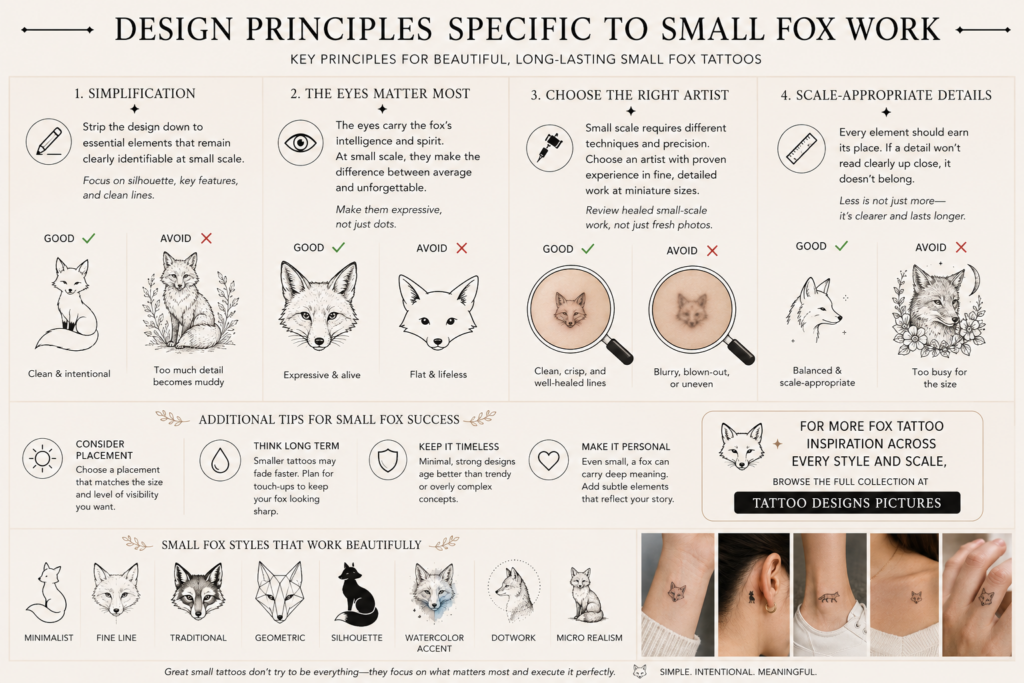
Several design principles apply specifically to small fox work and differ meaningfully from what produces successful results at larger scales.
Simplification is the foundational principle — stripping the design down to the elements that remain clearly identifiable as a fox at the scale being executed rather than attempting to include every element that a larger version would contain. A small fox that tries to include detailed fur texture, fine environmental elements, and elaborate background work at a scale that cannot hold these details will look muddy rather than detailed. A small fox designed around the elements that survive the scale reduction — the distinctive silhouette, the essential facial features, the characteristic tail — will look complete and intentional rather than compressed.
The fox’s eyes deserve special attention at small scale because they are the primary vehicle for the animal’s symbolic intelligence and the element whose quality most distinguishes genuinely successful small fox work from merely adequate execution. Eyes that capture the specific watchful awareness of the fox even at miniature scale create pieces with genuine psychological presence. Eyes that are simply dots or generic marks produce faces without the quality that makes the fox such a compelling tattoo subject in the first place.
Choosing an artist with specific experience in small scale work — rather than simply an artist whose larger work is impressive — is more important for small fox tattoos than the general principle of finding a skilled artist would suggest. The technical demands of producing clean, precise work at miniature dimensions are distinct from the demands of larger format tattooing, and artists who have developed genuine small scale expertise produce results that are qualitatively different from artists whose primary experience is in larger format work attempting to work at reduced scale.
For more tattoo inspiration across every style and scale, browse the full collection at Tattoo Designs Pictures