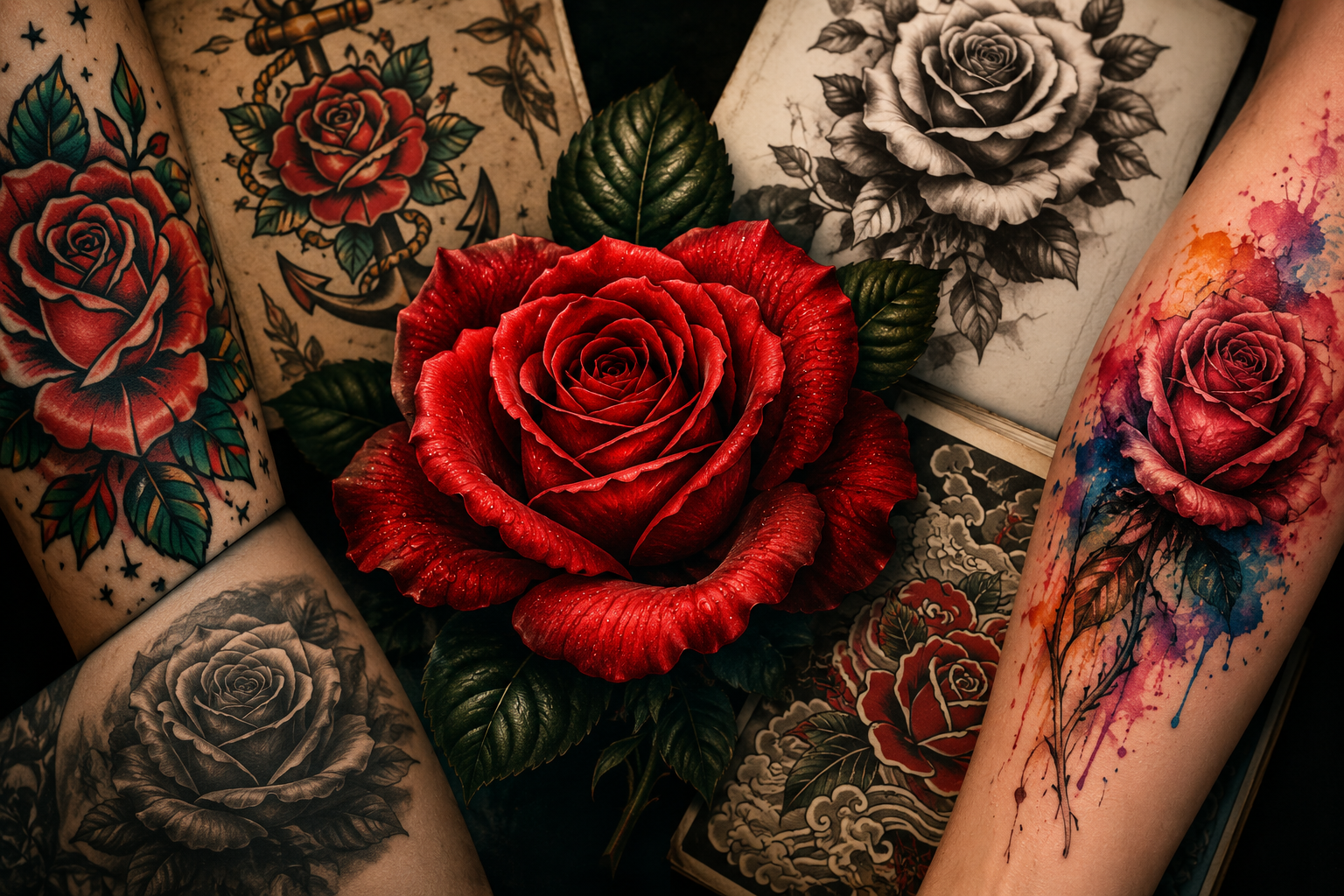
If there is a single image that has defined the history of tattoo art more completely than any other, it is the rose. Not the skull, not the anchor, not the eagle or the dragon or the heart — the rose. It appears on the oldest surviving American tattoo flash sheets. It fills the portfolios of artists working in every style from traditional American to Japanese to realism to watercolor to blackwork. It has been worn by sailors and soldiers, by bikers and debutantes, by people marking grief and people marking love, by people who spent months planning their design and people who walked into a shop on impulse and pointed at the wall.
The rose is so fundamental to the vocabulary of tattoo art that its presence in virtually every collection of flash, every artist’s portfolio, and every tattoo shop’s visual identity is simply taken for granted — it is the baseline against which all other tattoo subjects are measured. And yet despite that ubiquity, the rose has never become truly generic, because the range of meanings it carries and the range of styles in which it can be rendered are both so vast that no two rose tattoos need to say the same thing or look the same way.
Understanding the full depth of the rose as a tattoo subject — its history, its color symbolism, its stylistic range, and its capacity for personalization — reveals one of the richest and most versatile design categories in the entire world of tattoo art.
The Rose Tattoo Designs throughout Human History: Five Thousand Years of Symbolism
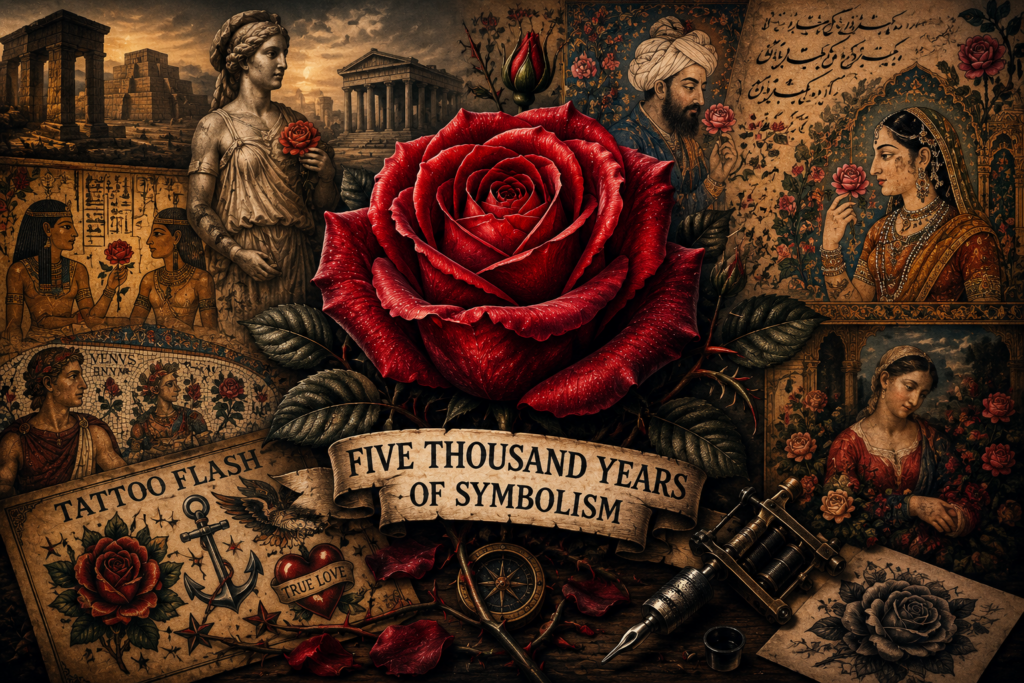
The rose has been a significant symbol in human culture for longer than almost any other flower, with evidence of rose cultivation and symbolic use dating back approximately five thousand years to ancient Persia and Mesopotamia. From those origins, the rose spread westward into the Greek and Roman worlds, where it became associated with Aphrodite and Venus respectively — the goddesses of love, beauty, and desire — and eastward into the Indian subcontinent, where it became associated with divine beauty and spiritual love in both Hindu and Islamic traditions.
The rose appears in ancient Egyptian tomb paintings, in Roman banquet decorations, in Persian poetry, in the gardens of medieval European monasteries, in the paintings of the Renaissance masters, and in the cut flower markets of the contemporary global economy. No other flower has maintained such consistent symbolic significance across such a wide range of cultures over such a long period of time.
The rose’s symbolic power comes from several of its actual physical characteristics. Its beauty is extraordinary and immediately apparent — the layered petals, the subtle color gradations, the perfect geometric spiral of the bud — creating a visual impact that has captivated human attention across every culture that has encountered it. Its fragrance is among the most complex and pleasing in the natural world, carrying associations of luxury, pleasure, and the fullness of sensory experience.
And its thorns — the sharp, curved spines that protect the stem — create a physical embodiment of the idea that beauty and danger coexist, that pleasure and pain are inseparable, that the most desirable things in life are also the most capable of wounding you. This combination of extraordinary beauty and genuine danger is what gives the rose its symbolic depth and its specific relevance to the most complex human experiences of love, loss, desire, and mortality.
American Traditional Rose Tattoos: The Foundation of Everything
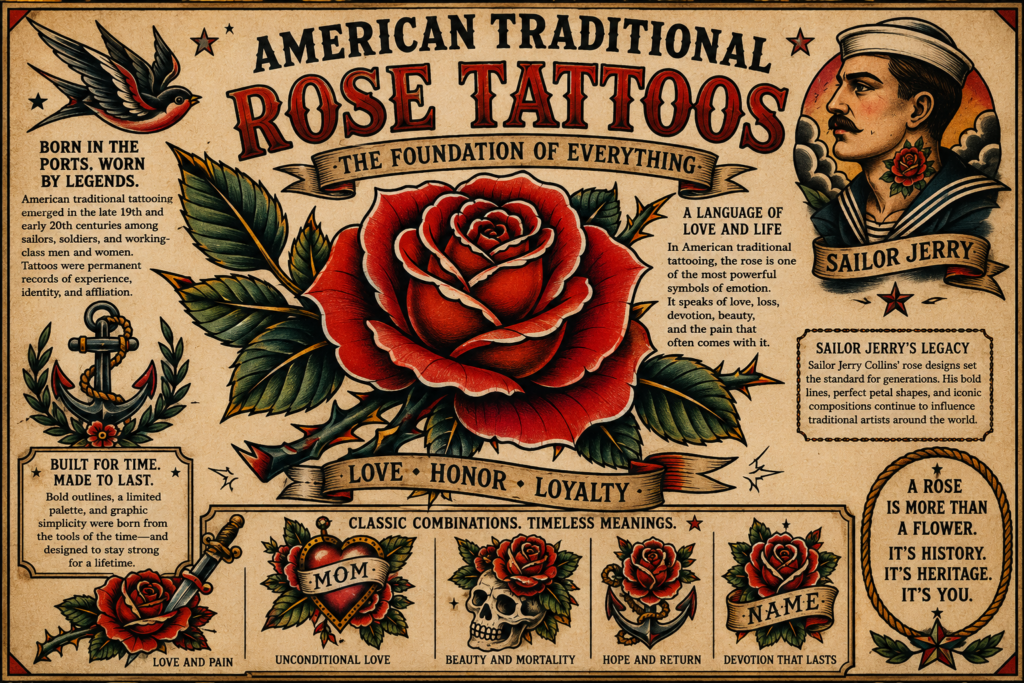
The rose in American traditional tattooing occupies a position that is essentially foundational — it is one of the images around which the entire visual language of the style was developed, and understanding it requires understanding something about the historical context from which traditional American tattooing emerged.
American traditional tattooing developed primarily in port cities and military communities in the late 19th and early 20th centuries, among sailors, soldiers, and working-class men and women for whom tattoos served as permanent records of experience, identity, and affiliation. The visual style that emerged from this context was shaped by the technical constraints of early tattooing equipment and ink, the need for designs that would remain legible over decades of wear, and the aesthetic preferences of the working-class communities that drove the demand. The result was a style characterized by bold black outlines, a limited palette of solid colors, flat areas of fill without complex shading, and a graphic simplicity that prioritized immediate visual impact over fine detail.
Within this style, the rose became one of the primary expressive vehicles for emotional content — specifically for the kind of direct, uncomplicated emotional directness that the traditional style embodies. A traditional red rose with a banner bearing a name said everything that needed to be said about love and devotion without requiring elaborate explanation or sophisticated artistic vocabulary.
The rose appeared alongside hearts, daggers, anchors, and swallows as part of the core iconographic vocabulary of the style, and the combinations it entered into were themselves standardized shorthand for specific emotional situations — a rose with a dagger through it for love and pain simultaneously experienced, a rose emerging from a heart for romantic devotion, a rose with a skull for the coexistence of beauty and mortality.
Sailor Jerry’s rose designs remain among the most influential in the history of tattoo art, and artists working in the traditional American style today still draw directly on his visual vocabulary when rendering roses. The bold, confident linework, the specific way the petals are shaped and layered, the characteristic treatment of the leaves — these elements have been passed down through generations of traditional artists and remain immediately recognizable as belonging to a specific tradition with a specific history. For people who want to carry that lineage beyond the skin, the American traditional tattoo shirts at In Vein bring the same bold visual vocabulary into wearable form.
Red Rose Tattoos: Love, Passion, and the Full Weight of Romance
The red rose is the most universally recognized floral symbol of romantic love in Western culture, and its meaning in tattoo design is rooted in this deep cultural association while being capable of considerably more nuance than the simple equation of red rose equals love might suggest. The red rose in Western tradition draws on multiple historical and literary associations that together create a symbol of remarkable emotional complexity.
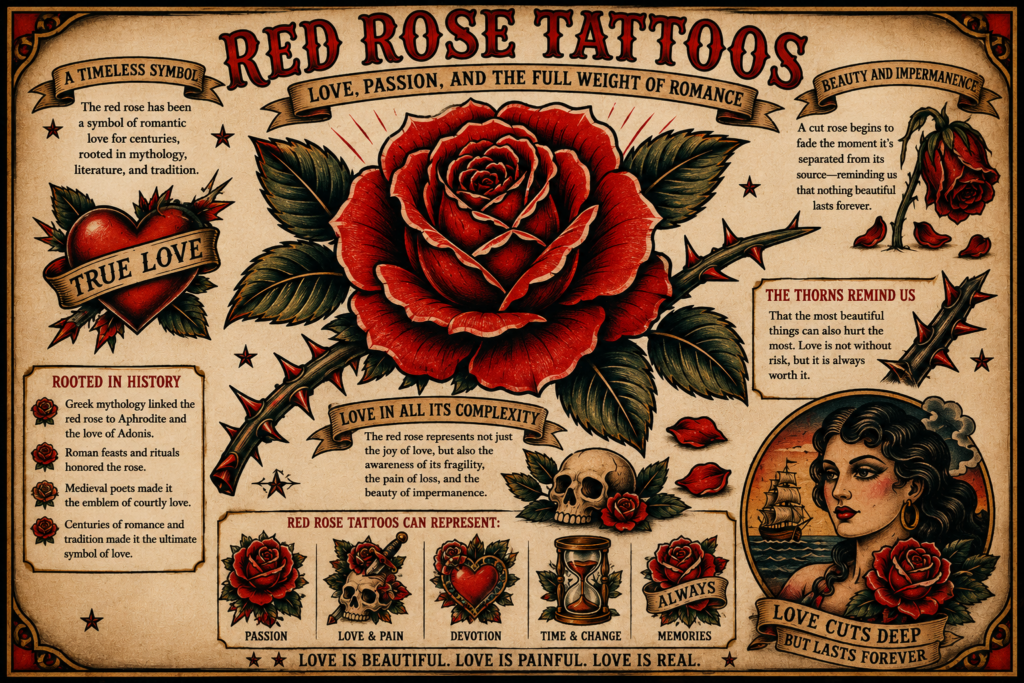
The association between the red rose and romantic love in Western culture has roots in Greek mythology — the rose was said to have been created by Aphrodite, stained red by the blood of her lover Adonis when he was wounded by a boar. It was reinforced in Roman culture, where roses were scattered at feasts and used in religious ceremonies associated with Venus.
It was developed further in medieval courtly love tradition, where the rose became the central symbol of the beloved woman in the poetry of the troubadours and in allegorical works like the Romance of the Rose. And it was cemented in popular culture through centuries of Valentine’s Day tradition, romantic poetry, and the cut flower industry that made the red rose the default gift for romantic occasions.
But the red rose in tattoo design carries more than simple romantic sentiment. The combination of the rose’s extraordinary beauty with its inevitable decay — the fact that a cut rose begins dying the moment it is separated from its source — gives the red rose a connection to the themes of impermanence and mortality that the rose has carried in European still life painting since the 17th century. A red rose tattoo can be a statement about love in its full complexity — not just the joy of it but the grief of its potential loss, the recognition that loving something intensely is inseparable from the vulnerability of potentially losing it.
Red rose tattoos with thorns specifically emphasize this darker dimension of the symbol. The thorns of a rose are not incidental — they are part of the rose’s essential nature, the physical expression of the paradox that the most beautiful things are also the most capable of drawing blood. A red rose rendered with prominent thorns says something about the wearer’s understanding of love that a thornless rose does not — that they know love cuts, that they have been cut by it, and that they choose it anyway.
Black Rose Tattoos: Grief, Loss, and Defiant Darkness

The black rose does not exist in nature — no rose produces truly black pigment, and what are sold as black roses in the floral industry are actually very dark red or purple varieties. But in tattoo art, the black rose has its own rich tradition and its own specific range of meanings that are distinct from any other color variation. The black rose is primarily a symbol of grief, loss, and mourning — the rose stripped of its color, its life, its vitality — but it also carries associations with mystery, the occult, anarchist politics, and a particular aesthetic of beautiful darkness that has resonated with subcultural communities from the Romantics through the Goths to the present day.
In the context of memorial tattoos, the black rose is one of the most direct and emotionally honest symbols available. Where a colorful butterfly memorial tattoo emphasizes transformation and the continuation of the soul, a black rose memorial tattoo does not soften the reality of loss with hopeful symbolism — it confronts that loss directly, acknowledging that something genuinely beautiful has been permanently removed from the world. For people who want their memorial tattoo to reflect the full weight of their grief rather than to resolve it prematurely into comfort, the black rose offers an honest symbolic vocabulary.
The black rose also carries a long tradition of use in anarchist and radical political movements, where it has served as a symbol of defiance against oppressive authority since the late 19th century. This association gives black rose tattoos a political dimension for people who are aware of it and who identify with that tradition of principled resistance to power. A black rose tattoo in this context says something about the wearer’s political identity and their relationship to authority that a red or white rose would not.
In gothic and darkly romantic aesthetic traditions, the black rose is simply the most beautiful version of an already beautiful flower — the darkness of the color amplifying rather than negating the rose’s beauty, creating something that is simultaneously elegant and mournful, attractive and foreboding. Black rose tattoos in this register often appear in highly detailed blackwork or black and gray realism styles, where the absence of color becomes a positive aesthetic choice rather than merely a removal of something present in other versions.
White Rose Tattoos: Purity, New Beginnings, and Sacred Love
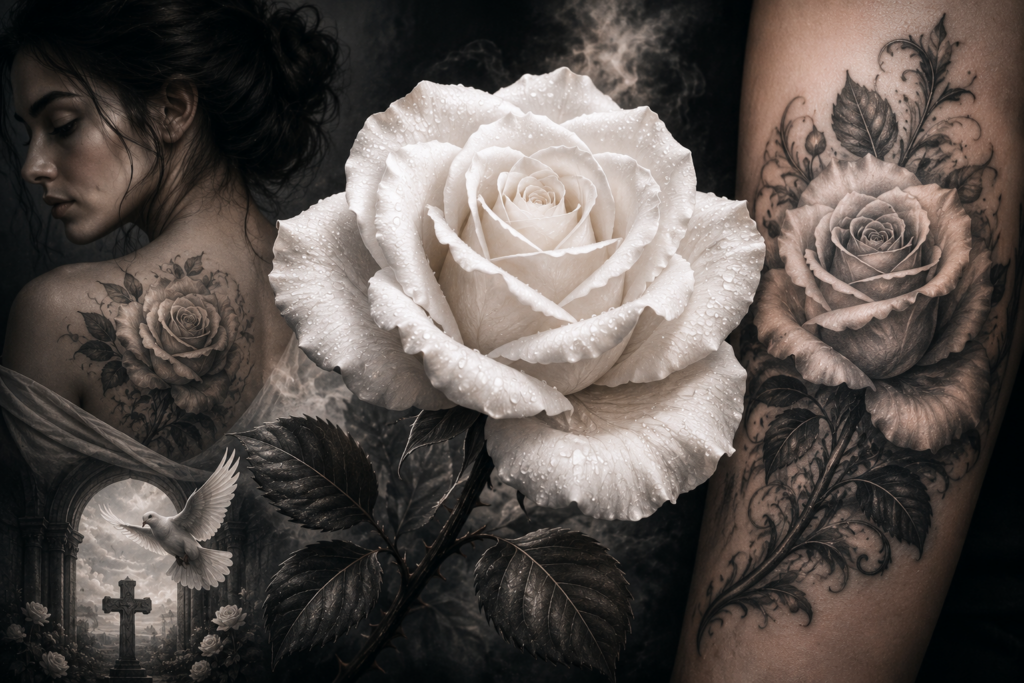
The white rose occupies a symbolic space in human culture that is distinct from both the passionate red rose and the mournful black rose, carrying associations of purity, innocence, spiritual love, and new beginnings that give it a specific emotional register all its own. In Christian tradition, the white rose was associated with the Virgin Mary — called the Rose Without Thorns in medieval devotional literature — and with the quality of spiritual love that transcends physical desire. White roses appear throughout Christian religious art as symbols of divine purity and the love that exists between God and the soul.
In the language of flowers — the Victorian practice of communicating emotions through specific floral choices — white roses carried meanings of worthiness, purity, and the kind of love that is given without expectation of return. White roses were used at weddings to symbolize the purity of the union being celebrated and at funerals to symbolize the purity of the soul departing. This dual association with both beginnings and endings gives the white rose a specific relevance to moments of transition — the threshold moments where something old is ending and something new is beginning.
White rose tattoos present a specific technical challenge that is worth understanding before committing to the design. White ink on skin does not behave the same way that white paint on canvas does — white ink tends to yellow and fade more quickly than other colors, and on many skin tones it is not fully visible.
Most white rose tattoos are therefore rendered primarily in black and gray, with the white quality of the rose suggested through negative space and careful shading rather than through white ink itself. This approach, when executed well by a skilled artist, can produce genuinely beautiful results — the rose defined by shadow and highlight rather than by color, with an elegance and restraint that suits the purity the white rose symbolizes.
Blue Rose Tattoos: The Impossible Made Permanent
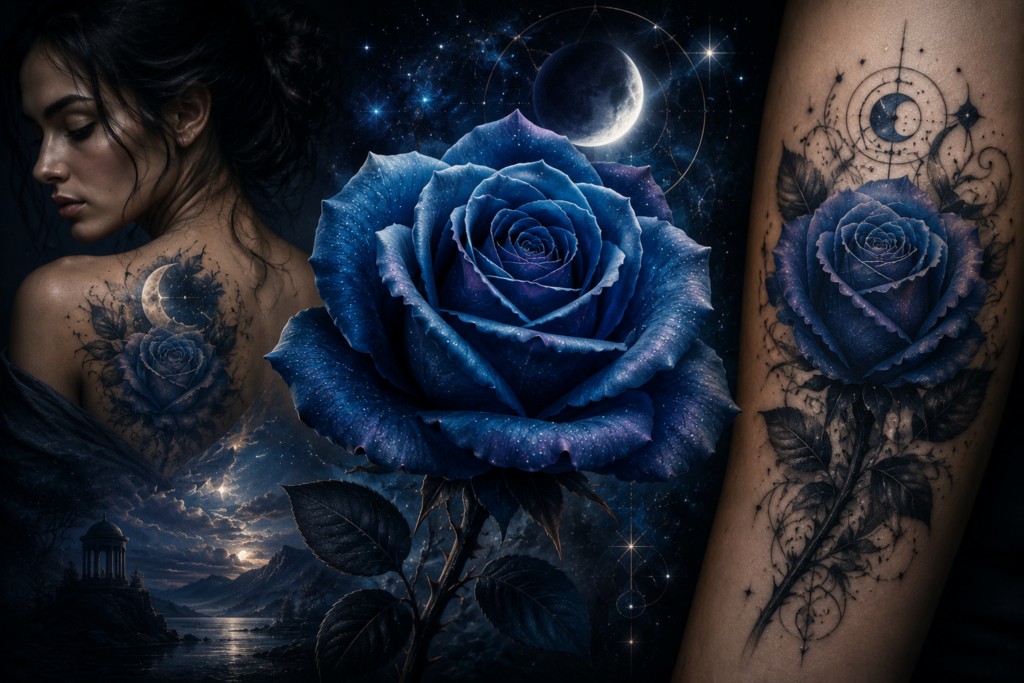
Like the black rose, the blue rose does not exist naturally — no rose variety produces blue pigment, and true blue roses remain one of the great unfulfilled projects of horticultural breeding, though genetic engineering has recently produced roses with blue-adjacent pigmentation. The blue rose is therefore a symbol of the impossible, the unattainable, the dream that is worth pursuing precisely because it cannot be fully realized — the kind of longing that remains beautiful even in its frustration.
In Japanese literature and culture, the blue rose became a symbol of this specific quality of impossible aspiration — the desire for something that does not exist and therefore can never disappoint because it can never be possessed. A blue rose tattoo in this tradition is a statement about the wearer’s relationship to the impossible — their willingness to long for things that cannot be fully had, to pursue dreams that cannot be completely realized, to find meaning in the pursuit itself rather than only in the achievement of the goal.
Blue rose tattoos in contemporary tattoo design are often rendered in rich, deep blues and purples that give them a mystical, almost supernatural quality. Combined with other elements — moons, stars, geometric forms — a blue rose can create a composition that emphasizes the dreaming, aspiring, mystery-oriented dimensions of the wearer’s character in a way that the more immediately legible red or black rose does not.
Thorns: With and Without
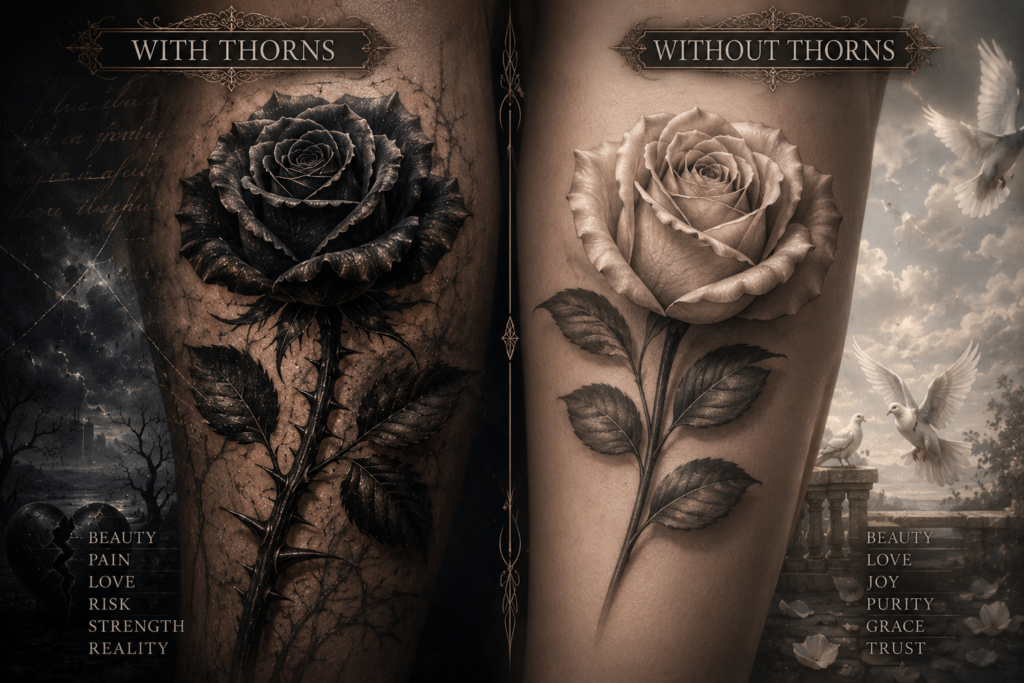
The decision of whether to include thorns in a rose tattoo design is one of the most meaningful design choices available and one that significantly shapes the symbolic content of the finished piece. A rose without thorns is a rose that emphasizes beauty, softness, and the positive dimensions of what the rose symbolizes — love, joy, sensory pleasure, the gift of something beautiful freely given. A rose with thorns is a rose that acknowledges the complete nature of the flower — beauty and danger inseparable, pleasure and pain coexisting, the capacity to wound being inherent in the capacity to enchant.
For people who have learned through experience that love, beauty, and desirable things generally carry risks and costs alongside their gifts, a rose with thorns is the more honest symbol. It does not pretend that the beautiful thing is safe. It does not suggest that the capacity to enchant and the capacity to wound are separable qualities. It says: I know what this is, completely, and I choose it anyway. That is a more sophisticated emotional statement than the thornless rose makes, and it suits people who have lived enough to understand that complexity.
Finding the Right Rose Tattoo for Your Story
The rose tattoo’s enduring position as the most popular tattoo subject in the world is not accidental or arbitrary. It reflects the genuine depth and versatility of a symbol that has been refined by five thousand years of human use across dozens of cultural traditions into something of extraordinary expressive power. Whatever you are trying to say — about love, about loss, about beauty, about grief, about passion, about purity, about the impossible dream — there is a version of the rose tattoo that says it precisely and says it beautifully.
The key is approaching the design with the same intentionality that the rose itself demands. Choose the color that carries your specific meaning. Decide honestly whether your rose has thorns. Consider the style that best reflects your relationship to the tradition the rose comes from. For those who want to extend that tattoo aesthetic into their everyday wardrobe, the tattoo graphic tees at In Vein are built around the same traditional flash visual language that makes the rose tattoo so enduring. Do those things, and you will have a tattoo that participates in one of the longest and richest traditions in human art — and that says something specific and true about who you are.